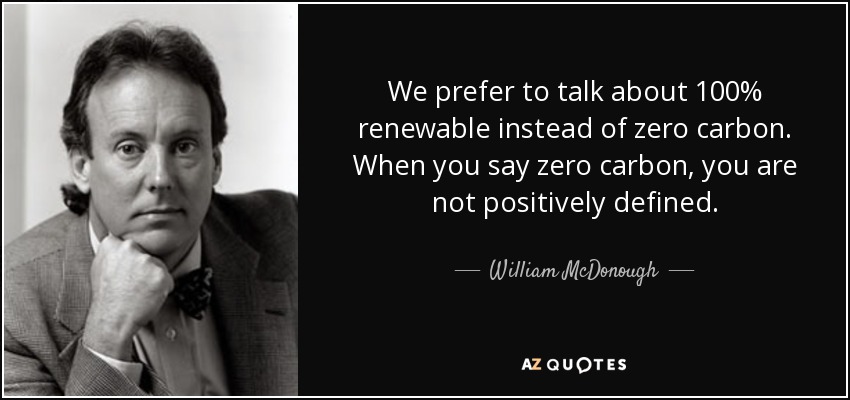
We prefer to talk about 100% renewable instead of zero carbon. When you say zero carbon, you are not positively defined.
The burning of fossil fuels has altered the amount of carbon dioxide in the atmosphere so rapidly and so abundantly that now, we are driving not just the warming trend, not just the sea level rise that is a consequence of the warming trend that is melting polar ice and alpine ice, but also [ocean acidification].
We need a price on carbon that accurately reflects its real costs on our society and our wellbeing.
After all, the same steps that reduce carbon pollution also clean the air we breathe, which saves lives and reduces disease.
A vegetarian driving a Hummer emits less carbon than a meat eater on a bicycle.
Remember that the problem is bigger than the car you drive or the types of lightbulbs in city hall. We need a fundamental shift away from dirty fossil fuels that spew carbon pollution. To make that happen, we need to put pressure on our leaders to take the bold actions necessary to move us off dirty sources of energy.
We have to get to the point where each individual, each corporation, each community chooses low carbon, because it makes fundamental sense. It should become a no-brainer.
Carbon neutrality is going to be so standardized that you will look at anything that is not carbon neutral and go, "where the hell did that monster come from?" It's exciting.
We're going to get to the point where we ask how the hell we put up with high carbon for so many years. You thank your lucky stars, because you are seeing this transformation in your lifetime. You are going to tell your children and your grandchildren you saw this whole thing in front of your eyes.
Essentially, my kids grew up with the emphasis on the environment because I became a political activist in about 1969 and it was not an easy time. Those were the days when the oil and gas companies pretty much controlled the show and anybody speaking about solar energy or carbon energy would get smashed down as being a radical or a tree-hugger or what have you. So I was out there feeling very often alone and my kids would get that.
The largest source of greenhouse gases in the coming decades will not be the US, Western Europe and Japan, but the developing economies of East Asia, Latin America and Eastern Europe. The coming eruption of carbon emissions from the poor world will dwarf any reductions in the North.
Each year we pump at least six billion tons of heat-trapping carbon into the innermost layer of our atmosphere, whose outer extent is only about twelve miles overhead. According to an IPCC (United Nations' Intergovernmental Panel on Climate Change) report released this year, atmospheric CO2 will, if the buildup is left unchecked, double from its pre-industrial level within the next century. That doubling of CO2 correlates with an increase in the global temperature of at least three to eight degrees Fahrenheit. The last ice age was just five to nine degrees colder than our current climate.
Today we find ourselves faced with the imminent end of the era of cheap oil, the prospect (beyond the recent bubble) of steadily rising commodity prices, the degradation of forests, lakes and soils, conflicts over land use, water quality, fishing rights and the momentous challenge of stabilising concentrations of carbon in the global atmosphere.
What an honor. What a responsibility. What a gift we have been given to be born in an atmosphere with oxygen and carbon dioxide and millions of years and phenotypes cheering us on with recycles of energy.
There is a point of no return after which warming becomes unstoppable - and we are probably going to sail right through it. It is the point at which anthropogenic (human-caused) warming triggers huge releases of carbon dioxide from warming oceans, or similar releases of both carbon dioxide and methane from melting permafrost, or both. Most climate scientists think that point lies not far beyond 2 degrees C hotter (3.6 degrees F).
hen the price of carbon reaches $100 a tonne, then it will become an economically viable business proposition to start taking CO₂ out of the atmosphere and sequestering it underground.
Originally, the atoms of carbon from which we're made were floating in the air, part of a carbon dioxide molecule. The only way to recruit these carbon atoms for the molecules necessary to support life-the carbohydrates, amino acids, proteins, and lipids-is by means of photosynthesis. Using sunlight as a catalyst the green cells of plants combine carbon atoms taken from the air with water and elements drawn from the soil to form the simple organic compounds that stand at the base of every food chain. It is more than a figure of speech to say that plants create life out of thin air.
No economic measure has more value for a nation than investing in a clean & sustainable low carbon future
If we go around clearing up our own mess and being positive about our own lifestyle, other people will start copying us and picking up their own carbon 'litter' too
To change our national economic story from one of financial speculation to one of future growth, we need a third industrial revolution: a green revolution. It will transform our economy as surely as the shift from iron to steel, from steam to oil. It will lead us toward a low-carbon future, with cleaner energy and greener growth. With an economy that is built to last - on more sustainable, more stable foundations
Embracing a low carbon economy will be as momentous as the previous industrial revolutions. As the shift from coal to oil did. And the shift from gas light to electric light. It has the potential to give us the competitive edge in the new global economy. The scale of the challenge is extraordinary. We will need to reinvent in the way we live our lives, the way our world works
Developing low carbon sources of energy supply will enhance our energy security
Reasons to be positive. The economic downturn could be the catalyst for positive change. It should be translated into the wake-up call we need for a major change in aspirations and lifestyles to save humanity from the ecological and economic disaster that would otherwise result from continuing on the high carbon and resource depleting path we have been pursuing
Our mission is, in truth, historic and world changing - to build, over the next fifty years and beyond, a global low carbon economy. And it is not overdramatic to say that the character and course of the coming century will be set by how we measure up to this challenge
We should be working towards a carbon-neutral Britain by 2050. We should be working towards the elimination of petrol-driven motor cars, we should be really radical in what we do - the urgency of the problem is really enormous
Follow AzQuotes on Facebook, Twitter and Google+. Every day we present the best quotes! Improve yourself, find your inspiration, share with friends
or simply: