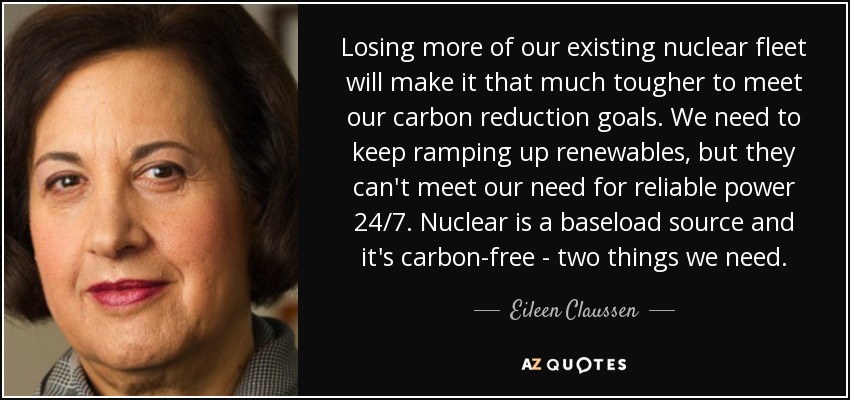
Losing more of our existing nuclear fleet will make it that much tougher to meet our carbon reduction goals. We need to keep ramping up renewables, but they can't meet our need for reliable power 24/7. Nuclear is a baseload source and it's carbon-free - two things we need.
If you have one volcano in the world, that one volcano puts out more carbon dioxide than everything man puts out.
Using less of the Earth’s resources more efficiently and productively in a circular economy and making the transition from carbon-based fuels to renewable energies are defining features of the emerging economic paradigm. In the new era, we each become a node in the nervous system of the biosphere.
To assert that the universe has a purpose implies the universe has intent. And intent implies a desired outcome. But who would do the desiring? And what would a desired outcome be? That carbon-based life is inevitable? Or that sentient primates are life's neurological pinnacle? Are answers to these questions even possible without expressing a profound bias of human sentiment? Of course humans were not around to ask these questions for 99.9999% of cosmic history. So if the purpose of the universe was to create humans then the cosmos was embarrassingly inefficient about it.
President Obama flew to China a few days ago and announced a joint environmental pact with the communist regime. The United States will reduce its carbon emissions substantially over the next 11 years. China will do absolutely nothing but hope that its emissions decline after 2030.
The press heralded this as a major accomplishment. The rush from the press as soon as it was announced suggested a high level of coordination. Like lemmings in a staged dive off a cliff, 'historic' became the media's rallying cry. There is nothing historic about the deal. In fact, news reports from November 2012 noted that China expected, in 2012, that its carbon emissions would begin to decline after 2030 because of factory upgrades, efficiencies, etc.
I'm interested in humor, and greeting cards just happen to be a perfect medium for my message. They're accessible to everyone, and thanks to all the advances that have been made by environmentally conscientious printers, I can get my message across while keeping my carbon footprint relatively small.
Any first-generation technology will. But we are looking at carbon the same way we look at every pollutant under the Clean Air Act; we look for the new technologies that are available. We recognize that these power plants are going to be around for decades.
I am all emptiness and futility. I am an empty stranger, a carbon copy of my form. I can no longer find what I'm looking for outside of myself. It doesn't exist out there. Maybe it's only in here, inside my head. But my head is glass and my eyes have stopped being cameras, the tape has run out and nobody's words can touch me.
Here's what the Encyclopedia Galactica has to say about alcohol. It says that alcohol is a colourless volatile liquid formed by the fermentation of sugars and also notes its intoxicating effect on certain carbon-based life forms.
If our goal in legislating against carbon releases is not simply punishing the West and its power companies but truly trying to reduce the accumulation of greenhouse gasses in the atmosphere, the main event will be in the developing world. We must use the smartest possible economics, and that means investing in China and India.
I don't like being called a denier because deniers don't believe in facts. There are no facts linking the concentration of atmospheric carbon dioxide with imminent catastrophic global warming there are only predictions based on complex computer models.
I must say that when I first learned of the existence of the Australian Greenhouse Office, I assumed it was responsible for supplying tomatoes to the Parliament House kitchen. But, no, as I soon learnt as industry minister, it was in fact a government funded redoubt of veritable soldiers in a war against carbon dioxide. The zealotry and obsessive passion of these warriors in the battle against the apparent evils of carbon dioxide remains a curiosity to me. After fighting these people for three years as industry minister, I really did wish they would just go away and grow tomatoes.
Scientists are telling us that 350 parts per million [of carbon] in the atmosphere is the upper limit. We're at 387 parts per million now, and we're up in that zone where the risk of going past irrevocable tipping points is elevated. It's no different than going to a doctor and learning your cholesterol is too high, and you're at risk for a heart attack. You have to work to lower your cholesterol and hope to get there before the heart attack comes.
The Kyoto theorists have put the cart before the horse. It is global warming that triggers higher levels of carbon dioxide in the atmosphere, not the other way round.
Global warming results not from the emission of greenhouse gases into the atmosphere, but from an unusually high level of solar radiation and a lengthy - almost throughout the last century - growth in its intensity. It is no secret that when they go up, temperatures in the world's oceans trigger the emission of large amounts of carbon dioxide into the atmosphere. So the common view that man's industrial activity is a deciding factor in global warming has emerged from a misinterpretation of cause and effect relations.
I wish we could grow up about it, I'm sure we are contributing to global warming, and we must do all we can to reduce that, but our climate has always changed. The Romans had vineyards in Yorkshire. We're all on this bandwagon of 'Ban the 4x4 in Fulham'. Why didn't we have global warming during the Industrial Revolution? In those days you couldn't have seen across the street for all the carbon emissions and the crap coming out of the chimneys.
As the world's largest economy and second-largest carbon emitter, as a country with unsurpassed ability to drive innovation and scientific breakthroughs, as the country that people around the world continue to look to in times of crisis, we've got a vital role to play. We can't stand on the sidelines. We've got a unique responsibility.
The hard truth is carbon pollution has built up in our atmosphere for decades now. And even if we Americans do our part, the planet will slowly keep warming for some time to come.
A low-carbon, clean energy economy can be an engine of growth for decades to come.
First, we must stop wasting energy. A quarter of the UK's carbon emissions come from the home. Our housing stock - the oldest in Europe - is costing us the earth... After transport, heating is the second biggest driver of energy demand in Britain. British Gas research suggests that householders who put in energy efficiency measures cut their gas consumption by 44%. Better insulated buildings will do much of the work for us.
We simply don't know yet what's going to happen to the carbon in the atmosphere.
We can't conclusively say whether man-made carbon dioxide emissions are contributing to climate change.
I also think that if you want to put a price on carbon, why not just do it with a simple tax? Why not ask motorists to pay more, why not ask electricity consumers to pay more and then at the end of the year you can take your invoices to the tax office and get a rebate of the carbon tax you've paid
If food was no longer obliged to make intercontinental journeys, but stayed part of a system in which it can be consumed over short distances, we would save a lot of energy and carbon dioxide emissions. And just think of what we would save in ecological terms without long-distance transportation, refrigeration, and packaging--which ends up on the garbage dump anyway--and storage, which steals time, space, and vast portions of nature and beauty.
Follow AzQuotes on Facebook, Twitter and Google+. Every day we present the best quotes! Improve yourself, find your inspiration, share with friends
or simply: