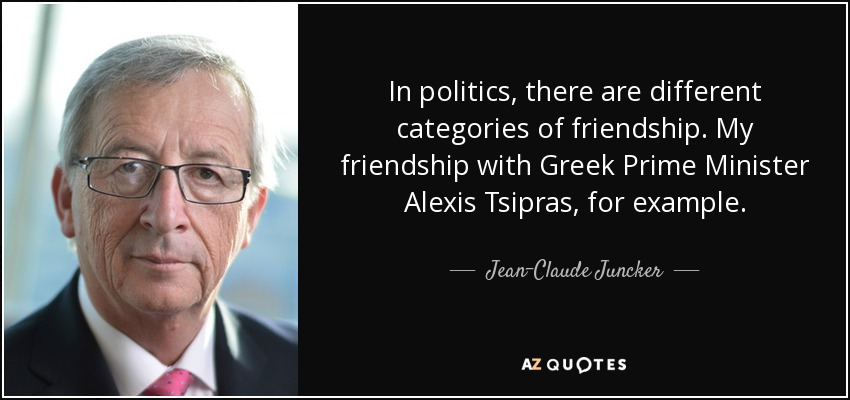
In politics, there are different categories of friendship. My friendship with Greek Prime Minister Alexis Tsipras, for example .
Energy use, transportation options, food choices, water use, purchasing choices, participating in elections, volunteering for nonprofits . . . and within each of these categories, each of us can learn to live a more conscious life.
I'm a member of the Recording Academy and I see the way it works and even with the whole voting process it's broken down into specific categories. There are Pop categories and Dance and Rock and Metal and Film and Score and everything else. Basically when you are voting you are urged not to vote in the category that you don't know anything about.
The Fourteenth Amendment, after the civil war, in principle brought former slaves into the category of persons, theoretically. But if you actually look, almost all the cases brought up for personal rights under the Fourteenth Amendment were by corporations. Freed slaves couldn't do it. In fact they were pretty much driven back into something like slavery by a north - south compact, that allowed former slave states to criminalize black life, which made a criminal force that was basically used as a forced labor force, up until the 1930s.
Morality has in the past made progress when we broadened the category of things we weren't permitted to harm (animals, 'infidels'); saw through some delusions and rationalisations about what harms are good for people themselves (prison punishment, hysterectomies for unhappy 1950s wives); and readjusted our for-the-good of others criteria so as to demand only reasonable sacrifices (ceasing to use children as handy chimney sweeps).
Superhero creators who engage in deconstruction fall into two categories: There are the guys who do it because it's easy, because it gets an audience reaction if you point out that superheroes must be a bunch of psychotic nuts. And there are the guys who do it because they're actually interested, and they're trying to get at what's going on underneath. They're interested in the process and the results.
I'm more of an 'erotic clown,' it doesn't fall into the female category.
The racial categories that are used in a given society (for example, in contemporary America) are biologically meaningless, but sometimes it turns out that a vernacular racial category has biological reality.
Instead of thinking of the question of race genealogically, and leaving it open whether vernacular races are genealogical units, the interest in biomedicine has been to determine whether vernacular racial categories are medically useful in diagnosis and treatment. There is on-going debate about this.
I was comparatively late in understanding Bob Dylan's overwhelming importance as a songwriter. Everybody who does my job exists in the shadow of Bob Dylan. There are two categories: Dylan and everybody else. It's as simple as that. And it's going to be that way until he dies.
On another front of the category-error argument are the insufferable fogeys who think the [Nobel] award is an outrage upon literature itself. That the problem is not simply a mistake may have been made about definitions, but that awful vulgarians are encroaching upon their sacred places. [Bob] Dylan, to them, is the harbinger of the low-culture mob; the latest in an unending number of final straws, or the thin end of a wedge that never seems to get thicker.
[I have] my own view about [Bob] Dylan's Nobel prize. Which is, I'm firmly in the Nay camp. I do think the award is a category error, but that's not why. Not in itself. What bothers me is the perceived status of the categories. If pop lyricists were routinely considered for the prize as are authors and poets, I'd still think it mistaken, but I wouldn't much care. But I am quite certain that Joni Mitchell and Leonard Cohen, for example, both at the very least Dylan's equals as writers, have never been in the running and never will be.
These commonplace categories - wife, mother, housewife, teacher - are in fact teleological referents. They gesture to profound states of being that animate, absorb and saturate the subject, like indelible dyes spilled repeatedly over a plain fabric. No matter if the fabric is sturdy or delicate, translucent or opaque, those dyes will stain. They will color the days and years and life.
You never know. Down the road you can do a lot of product categories. But I think you really have to build your core first and for people to know you and respect you for that.
Well, it had to be about the stories and the people who live under the volcano, what kind of new gods do they create? What sort of demons? And of course North Korea falls clearly into this category since the socialist revolution at the end of the Second World War. Somehow they adopted the myth of the power and dynamics of their volcano.
I spent the better part of a week trying to figure out how to organize these stacks of 30 years of conversations and dialogues. I finally began clustering them in these different categories, and I ended up with the ones you listed.It's interesting to me the kinds of questions I haven't been called to wrestle with. For example, I don't know what this says, but I'm not asked a lot of political questions.
Obama took 20 million people from the category of ignorables and put them into the category of unignorables. No one had to do anything for these 20 million people because they were outside the system. Now they're inside the system. Taking away their health care imposes all kind of political pain. We don't know the outcome, but every passing day it show how difficult it is for Trump to deprive them of what they now have.
Eleanor Roosevelt could easily have told negroes the deceitful maneuvering of the United States government that was going on behind the scenes. She never did it. In my opinion she was just another white woman whose profession was to make it appear that she was on the negro's side. You have a lot of whites who are in this category. Therefore, they have made negro loving a profession.
Maybe we need to start with the rethinking of what is "west" and what is "non-west." It seems to me that there are any number of populations who already cross that divide, and we could probably point to several existing states that belong exclusively neither to one category nor to the other. Do we use these terms to designate geographical realities, geopolitical ones, or perhaps sites of power, exploitation, orientalism that move through space and time in ways that have to be tracked historically.
Intersectionality has made an important contribution to social and political analysis, asking all of us to think about what assumptions of race and class we make when we speak about "women" or what assumptions of gender and race we make when we speak about "class." It allows us to unpack those categories and see the various kinds of social formations and power relations that constitute those categories.
We have to find a way of understanding how one category of sex can be "assigned" from both and another sense of sex can lead us to resist and reject that sex assignment. How do we understand that second sense of sex? It is not the same as the first - it is not an assignment that others give us. But maybe it is an assignment we give ourselves? If so, do we not need a world of others, linguistic practices, social institutions, and political imaginaries in order to move forward to claim precisely those categories we require, and to reject those that work against us?
I know that for category purposes, people have to lump certain artists in with genre that they make their name or their bones in. Nobody can tell me that Taj Mahal is pure blues. Nobody can tell me that Mike Bloomfield was pure blues. It was a lot of other things going on as well.
I think it's important not to view Martin Luther King Jr. in a narrow political manner. His fundamental commitment is to a radical love of humanity, and especially of poor and working people. And that radical love leads him to a radical analysis of power, domination and oppression. What's difficult is to situate him ideologically under a particular category.
My doctor told me that I really should lose some weight. "You're mildly obese," he said. And I thought, "Well, who couldn't afford to lose 20 or 30 pounds?" He said, "Well, a person in your category." I said, "What is that category, doctor?" He said, "Well, you're what I call upwardly middle aged." And I said, "I forgive you for everything."
Islamism implies some sort of political and social plan for Muslim people. In that classification, we find different categories. Legalist ones, traditional ones and revolutionary ones. Some of them are revolutionary but are non-violent, others are extremely violent. There are also the ones we call the literalists, like the Egyptian party Hizb al-Nour that used to be against democracy and now is getting into the political game.
Follow AzQuotes on Facebook, Twitter and Google+. Every day we present the best quotes! Improve yourself, find your inspiration, share with friends
or simply: