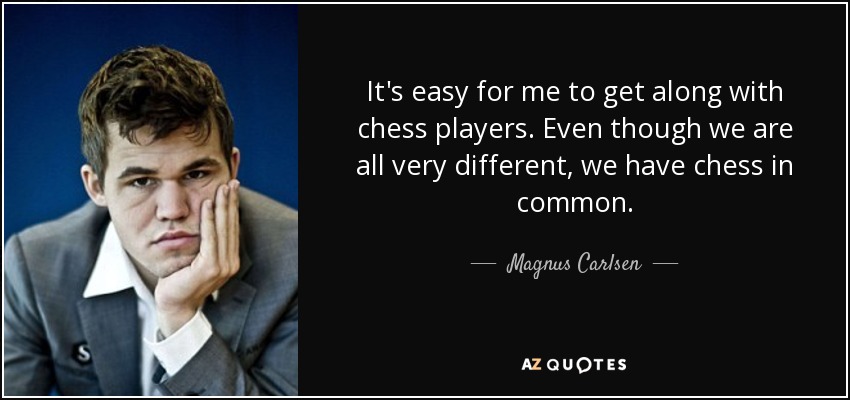
It's easy for me to get along with chess players. Even though we are all very different, we have chess in common.
Right now I'm really happy with how things are going with my chess career, so I'm not thinking of doing anything else.
I was lucky enough to attend schools where they were understanding about when I needed to go abroad to play chess. Of course, socially it is important to go to school and interact with people your own age.
Maybe if I didn't have the talent in chess I'd find the talent in something else. The only thing I know is that I have talent in chess, and I'm satisfied with that.
One of the things that first attracted me to chess is that it brings you into contact with intelligent, civilized people - men of the stature of Garry Kasparov, the former world champion, who was my part-time coach.
The older I grow, the more I find myself alone.
Scientists are a friendly, atheistic, hard-working, beer-drinking lot whose minds are preoccupied with sex, chess and baseball when they are not preoccupied with science.
I suspect millions of people from my generation probably have comparable stories to tell: if not of sports simulations then of Dungeons & Dragons, or the geopolitical strategy of games like Diplomacy, a kind of chess superimposed onto actual history.
The pitcher setting up the batter. It's chess, and you play with it.
Know that life, which does everything perfectly, is now moving you in a new direction. The chess piece of your existence is being moved to a new square on the board of life.
Initially I was very drawn to the Tao Te Ching, the Taoist philosophy. It was helping me deal with the balance of these external and internal issues with my chess life. Tai chi is the martial embodiment of Taoist philosophy. Initially, I had no intention of competing in the martial arts; it was just the meditation.
When you trade, the key concern is not always the value of the pieces being exchanged, but what's left on the board.
When everything on the board is clear it can be so difficult to conceal your thoughts from your opponent.
It is dangerous to maintain equality at the cost of placing the pieces passively.
One charming characteristic of many flank attacks I could mention is that they do not very often lead to simplification: if the attack is parried, there usually are still opportunities left for initiating action in another sector.
Strategically important points should be overprotected. If the pieces are so engaged, they get their regard in the fact that they will then find themselves well posted in every respect.
The infallible criterion by which to distinguish the true from the would-be strategist is the degree of originality of his conceptions. It makes little difference whether this originality is carried to excess, as was the case with Steinitz and Nimzowitsch.
During a chess tournament a master must envisage himself as a cross between an ascetic monk and a beast of prey.
It is better to follow out a plan consistently even if it isn't the best one than to play without a plan at all. The worst thing is to wander about aimlessly.
You must be able to handle a variety of move orders during the first 5-6 moves - otherwise you'll find yourself 'tricked' time and time again.
Only play into a variation in which your opponent is strong if you have your own personal novelty ready!
To find the right plan is just as hard as looking for its sound justification.
Play the move that forces the win in the simplest way. Leave the brilliancies to Alekhine, Keres and Tal.
The proper timing of an attacking plan is a difficult matter which places great strain on a player's nerves. Mastery of this art is required for success in the international arena, but perfect mastery eludes even the very best chessplayers!
As long as my opponent has not yet castled, on each move I seek a pretext for an offensive. Even when I realize that the king is not in danger.
Follow AzQuotes on Facebook, Twitter and Google+. Every day we present the best quotes! Improve yourself, find your inspiration, share with friends
or simply: