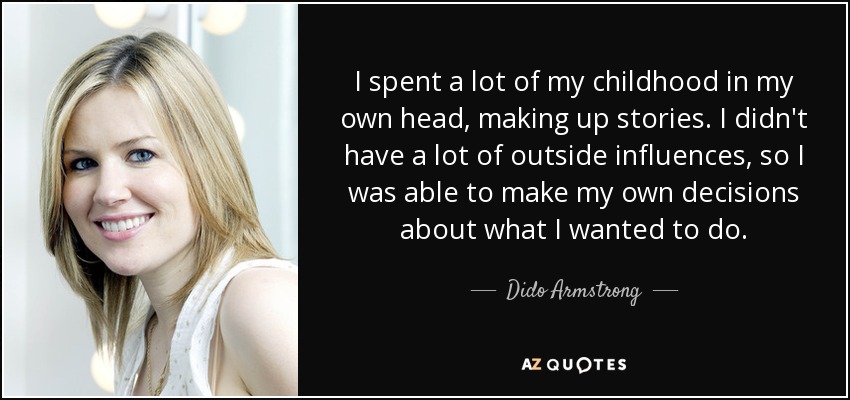
I spent a lot of my childhood in my own head, making up stories. I didn't have a lot of outside influences, so I was able to make my own decisions about what I wanted to do.
I consider myself to have been formed by a lot of the locutions and aesthetics and principles of the Muslim way of life, and those are an important part of my childhood and my identity.
The books one reads in childhood, and perhaps most of all the bad and good bad books, create in one's mind a sort of false map of the world, a series of fabulous countries into which one can retreat at odd moments throughout the rest of life, and which in some cases can survive a visit to the real countries which they are supposed to represent.
Everyone starts at the beginning of the road, and the world is in an endless state of childhood.
My childhood dreams were focused on being part of the effort to make humanity a multiplanetary species.
Indeed, my conclusion from a lifetime of psychohistorical study of childhood and society is that the history of humanity is founded upon the abuse of children. Just as family therapists today find that child abuse often functions to hold families together as a way of solving their emotional problems, so, too, the routine assault of children has been society's most effective way of maintaining its collective emotional homeostasis.
My childhood was colorfully anarchic and punctuated by a lot of change.
I believe the power of observation in numbers of very young children to be quite wonderful for its closeness and accuracy. Indeed, I think that most grown people who are remarkable in this respect, may with greater propriety be said not to have lost the faculty, than to have acquired it; the rather, as I generally observe such men to retain a certain freshness, and gentleness, and capacity of being pleased, which are also an inheritance they have preserved from their childhood.
I hated my childhood. It was loathsome. My parents were deaf and dumb. Profoundly so. They could make noises when they were emotionally aroused, but they couldn't form it into speech.
Drawn to childhood, the old man will seek it in a thousand different ways.
The act of writing is for me often nothing more than the secret or conscious desire to carve words on a tombstone: to the memory of a town forever vanished, to the memory of a childhood in exile, to the memory of all those I loved and who, before I could tell them I loved them, went away.
The dominant expression of a child is gravity.
I've begun to appreciate the generational patterns that ripple out from our lives like stones dropped in water, pulsing outward even after we are gone. Although we have but one childhood, we relive it first through our children's and then our grandchildren's eyes.
My childhood wasn't very happy. It's a long, grim story about being a Jew in a small southern town.
I didn't have a normal childhood by any means. But it was what it was, and I appreciate what my parents did for me.
A lot of the characters I play have problems, they are marginalised, they have serious psychological problems, problems with relationships, with childhood. These are big subjects, big subjects. You can't balk at work like that. As an actor, that's as good as it gets.
Childhood didn't have a big influence on me, really - in fact I spent most of it plotting how to escape.
I didn't have a normal childhood by any means.
I have a good memory for early life. My visual memory is good about childhood and adolescence, and less good in the last 10 years. I could probably tell you less what happened in the last 10 years. I remember what houses looked like, sometimes they just pop into my head.
I wrote poetry, journals, and, especially, plays for the neighborhood kids to perform. I had an ordinary, happy childhood. Nothing much was going on, but I had fun.
I loved every minute of my childhood - sunbathing on the fire escape, digging for buried treasure in the back yard, pulling alewives out of the sand... Then it was all taken away from me. I came back every summer to visit my father until I was 18, but I was always the outsider.
The greatest lessons in life, if we would but stoop and humble ourselves, we would learn not from the grown-up learned men, but from the so-called ignorant children.
If you want to say how can we step into childhood and make it better for them, I would start at the activity level. I'd like to say let your kids go out and play.
My childhood was very colourful, and I am very good friends with both my parents. We have no secrets.
There's something about strip malls that just reeks of my childhood.
Follow AzQuotes on Facebook, Twitter and Google+. Every day we present the best quotes! Improve yourself, find your inspiration, share with friends
or simply: