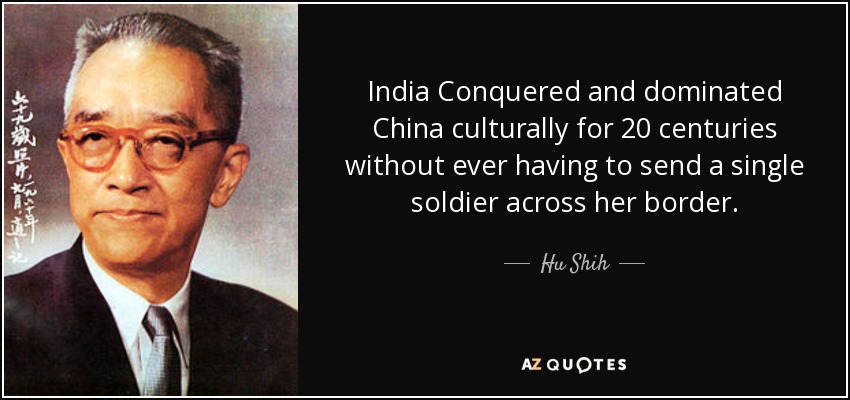
India Conquered and dominated China culturally for 20 centuries without ever having to send a single soldier across her border.
In the space of a decade, China and India have emerged as dramatic, dynamic competitors.
The key issue is the shift of the centre of gravity from the West to the East, the rise of China and India.
I am firmly convinced that, in future years, China and India will join hands in playing a more active role in maintaining peace and stability in the region and the world at large and make due contribution to the cause of human progress and development.
When I was growing up, my parents told me, 'Finish your dinner. People in China and India are starving.' I tell my daughters, 'Finish your homework. People in India and China are starving for your job.'
For more than 3,000 years, China and India accounted for half of the world's economic output. But then the Industrial Revolution gave North America and Europe 150 golden years. If you take the long-term perspective, our economic dominance has been more of an exception than the rule.
If China and India were as rich as the United States is today, the market for cancer drugs would be eight times larger than it is now.
How can you possibly have an international agreement that's effective unless countries like China and India are not full participants?
The thing that makes me most optimistic is China and India - both of them doing well.
In the new century, we should continue to work together to safeguard the legitimate rights and interests of the vast number of developing countries including China and India and promote the establishment of a just and equitable new international political and economic order.
China and India are close neighbours linked by mountains and rivers and the Chinese and Indian peoples have enjoyed friendly exchanges for thousands of years.
The idea that China and India will just abandon climate action is not true, because they're doing it for more reasons than we are.
As a global society we are performing a great experiment on ourselves. Half of the world population wants to race faster into the future. Go visit China and India. They're ready to go. And half of the world wants to drag us into the past. The problem is both sides have guns. I think there really is a reaction. A lot of people are saying enough is enough.
The first country to adopt happiness as an official goal of public policy is the tiny little country of Bhutan in Asia near China and India.
The demographic weight of countries such as China and India exercise a massive pressure on our wages and salaries. They have accomplished massive technological advances and the revolution in information technology has reduced the costs of transport.
Today, being the biggest developing countries in the world, China and India are both committed to developing their economy and raising their people's living standards.
China and India will take the global leadership on climate change: they are suffering for it.
If I were personally to define religion, I would say that it is a bandage that man has invented to protect a soul made bloody by circumstances. All forms of dogmatic religion should go. The world did without them in the past and can do so again. I cite the great civilizations of China and India.
Burma wants to have good relations with our neighboring countries, China and India. I do believe the United States itself wants to live in harmony with China and India. That's why we have to lay down political policies that are fair for everyone.
What the Paris agreement now does is say to China and India and other countries that are potentially polluting, come on board. Let's work together so you guys do the same thing.
At the beginning of the 20th century, there were less than 3 billion people on the earth, closer to 2 billion. By all measures that we can come up with right now,. with the lifestyle and consumption pattern of the Western industrial civilization, we can probably sustain about 2 billion people on this earth. We already have over 6 billion. China and India are aspiring to come on as industrial nations, aspiring to the lifestyle of the Western world, and it simply can't happen.
It certainly makes sense to expand the pulp industry in Indonesia, .. It's clear that it will be a very competitive exporter of pulp to the rest of the world, including China and India. So the interest by the Indonesian government is clearly to establish a really competitive plantation fiber base to support a globally attractive export industry.
With support jobs moving to China and India, it's not surprising that English-speaking countries' top frustration revolves around the difficulty of understanding customer service representatives. However, even if the level of customer service is exceptional, the extent to which poorly-understood accents trump quality of service speaks to English-speaking customers' growing intolerance of non-native speech, more so than in other countries.
American workers won't be able to compete fairly for jobs until companies have to pay higher wages in countries like China and India.
What's the third largest nation in the world after China and India? It's the Facebook nation - 430 million people on Facebook.
Follow AzQuotes on Facebook, Twitter and Google+. Every day we present the best quotes! Improve yourself, find your inspiration, share with friends
or simply: