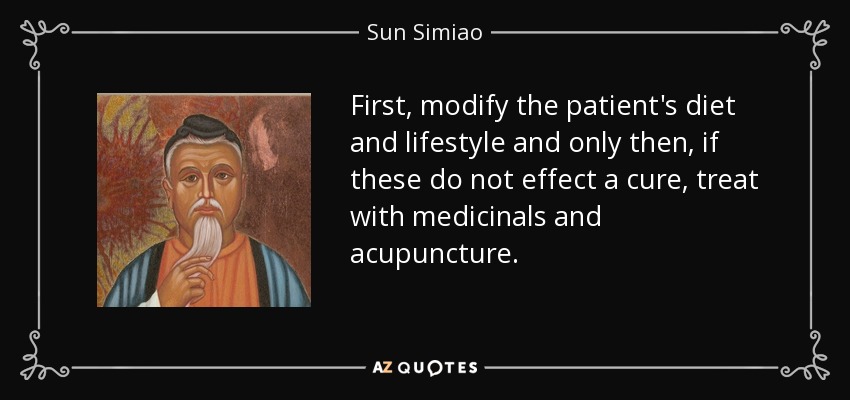
First, modify the patient's diet and lifestyle and only then, if these do not effect a cure, treat with medicinals and acupuncture.
It doesn't matter where I am - China will stay in me. I don't know how far I can still walk on this road and what is the limit.
America is stagnant. We've lost our jobs. We've lost our businesses. We're not making things anymore, relatively speaking. Our product is pouring in from China, pouring in from Vietnam, pouring in from all over the world.
What China would do, I cannot predict. China has all but given up the claim to the use of force, except in the circumstance of Taiwan declaring its independence. That is a huge step forward over what the situation was many years ago.
Even if they're functioning out of ignorance, they are still participating and must be suppressed. In China, even one million people can be considered a small sum.
In yielding we are like the water, by nature placid, conforming to the hollow of the smallest hand; in time, shaping even the mountains to its will. Thus we keep duty and honor. We cherish clan and civilization. We are Chinese.
What is applicable is to understand that first of all China has undergone a huge revolution in the last years. Anyone who saw China as I did in 1971 - and for that matter even in 1979, because not much had changed between 1971 and 1979 - and sees China today, knows one is in a different economic system.
Certainly nothing is easier than to rewrite history. If we had made Taiwan a separate state, it would have led to a fundamental conflict with China, and probably to war. Certainly in the long term, it would have led to war.
I knew Deng Xiaoping when he came out of prison. He had, after all, been imprisoned for nearly ten years by Mao. I know what China looked like before he took over, and so in my own mind, I don't think of Deng Xiaoping as an oppressor. I think of somebody who, faced with that crisis, made a very painful and decision with which I cannot agree. But I also think of him as a great reformer.
Our concern for human rights comes to the fore when there are gross violations of human decencies. Then other countries, including China, must recognize that this affects the American attitude towards their country. But towards what precise institutions will it evolve? I think we ought to leave something to history.
China has had a long and complex history and has managed to evolve its own culture for 4,000 years. It therefore not necessarily true that we know exactly what is best for the internal structure of China.
No, [the U.S.] has made it clear that we consider a peaceful resolution an essential aspect of American foreign policy. This I believe to be a situation understood by China, but again, it is important to not sound too truculent. Taking on a billion-plus Chinese is not an enterprise which one should enter lightly.
In the short term, it would not have made it possible to resume relations, because in the Chinese mind, the humiliation of China started with the annexation of Taiwan by Japan. If the United States had suddenly declared Taiwan as a separate state - for which we would have had no support among other nations - the consequences would have been giving up our relationship with China and committing ourselves to a long-term conflict with China.
When I first saw China, there were no automobiles. There were no supermarkets. There were no high-rise buildings. There were no consumer goods. There were no restaurants that were at least accessible that foreigners could see. It was a Stalinist society, and a very poor Stalinist society. So the economic system has totally changed, and the private sector in the economic system is now the dominant sector. It didn't exist at all as late as 1979.
Chinese companies may well be competitive on their domestic market, but it will be another 6 to 8 years before they become serious competitors internationally. We should not be afraid of China, but should learn from them instead.
I do not know what will happen in China politically. I do know that it is impossible to maintain the communist system or probably even a strict one-party system when the economy becomes so pluralistic. Now, what form that takes and what institutions will evolve, I do not have a clear view about. I do not think the United States, as a general principle, ought to intervene in this.
We have no lesson to teach Russia if we concurrently roll out the red carpet to Qatar, Saudi Arabia and China.
There are a lot of movies that take place internationally, like Kung Fu Panda portraying a little bit of China, and Ratatouille portraying a little about Paris, but it's hard to find a movie that portrays Rio or Brazil.
Well, I don't know whether it caused anguish in China, but it was not a wise way to proceed. But one has to remember that it was the first experience. And in a Republican administration, there is a conservative wing that looks at China as the last embodiment of communism, which therefore tends towards a more bellicose rhetoric anyway than I would. It's not the dominant element, but every once in a while they get a crack at public statement.
The China of the 1970s was a communist dictatorship. The China of the twenty-first century is a one-party state without a firm ideological foundation, more similar to Mexico under the PRI than Russia under Stalin. But the measurement of the political and the economic evolution has not yet been completed, and is one of the weak points of the system.
I don't consider China a communist state, no. I know that sounds paradoxical, but it's my view.
Well it did not make excessive sense to say that 20 million people are the recognized government of a billion people that have their own institutions. We did not change it in the sense that we said this has to end, but there was a U.N. vote that transferred the legitimacy of China from Taiwan to Beijing. Beijing was recognized as the government of all of China. Then, under President Carter, we followed what the U.N. had already done eight years earlier.
I have great respect for the Taiwanese. They have done an extraordinary job. But it was not a sustainable position to say that the legitimate government of China resides in Taiwan, which at that time didn't have much contact with the mainland.
Every time there has been an attempt to disturb it, it led to two things. It led to immediate intense conflict with China, and it led to a reaffirmation in the end, because nobody wanted a major confrontation with China to this principle of a "one China" policy within which Taiwan is finding a place now. Its own position has greatly improved since the Nixon policy. It is richer, it is stronger and it is participating in many international organizations.
America has made it very clear in several administrations that if there is an attack by China on Taiwan, the United States is very likely to resist.
Follow AzQuotes on Facebook, Twitter and Google+. Every day we present the best quotes! Improve yourself, find your inspiration, share with friends
or simply: