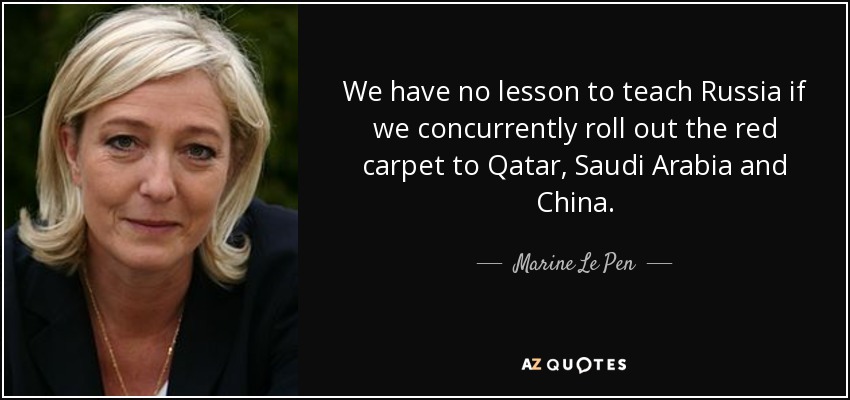
We have no lesson to teach Russia if we concurrently roll out the red carpet to Qatar, Saudi Arabia and China.
Chinese companies may well be competitive on their domestic market, but it will be another 6 to 8 years before they become serious competitors internationally. We should not be afraid of China, but should learn from them instead.
Well, I don't know whether it caused anguish in China, but it was not a wise way to proceed. But one has to remember that it was the first experience. And in a Republican administration, there is a conservative wing that looks at China as the last embodiment of communism, which therefore tends towards a more bellicose rhetoric anyway than I would. It's not the dominant element, but every once in a while they get a crack at public statement.
What is applicable is to understand that first of all China has undergone a huge revolution in the last years. Anyone who saw China as I did in 1971 - and for that matter even in 1979, because not much had changed between 1971 and 1979 - and sees China today, knows one is in a different economic system.
The defining issue is that the government in Taiwan was considered to be the government of all of China, and the authorities in Beijing were not recognized as a government of China. So Taiwan was the residuary for all of China.
Well it did not make excessive sense to say that 20 million people are the recognized government of a billion people that have their own institutions. We did not change it in the sense that we said this has to end, but there was a U.N. vote that transferred the legitimacy of China from Taiwan to Beijing. Beijing was recognized as the government of all of China. Then, under President Carter, we followed what the U.N. had already done eight years earlier.
Certainly nothing is easier than to rewrite history. If we had made Taiwan a separate state, it would have led to a fundamental conflict with China, and probably to war. Certainly in the long term, it would have led to war.
No, [the U.S.] has made it clear that we consider a peaceful resolution an essential aspect of American foreign policy. This I believe to be a situation understood by China, but again, it is important to not sound too truculent. Taking on a billion-plus Chinese is not an enterprise which one should enter lightly.
China has had a long and complex history and has managed to evolve its own culture for 4,000 years. It therefore not necessarily true that we know exactly what is best for the internal structure of China.
I do not know what will happen in China politically. I do know that it is impossible to maintain the communist system or probably even a strict one-party system when the economy becomes so pluralistic. Now, what form that takes and what institutions will evolve, I do not have a clear view about. I do not think the United States, as a general principle, ought to intervene in this.
We're not going to give tax breaks to billionaires and then cut back on the needs of our elderly or poor or kids or education. We're not going to privatize Social Security - in fact, we're going to strengthen it. We're going to provide quality education for every kid in America, from preschool through college. We have to take on these corporate leaders who are selling out the American people, whose allegiance is now much more to China than it is to the United States. If we have the courage to take these people on, I think we can overwhelm George W. Bush and his friends.
"A Tale of Three Cities" is a tribute to our parents' generation, who escaped from city to city in search of their loved ones and in search of a place to build a better home. The story is set during the turbulent war years in China in the '40s and '50s.
We face the gravest threat that civilization has ever confronted. It's global in nature and requires a global solution. Increased CO2 emissions anywhere, whether from China or the United States or from one of the countries that is burning its forests like Brazil or Indonesia.
Once I was in New York, I completely had no interest for a long time in what happened in China because I had been through so much. Seeing my father's life struggle and so many whole generations lose their potential or possibility in their lives. Just being pushed into this political struggle and the damage done not only to their lives but their relatives.
For me to start working, projects have to catch my attention whether they are here (in the USA) or in Mexico. All I want is to be involved in projects that are interesting to me, projects that are a challenge wherever they may happen, in Spain, in China, or in Hollywood.
I require silence to write the way an apple tree requires winter to make fruit. Being with people is intimate and joyous, but at some point, I'll wander off by myself. The paradox is that what began in childhood as an act of necessary solitude has led me straight to a life with others, in which I fly to China or Lithuania or northern Minnesota to read my poems and talk with other people who love language made into a lathe on which a life can be tuned and be turned.
All countries have problems with China's economic power.
China is incredibly important to the future of mankind. For me, this is something that we all need to have intelligent discussions about in America, in Britain, in Europe. We need to really understand that their destiny and our destiny, Africa's destiny, etc., are all completely tied in. The argument for getting to know your neighbors is very compelling.
National law has no place in cyberlaw. Where is cyberspace? If you don't like banking laws in the United States, set up your machine on the Grand Cayman Islands. Don't like the copyright laws in the United States? Set up your machine in China. Cyberlaw is global law, which is not going to be easy to handle, since we seemingly cannot even agree on world trade of automobile parts.
An American diplomat is sometimes like a bull who carries his own china shop around with him.
A man is allowed sufficient freedom of thought, provided he knows how to choose his subject properly.... But the scene is changed as you come homeward, and atheism or treason may be the names given in Britain to what would be reason and truth if asserted in China.
There are a host of ethnic minorities in China but they often have a weak sense of identity and are relatively small in total number. History has taught the Han that other groups will and should ultimately be absorbed and assimilated as Han. There is a belief that the Han enjoy a superior and far more advanced culture.
First, there was Confucius. Then, the sayings of Chairman Mao. And now the pithy, ironic, and humorous insights of Ai Weiwei. I thoroughly enjoyed reading this collection, which reflects a well-developed philosophy as well as a keen understanding of the Chinese Communist system. This is China made easy and interesting.
What business could be mature when you have economies with more than 2 billion people in India, China and Southeast Asia?
China has many successful entrepreneurs and business people. I hope that more people of insight will put their talents to work to improve the lives of poor people in China and around the world, and seek solutions for them.
Follow AzQuotes on Facebook, Twitter and Google+. Every day we present the best quotes! Improve yourself, find your inspiration, share with friends
or simply: