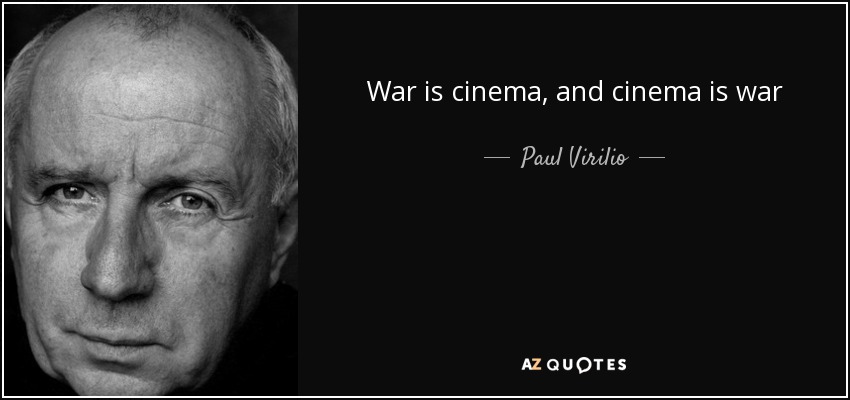
War is cinema, and cinema is war
I think that it's not a bad thing to not be too versed in the vocabulary of cinema, because you start to think that certain things are allowed and not allowed.
Previously the same Polish audiences would have been pressured into seeing cinema made for adults, films made by us about those spheres of life that were significant for us and which should be significant for our society.
Magic in cinema is a bit like ventriloquism on the radio.
During the war, I saw many films that made me fall in love with the cinema.
But rather that we should lose our sense that neither can become the other, that the traditional novel form continues to enlarge our experience in those very areas where the wide-angle lense and the Cinerama screen tend to narrow it.
I am sure that the two main forms of English, American English and British English, separated geographically from the beginning and severed politically since 1776, are continuing to move apart, and that existing elements of linguistic dissimilarity between them will intensify as time goes on, notwithstanding the power of the cinema, TV, Time Magazine, and other two-way gluing and fuelling devices.
What happened in the late Fifties, early Sixties in French cinema was a fantastic revolution. I was in Italy, but completely in love with the nouvelle vague movement, and directors like Godard, Truffaut, Demy. 'The Dreamers' was a total homage to cinema and that love for it.
I think people need to understand that with plays and with cinema, when you hear about it, call and get a ticket then or go and see it then. It's especially with the play, which I can do because it's a limited run.
I'm not naive enough to pretend that on its own cinema can capture the very soul of significant social and cultural problems.
At its best, cinema does retain a remarkable ability to speak to people of every age, from every background, and in ways that almost any other art form in popular culture struggles to compete with.
The select group of people who do make realistic cinema, who do make cinema perhaps a little more acceptable to the Western audience, is a very small percentage.
My mother and my father went to the cinema for the first time when I made my first movie in 1978.
When you're on TV, you come into people's homes. In theater and film, they go to you - to the temple of the cinema or theater. And it's very different.
Used properly, cinema is the coolest thing in the world.
You see thousands of films you forget the minute you come out of the cinema, don't you? Because they don't mean anything. It's the tough ones like 'Breaking the Waves' and 'Nil By Mouth' that stay with you, that you never forget. I'd like to leave a few of those behind if possible.
When I saw what painting had done in the last thirty years, what literature had done - people like Joyce and Virginia Woolf, Faulkner and Hemingway - in France we have Nathalie Sarraute - and paintings became so strongly contemporary while cinema was just following the path of theater. I have to do something which relates with my time, and in my time, we make things differently.
Music is one of the important things for me in cinema.
Jean-Luc Godard said that cinema is the truth 24 frames a second. I think cinema is lies 24 frames a second.
I just don't think there's a lot of support for the woman's voice in cinema, and it becomes really difficult to raise that money and start again every time.
I didn't go to the cinema a lot when I was young.
Just telling a story. That's cinema. It's not silent, black and white. It's a simple story that's well made.
Realism is always subjective in film. There's no such thing as cinema verite. The only true cinema verite would be what Andy Warhol did with his film about the Empire State Building - eight hours or so from one angle, and even then it's not really cinema verite, because you aren't actually there.
I became a director just for the love of movies, because of the power of cinema.
When I make a film, I never stop uncovering mysteries, making discoveries. When I'm writing, filming, editing, even doing promotional work, I discover new things about the film, about myself, and about others. That is what I'm subconsciously looking for when shooting a film: to glimpse the enigmas of life, even if I don't resolve them, but at least to uncover them. Cinema is curiosity in the most intense meaning of the word.
Follow AzQuotes on Facebook, Twitter and Google+. Every day we present the best quotes! Improve yourself, find your inspiration, share with friends
or simply: