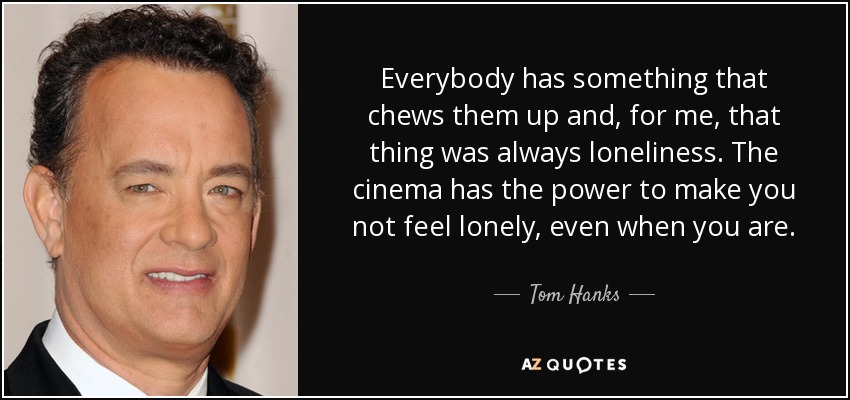
Everybody has something that chews them up and, for me, that thing was always loneliness. The cinema has the power to make you not feel lonely, even when you are.
There's a difference between watching a film and watching a bit of cinema and enjoying a film as a piece of cinema.
When I'm writing, it's about the page. It's not about the movie. It's not about cinema. It's about the literature of me putting my pen to paper and writing a good page and making it work completely as a document unto itself. That's my first artistic contribution. If I do my job right, by the end of the script, I should be having the thought, 'You know, if I were to just publish this now and not make it . . . I'm done.
The whole 'R' rating depends on a strange sort of fantasy land where all adults are responsible people, and children only ever go to the cinema with their parents.
In American cinema, people will take a chance on you, though they'll often remind you that really, they always liked you.
The cinema began with a passionate, physical relationship between celluloid and the artists and craftsmen and technicians who handled it, manipulated it, and came to know it the way a lover comes to know every inch of the body of the beloved. No matter where the cinema goes, we cannot afford to lose sight of its beginnings.
All my life, I have loved and been inspired by French cinema, and as a studio head it has been my pride and joy to have the ability to bring movies to audiences around the world.
I think it's important that we all try to give something to this medium, instead of just thinking about what is the most efficient way of telling a story or making an audience stay in a cinema.
It has been said that I have three heroes: Christ, Marx and Freud. This is reducing everything to formulae. In truth, my only hero is Reality. If I have chosen to be a filmmaker as well as a writer it is because, rather than expressing reality through those symbols that are words, I have preferred the cinema as a means of expression - to express reality through reality.
Cinema is a technologically mediated dreamspace, a way to access, a portal to the numinous that unfolded in the fourth dimension, so cinema became sort of a waking dream where we can travel in space and time, where we can travel in mind. This became more than virtual reality, this became a real virtuality.
Juxtaposing a person with an environment that is boundless, collating him with a countless number of people passing by close to him and far away, relating a person to the whole world, that is the meaning of cinema.
Architecture exists, like cinema, in the dimension of time and movement
Life is not just eating, drinking, television and cinema...The human mind must be creative, must be self-generating ; it cannot depend on just gadgets to amuse itself.
I live cinema and passionately love music, and my efforts in both these crafts are unfolding.
I think my dyslexia was a vital part of my development because my inability to read and write meant that I had to find knowledge elsewhere so I looked to the cinema.
I loved cinema from a very young age. I was also obsessed with Hitchcock and actresses like Kim Novak in Vertigo. They all played heroines and were strong, powerful women, yet they were very feminine.
And having those mystical elements you see in Asian cinema and certainly Asian martial arts cinema, it's something that we wanted to begin to introduce - the idea of spirituality and the idea of there being something else out in the world besides people who are great fighters.
The films that I go to see at the cinema are not Hollywood blockbusters particularly. I've not got anything against them... I'm in them! But I don't go and spend my money on them.
One of the more problematic aspects of the current state of cinema in Japan is that the movies playing in the theaters are by and large made not by film studios but by broadcasting companies. They're either extensions of popular television dramas or adaptations of manga or anime. Younger Japanese are simply not being exposed to good films. That situation needs to change.
I'm interested in the cultural thing - music, then eventually cinema. I think it's part of my struggle as a cultural worker. I'm not into the armed thing. I cannot be violent.
I make films, and festivals, museums, and academia are embracing the work. It will be heard. It's bound to happen because cinema is universal. You create it, some people will notice it, some people will watch it.
The novelistic attribute of my work is very much like the Russian way of creating novels. Tolstoy, Dostoyevsky - their work has so many gaps. But for the reader, you cannot erase those gaps because they are important. They contextualize the whole struggle. My cinema is like that.
There is no border. I'm branding my films as Malay cinema, but it's just about cinema. Everything that I make is about humanity's struggle, so there is no border, really.
There is no border in my films. You can see yourself in these stories. This is the greatest thing about the power of cinema. It's very present. It's all there. You can't escape it.
Cinema is the greatest mirror of humanity's struggle. You see this alternative world, but you're part of it. Everybody is part of it. This is our world.
Follow AzQuotes on Facebook, Twitter and Google+. Every day we present the best quotes! Improve yourself, find your inspiration, share with friends
or simply: