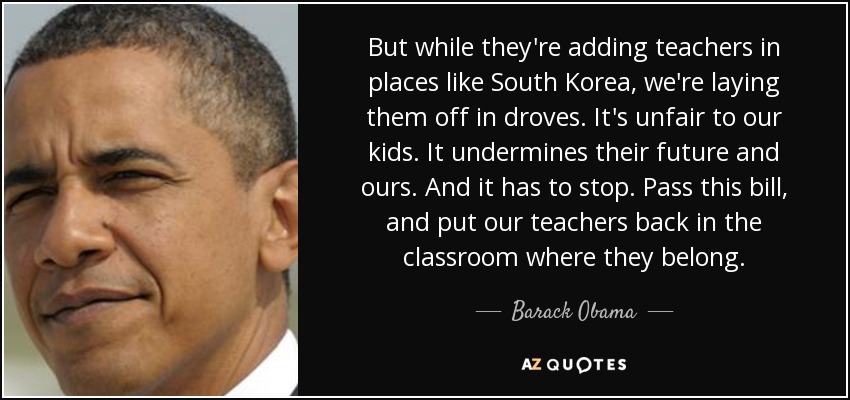
But while they're adding teachers in places like South Korea, we're laying them off in droves. It's unfair to our kids. It undermines their future and ours. And it has to stop. Pass this bill, and put our teachers back in the classroom where they belong.
[T]he seeds of [the Argument Culture] can be found our classrooms, where a teacher will introduce an article or an idea . . . setting up debates where people learn not to listen to each other because they're so busy trying to win the debate.
The history of our nation is intertwined with a certain religious tradition, and that the First Amendment was not intended to result in the complete exclusion of religious beliefs from our public classrooms.
For God to be kept out of the classroom or out of America's public debate by nervous school administrators or overcautious politicians serves no one's interests. That restriction prevents people from drawing on this country's rich and diverse religious heritage for guidance, and it degrades the nation's moral discourse by placing a whole realm of theological reasoning out of bounds. The price of that sort of quarantine, at a time of moral dislocation, is - and has been - far too high.
It wasn't the Supreme Court that expelled God from our public school classrooms. It was the textbook publishers.
If religion and churches are truly threats to our liberties, how did those liberties survive, and in such healthy condition, all those years of classroom prayer and Bible-reading?
A basically dishonest man can survive longer in the church or the classroom than he can in the grain exchange or the furniture business.
If they believe only what they can see, why do we have classrooms?
We must continually remind students in the classroom that expression of different opinions and dissenting ideas affirms the intellectual process. We should forcefully explain that our role is not to teach them to think as we do but rather to teach them, by example, the importance of taking a stance that is rooted in rigorous engagement with the full range of ideas about a topic.
Monica Langley has a great piece in The Wall Street Journal about how they're trying to create different kinds of moments for Donald Trump, as opposed to just him shouting at rallies. They're trying to get him in classrooms, and in churches, and in diners and places where he can make a more personal connection.
During bomb drills, we students were told to crouch under our desks. Apparently the desks used in classrooms in the fifties were made of an exceptionally missile-resistant variety of wood. During the Cold War years I often wondered why it never occurred to our defense planners to protect the entire nation from nuclear attack by simply covering it, from sea to shining sea, with a huge Strategic Classroom Desk.
I was never ignorant, as far as being experienced in classrooms and learning about different subjects and actually soaking it up.
While we bemoan the decline of literacy, computers discount words in favor of pictures and pictures in favor of video. While we fret about the decreasing cogency of public debate, computers dismiss linear argument and promote fast, shallow romps across the information landscape. While we worry about basic skills, we allow into the classroom software that will do a student's arithmetic or correct his spelling.
When the Irish nun said to me, "Speak your name loud and clear so that all the boys and girls can hear you," she was asking me to use language publicly, with strangers. That's the appropriate instruction for a teacher to give. If she were to say to me, "We are going to speak now in Spanish, just like you do at home. You can whisper anything you want to me, and I am going to call you by a nickname, just like your mother does," that would be inappropriate. Intimacy is not what classrooms are about.
I believe that part of what propels science is the thirst for wonder. It's a very powerful emotion. All children feel it. In a first grade classroom everybody feels it; in a twelfth grade classroom almost nobody feels it, or at least acknowledges it. Something happens between first and twelfth grade, and it's not just puberty. Not only do the schools and the media not teach much skepticism, there is also little encouragement of this stirring sense of wonder. Science and pseudoscience both arouse that feeling. Poor popularizations of science establish an ecological niche for pseudoscience.
When it comes to my vocabulary, I felt a responsibility when I was teaching to raise the bar of conversation in my classroom. And with my own students, I refused to let them use the phrase "I like" or "I don't like" when we were engaged in a critique.
I often notice how students can gain the capacity to use certain critical methodologies through engaging with very different texts - how a graphic novel about gentrification and an anthology about Hurricane Katrina and a journalistic account of war profiteering might all lead to very similar classroom conversations and critical engagement. I'm particularly interested in this when teaching law students who often resist reading interdisciplinary materials or materials they interpret as too theoretical.
One teacher told me that my work belonged in the trash. That day I ran out of the classroom and ended up in the library, where there happened to be a black and white photography exhibition of Robert Rauschenberg's photographs of the streets of New York. The subject of his photos were exactly what I was painting about.
I knew that I wanted to be an illustrator since I was in kindergarten. I can remember the exact day. The art teacher usually came to our classroom once a week, but she was absent that day. Instead, our regular teacher gave us each a huge piece of paper and crayons, and we could do whatever we wanted.
If complex organisms demand an explanation, so does a complex designer. And it's no solution to raise the theologian's plea that God (or the Intelligent Designer) is simply immune to the normal demands of scientific explanation. To do so would be to shoot yourself in the foot. You cannot have it both ways. Either ID belongs in the science classroom, in which case it must submit to the discipline required of a scientific hypothesis. Or it does not, in which case, get it out of the science classroom and send it back to church, where it belongs.
To be sure, Darwin's theory of evolution is imperfect. However, the fact that a scientific theory cannot yet render an explanation on every point should not be used as a pretext to thrust an untestable alternative hypothesis grounded in religion into the science classroom or to misrepresent well-established scientific propositions.
Create sacred spaces in the workplace as well. Classrooms, five years ago, professors would say, I don't want be a nanny to my students. They can do whatever they want. Now professors are saying, put away that laptop, because studies show that it not only takes away the attention of the person who's on the laptop from the class, but everyone around them. There's like a circle around that person that's distracted and not paying attention.
How do you remember everything from different books when you are still writing the HP series? As obsessive fans will tell you, I do slip up! Several classrooms move floors mysteriously between books and these are the least serious continuity errors! Most of the fansites will point you in the direction of my mistakes. But the essentials remain consistent from book to book because the story has been plotted for a long time and it is clear in my mind.
Rarely do outside of school remedies work their way into the fabric of the schools or into the teachers lives, and more rarely into the classrooms. Therefore they only offer a modest hope of influencing the basic culture of the school
Wherever possible, home is by far the best nest until at least eight, ten or twelve. Psychologists and psychiatrists who understand child development would prefer an even later age. In a reasonably warm home, parent-child responses, the true ABC's of sound education, are likely to be a hundred times more frequent than the average teacher-child responses in a classroom.
Follow AzQuotes on Facebook, Twitter and Google+. Every day we present the best quotes! Improve yourself, find your inspiration, share with friends
or simply: