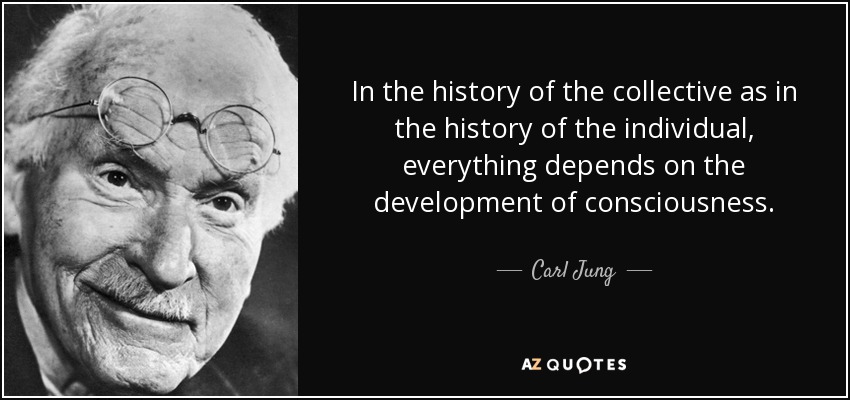
In the history of the collective as in the history of the individual, everything depends on the development of consciousness.
Something very beautiful happens to people when their world has fallen apart: a humility, a nobility, a higher intelligence emerges at just the point when our knees hit the floor. Perhaps, in a way, that's where humanity is now: about to discover we're not as smart as we thought we were, will be forced by life to surrender our attacks and defenses which avail us of nothing, and finally break through into the collective beauty of who we really are.
If the 19th [century] was the century of the individual (liberalism means individualism), you may consider that this is the "collective" century, and therefore the century of the state.
Although the patriarchal ego prides itself on being reasonable, the twentieth century has been anything but the Age of Reason. In our collective neurosis, we have raped the earth, disrupted the delicate balance of nature, and created phallic missiles of mass destruction.
Simply put, international terrorism made international cooperation mandatory rather than elective. Collective security has become the only real security against the hydra-headed monster of international terror.
Collective unity is not the result of the brotherly love of the faithful for each other. The loyalty of the true believer is to the whole the church, party, nation and not to his fellow true believer. True loyalty between individuals is possible only in a loose and relatively free society .
Liberalism is extremely harmful in a revolutionary collective. It is a corrosive which eats away unity, undermines cohesion, causes apathy and creates dissension. It robs the revolutionary ranks of compact organization and strict discipline, prevents policies from being carried through and alienates the Party organizations from the masses which the Party leads. It is an extremely bad tendency.
Exhibitions of minority art are often intended to make the minority itself more aware of its collective experience. Reinforcing the common memory of miseries and triumphs will, it is expected, strengthen the unity of the group and its determination to achieve a better future. But emphasizing shared experience as opposed to the artist's consciousness of self (which includes his personal and unshared experience of masterpieces) brings to the fore the tension in the individual artist between being an artist and being a minority artist.
The outcome of a non-constant-sum game may be dictated by the individual rationality of the respective players without satisfying a criterion of collective rationality.
The need of the hour is that your life should be revolutionised. The revolution should not be an individual one but a collective one. The change should be concerning your belief, your morals, your actions, your dealings, your decisions, and your efforts. Your life in every way should become a beacon of guidance and it should become a means for Dawah.
Why do we place such a disproportionate emphasis on sporting achievement? Why doesn't success in other fields receive similar attention... Maybe it's because in a country that prides itself on being egalitarian, sport is intellectually and socio-economically an equal playing field. In fact, the more humble your background, the better, the underdog-turned champion is a narrative that resonates powerfully. We're far less interested in the stories of our best doctors, writers, lawyers, engineers, teachers or social workers. Their triumphs do not capture our collective imaginations.
War...seems a mere madness, a collective insanity.
Think of how Wikipedia works, how Amazon harnesses user annotation on its site, the way photo-sharing sites like Flickr are bleeding out into other applications. We're entering an era in which software learns from its users and all of the users are connected.
Don't travel alone....meet up with others who are traveling also on the path of change, you can learn from each other a lot and together carry more learning experiences (social learning and collective intelligence). -Nadia Gabriela Dresscher
It's very hard not to be a scoundrel nowadays. Everywhere there are pressures that work towards our personal and collective debasement.
Privacy with medical information is a fallacy. If everyone's information is out there, it's part of the collective.
Tyranny is usually tempered with assassination, and Democracy must be tempered with culture. In the absence of this, it turns into a representation of collective folly.
Now it is worth noticing two things about the private substitutes that I have described. The first is that in the aggregate they are probably much more expensive than would be the implementation of the appropriate public policy. The second is that they are extremely poor replacements for the missing outcomes of good public policy. Nevertheless, it is plain that the members of a society can become so alienated from one another, so mistrustful of any form of collective action, that they prefer to go it alone.
The gang that trashed the town was now back in town to trash it even more and you'll never guess.. they decided that the only way to save an economy brought to its knees by their collective actions and the banking system they represent was to, well, no, surely not.. hand trillions of taxpayer-borrowed dollars to the Rothschild-controlled banks and insurance companies like CitiGroup, J. P. Morgan, AIG and a long list of others.
Through scientific experiment they'd demonstrated that there may be such a thing as a life force flowing through the universe - what has variously been called collective consciousness or, as theologians have termed it, the Holy Spirit.
I believe we should try to move away from the vocabulary and attitudes which shape the stereotyping of developed and developing country approaches to human rights issues. We are collective custodians of universal human rights standards, and any sense that we fall into camps of "accuser" and "accused" is absolutely corrosive of our joint purposes. The reality is that no group of countries has any grounds for complacency about its own human rights performance and no group of countries does itself justice by automatically slipping into the "victim" mode.
We may have made one of the biggest and most stupid collective mistakes in history by getting so worried about global warming.
We must turn the greatest collective challenge facing humankind today – climate change – into the greatest opportunity for common progress towards a sustainable future.
The ideal of a perfectly functioning democracy is one person, one vote; the ideal of a perfectly functioning market is one dollar, one vote.It's a hoary superstition that democratically elected governments invariably function as instruments of the collective will.A society in which consumption has to be artificially stimulated in order to keep production going is a society founded on trash and waste.
Are there still other possibilities? Of course there are. What is important to recognize is that all three historical options are really there, and the choice will depend on our collective world behavior over the next fifty years. Whichever option is chosen, it will not be the end of history, but in a real sense its beginning. The human social world is still very young in cosmological time. In 2050 or 2100, when we look back at capitalist civilization, what will we think?
Follow AzQuotes on Facebook, Twitter and Google+. Every day we present the best quotes! Improve yourself, find your inspiration, share with friends
or simply: