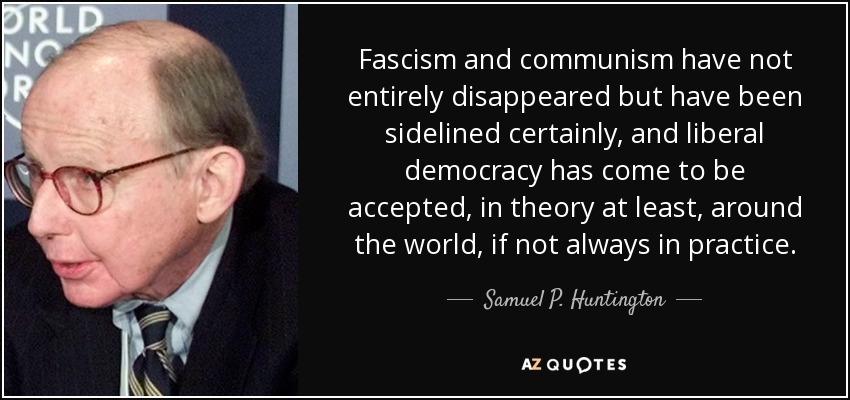
Fascism and communism have not entirely disappeared but have been sidelined certainly, and liberal democracy has come to be accepted, in theory at least, around the world, if not always in practice.
When you mention the word ideology, everyone has communism in the back of their minds, which was an entirely well formulated ideology and statement of belief. You read the Communist Manifesto and you know what the core of it is.
Two significant developments in the past several decades have been the collapse of communism as an ideology and the general acceptance, in rhetoric, if not practice, of liberal democracy.
A revolution is already taking place in India. Things are changing here already - peacefully and democratically. There's no danger of communism. There would be if we had a rightist government instead of mine.
If they were going to go to London or to the UK to find out how health care is, national health care doesn't work, all they have to do is go to the Soviet Union to find out how communism and socialism didn't work, but it hasn't dissuaded them from trying it here because they think the only thing that hasn't happened is the right people haven't tried it with the proper funding.
I think what happened with 9/11 is that people sort of felt that it came from nowhere. Whereas I think now we understand the roots are very deep. I say it's like revolutionary Communism, something that is going to have to be knocked out over a very long period of time. This strain of extremism continues to be very strong, whether it's in Afghanistan, or Somalia or Yemen, or any of these places.
I think it's pretty classic if you look at the way entertainment reflects the country's status. There was a reason in the '50s when communism was bubbling that there were a million zombie movies. Because that is the direct allocation. So for the last two years we've been hearing, "Make America great again." People go, "Well, America was never great." What do you mean? What you mean is that they want to look back in history. And so I think it's only natural for entertainment to reflect that.
At the higher stage of communism, when the productive forces will be greatly developed and the principle "from each according to his ability, to each according to his needs" will be practised, personal interests will be acknowledged still more and more personal needs will be satisfied.
We must pay close attention to those with another imagination: an imagination outside of capitalism, as well as communism. We will soon have to admit that those people, like the millions of indigenous people fighting to prevent the takeover of their lands and the destruction of their environment - the people who still know the secrets of sustainable living - are not relics of the past, but the guides to our future.
Communism is something that comes from the classics of Marxism that talked of a modern society we should aspire to. One that is truly fair where relations of monetary exchange are not the priority but rather one where peoples' needs could be satisfied.
The classics of Marxism talked of communism as a society to which a modern society should aspire, a society truly fair, where the relations of monetary exchange were not the priority but one wher the people's needs could be satisfied, and where people would not be worth more according to how much monetary wealth they acquired. Instead their value would be based on their contribution to society as a whole. It would be a society without class that would accept people based on their capabilities and their potential to contribute to that society.
Under communism, no one would be living in marginal conditions as they do under capitalism today and where the greatest part of humanity lives.
Communism is an aspiration, an aspiration is an ideal, a dream, a longing of something that would be perfect, but hard to build because it has to clash with human nature and against the egotism of humans and the egotism of the elites which usually try to guarantee their own interests above those of their nations and of their own people. But they are the ones that prevail because they have the economic power, the political power and the military power.
Now, we're used to thinking of communism as being once-upon-a-time-all-things-were-owned-in-common, maybe-someday-this-will-come-again. And people agree that there is a sort of epic narrative going on here. I think we should just throw this narrative out, it's irrelevant anyway, and who cares who owns things? I don't. You know, we all own the White House. So what? I still can't go in, right?
We have seen many instances where the free world didn't seem to understand the nature of evil or the battle against evil in their time. We've watched Nazism and fascism and imperial Japan and communism and totalitarianism, and now it seems to be we're all battling against terrorism.
I don't know the history of hating communism in America. I've always been interested in it, and I've thought about studying it in the past, but I've just looked into other topics first. That certainly sounds like a good topic that we could do on the show. I think it would be really interesting. We would just need to spend a lot of time researching it, getting into it, running down that topic. So I'll take that as a really good pitch for a future episode.
Socialism and Communism don't work, but neither does straightforward capitalism. We've got to get a new way of thinking and working. We blew it so there was good and bad about the celtic tiger. But we're tiny. There's four million in the country, do you know what I mean? We're tiny. Four million in a country, how many is in New York? Seven? Ten? But we're strong, so hopefully we pull through.
The American press exists for one purpose only, and that is to convince Americans that they are living in the greatest and most envied country in the history of the world. The Press tells the American people how awful every other country is and how wonderful the United States is and how evil communism is and how happy they should be to have freedom to buy seven different sorts of detergent.
You cannot bring about prosperity by discouraging thrift. You cannot help small men by tearing down big men. You cannot strengthen the weak by weakening the strong. You cannot lift the wage-earner by pulling down the wage-payer. You cannot help the poor man by destroying the rich. You cannot keep out of trouble by spending
Communists have become bureaucrats. If anything will destroy us, it is this.
There is a serious tendency towards capitalism among the well-to-do peasants. This tendency will become rampant if we in the slightest way neglect political work among the peasants during the co-operative movement and for a very long period after.
The agricultural co-operative movement has been a severe ideological and political struggle from the very beginning. No cooperative can be established without going through such a struggle. Before a brand-new social system can be built on the site of the old, the site must be swept clean. Invariably, remnants of old ideas reflecting the old system remain in people's minds for a long time, and they do not easily give way. After a co-operative is established, it must go through many more struggles before it can be consolidated. Even then, the moment it relaxes its efforts it may collapse.
By over-all planning, we mean planning which takes into consideration the interests of the 600 million people of our country. In drawing up plans, handling affairs or thinking over problems, we must proceed from the fact that China has a population of 600 million people, and we must never forget this fact.
The Communists claim that they liberated the Russian people. Yet, when the Great Patriotic War began, these same Russians greeted their foreign invaders with tears, with flowers and with enthusiastic hospitality. What can have brought them to the point at which they would greet even Hitler as their saviour and liberator?
It seems strangely difficult for some to realize that here in Asia is where the Communist conspirators have elected to make their play for global conquest, and that we have joined the issue thus raised on the battlefield; that here we fight Europe's war with arms while the diplomats there still fight it with words; that if we lose the war to communism in Asia the fall of Europe is inevitable, win it and Europe most probably would avoid war and yet preserve freedom. As you pointed out, we must win. There is no substitute for victory.
Follow AzQuotes on Facebook, Twitter and Google+. Every day we present the best quotes! Improve yourself, find your inspiration, share with friends
or simply: