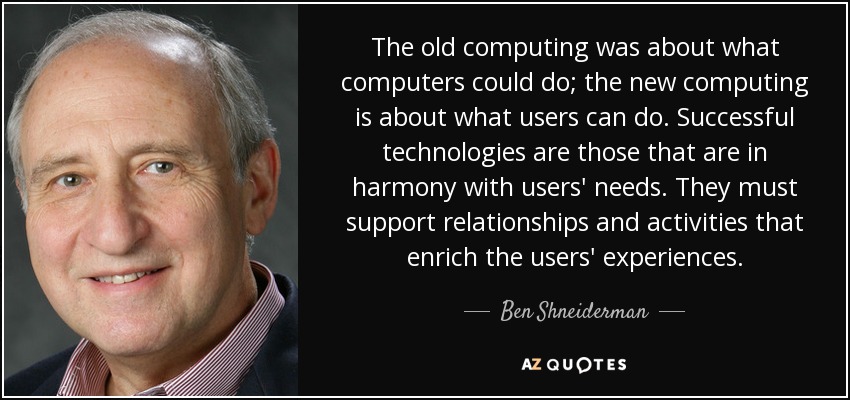
The old computing was about what computers could do; the new computing is about what users can do. Successful technologies are those that are in harmony with users' needs. They must support relationships and activities that enrich the users' experiences.
Persuading through Simplifying - Using computing technology to reduce complex behavior to simple tasks increases the benefit/cost ratio of the behavior and influences users to perform the behavior.
I think computing power is ready to do 3D justice. It was great for shooters and racing games in the past, but I didn't think it was right for strategy games.
Cloud computing is actually a spectrum of things complementing one another and building on a foundation of sharing. Inherent dualities in the cloud computing phenomenon are spawning divergent strategies for cloud computing success. The public cloud, hybrid clouds, and private clouds now dot the landscape of IT based solutions. Because of that, the basic issues have moved from 'what is cloud' to 'how will cloud projects evolve'.
The infrastructure of today's computing environment is for good or ill structured around the Windows operating system. Can you get around that? Yes you can, but you have to work harder to do that and most individuals and most corporations are not going to make that extra effort.
Personal computing today is a rich ecosystem encompassing massive PC-based data centers, notebook and Tablet PCs, handheld devices, and smart cell phones. It has expanded from the desktop and the data center to wherever people need it - at their desks, in a meeting, on the road or even in the air.
At every juncture, advanced tools have been the key to a new wave of applications, and each wave of applications has been key to driving computing to the next level.
We don't have enough parallel universes to allow all uses of all junction types - in the absence of quantum computing the combinatorics are not in our favor.
What do you think will be the biggest problem in computing in the 90's? There are only 17,000 three-letter acronyms.
The computing scientist's main challenge is not to get confused by the complexities of his own making.
Such is modern computing: everything simple is made too complicated because it's easy to fiddle with; everything complicated stays complicated because it's hard to fix.
There's nothing in computing that can't be broken by another level of indirection.
In some far-off distant time, when the twentieth century history of primitive computing is just a murky memory, someone is likely to suppose that devices known as logic gates were named after the famous co-founder of Microsoft Corporation
I have discovered that there are two types of command interfaces in the world of computing: good interfaces and user interfaces.
Future is mobile computing - smartphones and tablets are just elements of it. The industry is on the verge of a whole new paradigm.
[Computing] is just a fabulous place for that, because it's a place where you don't have to be a Ph.D. or anything else. It's a place where you can still be an artisan. People are willing to pay you if you're any good at all, and you have plenty of time for screwing around.
Much of my work has come from being lazy. I didn't like writing programs, and so, when I was working on the IBM 701 (an early computer), writing programs for computing missile trajectories, I started work on a programming system to make it easier to write programs.
The human brain became large by natural selection (who knows why, but presumably for good cause). Yet surely most "things" now done by our brains, and essential both to our cultures and to our very survival, are epiphenomena of the computing power of this machine, not genetically grounded Darwinian entities created specifically by natural selection for their current function.
The Relativity theory, the copernican upheaval, or any great scientific convulsion, leaves a new landscape. There is a period of stunned dreariness; then people begin, antlike, the building of a new human world. They soon forget the last disturbance. But from these shocks they derive a slightly augmented vocabulary, a new blind spot in their vision, a few new blepharospasms or tics, and perhaps a revised method of computing time.
We are not the only avatars of humanity. Once our computing machines achieved self-consciousness, they became part of this design.
What's needed now are software technologies that interconnect computing systems, people and data to produce more rapid answers to the questions of science, and to help researchers use computation in the most effective manner.
We couldn't build quantum computers unless the universe were quantum and computing. We can build such machines because the universe is storing and processing information in the quantum realm. When we build quantum computers, we're hijacking that underlying computation in order to make it do things we want: little and/or/not calculations. We're hacking into the universe.
Genuinely ubiquitous computing spreads like warm Vaseline.
While I admire the insights of many of the people in the world of computing, I get this cold feeling that I speak a different language.
Hydrodynamics procreated complex analysis, partial differential equations, Lie groups and algebra theory, cohomology theory and scientific computing.
Follow AzQuotes on Facebook, Twitter and Google+. Every day we present the best quotes! Improve yourself, find your inspiration, share with friends
or simply: