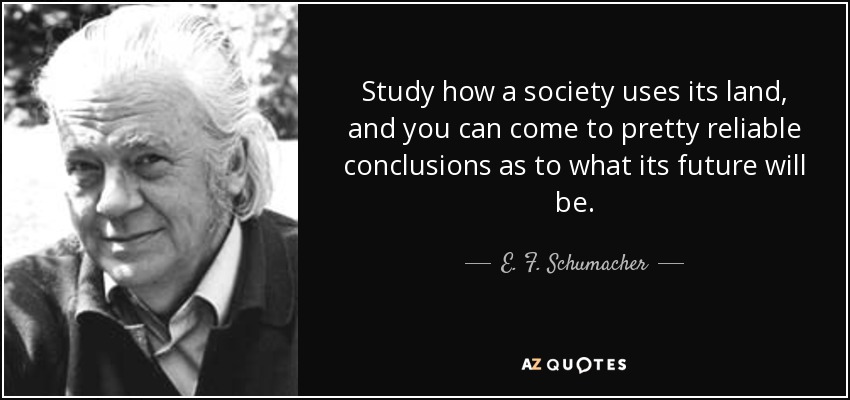
Study how a society uses its land, and you can come to pretty reliable conclusions as to what its future will be.
The Besicovitch style is architectural. He builds out of simply elements a delicate and complicated architectural structure, usually with a hierarchical plan, and then, when the building is finished, the completed structure leads by simple arguments to an unexpected conclusion. Every Besicovitch proof is a work of art, as carefully constructed as a Bach fugue.
No conclusion is more fully established, than the important fact of the total absence of any vestiges of the human species throughout the entire series of geological formations.
Think before you speak. Read before you think. This will give you something to think about that you didn't make up yourself - a wise move at any age, but most especially at seventeen, when you are in the greatest danger of coming to annoying conclusions.
Mathematics is ordinarily considered as producing precise and dependable results; but in the stock market the more elaborate and abstruse the mathematics the more uncertain and speculative are the conclusions we draw there from. Whenever calculus is brought in, or higher algebra, you could take it as a warning that the operator was trying to substitute theory for experience, and usually also to give to speculation the deceptive guise of investment.
The research in Ralph Keyes' The Quote Verifier is impressive, and each conclusion is like the solution to a real-life historical mystery. Who knew a reference book could be so entertaining?
James Watson summarizes the conclusion: “A predisposition does not a predetermination make.
But lack of evidence, if indeed evidence is lacking, is no grounds for atheism. No one thinks there is good evidence for the proposition that there are an even number of stars; but also, no one thinks the right conclusion to draw is that there are an uneven number of stars. The right conclusion would instead be agnosticism.
I think you have to be who you truly are and love who you are (to be beautiful). It's also important to be free and honest, enjoying life and having fun. In conclusion, ... I am who I am.
The elimination of horrible disease, the increase of the quality of lives (for humans and for animals) achieved through research using animals is so incalculably great that the argument of these critics, systematically pursued, establishes not their conclusion but its reverse: to refrain from using animals in biomedical research is, on utilitarian grounds, morally wrong.
Let us hear the conclusion of the whole matter: Fear God, and keep his commandments: for this is the whole duty of man. For God shall bring every work into judgment, with every secret thing, whether it be good, or whether it be evil.
Exegetical commentaries on the books of the Bible come in all shapes and sizes. Harold Hoehner's new volume on Ephesians has both a distinctive shape and a monumental size. Its value lies in its attention to detail and its full discussion of all relevant and disputed points. The volume will be an invaluable resource for scholars and students. Not all Hoehner's conclusions will command consent, but he has produced a stout and readable volume that all will turn to for guidance and help.
Use all your suffering for meditation, and soon you will come to know that the suffering disappears because the energy starts moving inwards. It is not moving to the periphery, to the suffering, you are not feeding your suffering. It looks illogical, but this is the whole conclusion of all the mystics of the world: that you feed your suffering and you enjoy it in a subtle way, you don't want to be well—there must be some investment in it.
A singular fact about modern war is that it takes charge. Once begun it has to be carried to its conclusion, and carrying it there sets in motion events that may be beyond men's control. Doing what has to be done to win, men perform acts that alter the very soil in which society's roots are nourished.
Faith is not a conclusion you reach...it's a journey you live.
Indeed, my conclusion from a lifetime of psychohistorical study of childhood and society is that the history of humanity is founded upon the abuse of children. Just as family therapists today find that child abuse often functions to hold families together as a way of solving their emotional problems, so, too, the routine assault of children has been society's most effective way of maintaining its collective emotional homeostasis.
Life offers its wisdom generously. Everything teaches. Not everyone learns. Life asks of us the same thing we have been asked in every class: "Stay awake." "Pay attention." But paying attention is no simple matter. It requires us not to be distracted by expectations, past experiences, labels, and masks. It asks that we not jump to early conclusions and that we remain open to surprise.
It is well to fetter the wings of our fancy and restrain its flights. It is quite possible we may have formed entirely erroneous ideas of what we actually see. The greenish gray patches may not be seas at all, nor the ruddy continents, solid land. Neither may the obscuring patches be clouds of vapor. Man is too quick at forming conclusions. Let him but indistinctly see a thing, or even be undecided as to whether he does actually see it and he will then and there set himself to theorizing, and build immense castles of conjecture on a foundation, of whose existence he is by no means certain.
We have concluded that the rocks here were once soaked in liquid water. It changed their texture, and it changed their chemistry. We've been able to read the tell-tale clues the water left behind, giving us confidence in that conclusion.
Why you were born and why you are living depend entirely on what you are getting out of this world and what you are giving to it. I cannot prove that this is a balance of mathematical perfection, but my own observation of life leads me to the conclusion that there is a very real friendship, both quantitatively and qualitatively, between what you contribute and what you get out of life.
She tended to be impatient with that sort of intellectual who, for all his brilliance, has never been able to arrive at the simple conclusion that to be reasonably happy you have to be reasonably good.
A much more radical conclusion . . . that, so far as I know, is shared by only a very few students of public choice [is]: that government employees or people who draw the bulk of their income from government by other means should be deprived of the vote . . . It is another example of the opening up of alternatives for investigation and the presentation of new conceivable policy options characteristic of public choice, rather than a policy that all its students favor.
Much of our adult morality, in books and out of them, has a stuffiness unworthy of childhood. Our grown-up conclusions often rest on perilously soft bottom.
History, insofar as it accustoms human beings to comprehend the whole of the past and to hasten forward with its conclusions into the far future, conceals the boundaries of birth and death, which enclose the life of the human being so narrowly and oppressively, and with a kind of optical illusion, expands his short existence into endless space, leading the individual imperceptibly over into humanity.
However, if you don't agree with their lifestyle, they spread the most hate. It is so hypocritical it makes my stomach turn. They need to learn how to respect others' opinions and not just jump to the conclusion that everyone who doesn't support homosexuality and gay marriage is homophobic.
Follow AzQuotes on Facebook, Twitter and Google+. Every day we present the best quotes! Improve yourself, find your inspiration, share with friends
or simply: