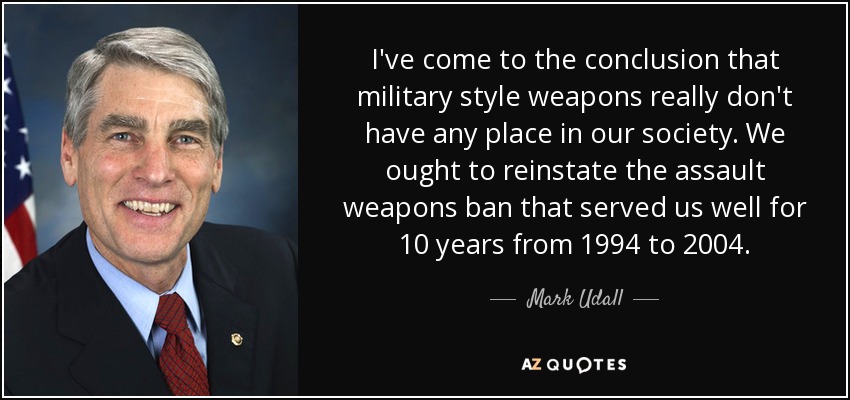
I've come to the conclusion that military style weapons really don't have any place in our society. We ought to reinstate the assault weapons ban that served us well for 10 years from 1994 to 2004.
I have always been a big advocate of tap water-not because I think it harmless but because the idea of purchasing water extracted from some remote watershed and then hauled halfway round the world bothers me. Drinking bottled water relieves people of their concern about ecological threats to the river they live by or to the basins of groundwater they live over. It's the same kind of thinking that leads some to the complacent conclusion that if things on earth get bad enough, well, we'll just blast off to a space station somewhere else.
I have epiphanies all the time, because I'm always thinking. I'm a thinker. I'm always writing poetry, I'm always coming to conclusions.
Suffice it to say, during the whole long day I came not to the conclusion, even once, that the southern slave, fed, clothed, whipped and protected by his master, is happier than the free colored citizen of the North. To that conclusion I have never since arrived.
If we believe that he [Jesus Christ]really countenanced the follies, the falsehoods, and the charlatanisms, which his biographers [writers of the New Testament]father upon him, and admit the misconstructions, interpolations, and theorizations of the fathers of the early and the fanatics of the latter ages, the conclusion would be irresistible by every sound mind that he was an impostor.
Experience is valuable only if it's imbued with meaning from which one can draw salient conclusions. Otherwise, experience becomes imprisoning.
Justice White's conclusion is perhaps correct, if one assumes that the task of a court of law is to plumb the intent of the particular Congress that enacted a particular provision. That methodology is not mine nor, I think, the one that courts have traditionally followed. It is our task, as I see it, not to enter the minds of the Members of Congress - who need have nothing in mind in order for their votes to be both lawful and effective - but rather to give fair and reasonable meaning to the text of the United States Code, adopted by various Congresses at various times.
If you look at those matters, you will come to the conclusion that the attitude of the United States of America is a threat to world peace.
Once again, I arrived at my usual conclusion: one must educate oneself.
I always had an existential crisis, trying to figure out ‘what does it all mean?’ I came to the conclusion that if we can advance the knowledge of the world, if we can expand the scope and scale of consciousness, then, we’re better able to ask the right questions and become more enlightened. That’s the only way to move forward.
Personally, I’ve gotten so that I now use a kind of two-track analysis. First, what are the factors that really govern the interests involved, rationally considered? And second, what are the subconscious influences where the brain at a subconscious level is automatically conclusions in various ways — which, by and large, are useful — but which often malfunction? One approach is rationality… And the other is to evaluate the psychological factors that cause subconscious conclusions — many of which are wrong.
The simpler the insight, the more profound the conclusion.
Coincident with the right of individual property under the provisions of our Government is the right of individual property. . . . When once the right of the individual to liberty and equality is admitted, there is no escape from the conclusion that he alone is entitled to the rewards of his own industry. Any other conclusion would necessarily imply either privilege or servitude.
As a Jew reading about Jesus, I thought, 'He's a pretty good guy.' It's the same conclusion Monty Python drew in 'Life of Brian' - if people actually live what he did, it would be a pretty good world. But Jesus and Christianity have a tenuous relationship at best.
Scientists and theologians can’t offer better than circular arguments, because there are no other kinds of arguments. Bible believers quote the Bible, and scientists quote other scientists. How do either scientists or theologians answer this question about the accuracy of their conclusions: “In reference to what?
Hey. Sometimes to conclusions.
I don't believe that anybody has come to a conclusion on why something is funny. It's funny because it's ridiculous and it's ridiculous for different reasons at different times.
If the world had two gods, it would surely go to ruin-this is the first premise. Now it is known that it has not gone to ruin-this is the second premise. From these premises the conclusion must of necessity follow, that is, the denial of two gods.
Talent jogs to conclusions to which Genius takes giant leaps.
This high proportion of history's decisive campaigns, the significance of which is enhanced by the comparative rarity of the direct approach, enforces the conclusion that the indirect is by far the most hopeful and economic form of strategy.
Astronomers who do not draw theistic or deistic conclusions are becoming rare, and even the few dissenters hint that the tide is against them. Geoffrey Burbidge, of the University of California at San Diego, complains that his fellow astronomers are rushing off to join 'the First Church of Christ of the Big Bang.'
Fighting is not the best way to win an argument. If carried to its ultimate conclusions, the old idea of "an eye for an eye" eventually ends in making everybody blind.
Always be suspicious of conclusions that reinforce uncritical hope and follow comforting traditions of Western thought.
I engaged - started engaging in yoga as a physical practice, but very quickly found out there was something broader to it, and that it was actually helpful for my pain, and started to get into meditation, started to study the Upanishads and the Bhagavad Gita and a lot of the scriptures associated with yoga, the Yoga Sutras, and very quickly came to this conclusion that this had a huge impact on my ability to lead, but, more importantly, the ability to control my sympathetic nervous system, which had a direct tie to the pain in my arm.
I came to the conclusion is that we have a very shallow view of human nature in the policy world. We're really good at talking about material things, really bad at talking about emotions, really good at stuff we can count, really bad at the deeper stuff that actually drives behavior.
Follow AzQuotes on Facebook, Twitter and Google+. Every day we present the best quotes! Improve yourself, find your inspiration, share with friends
or simply: