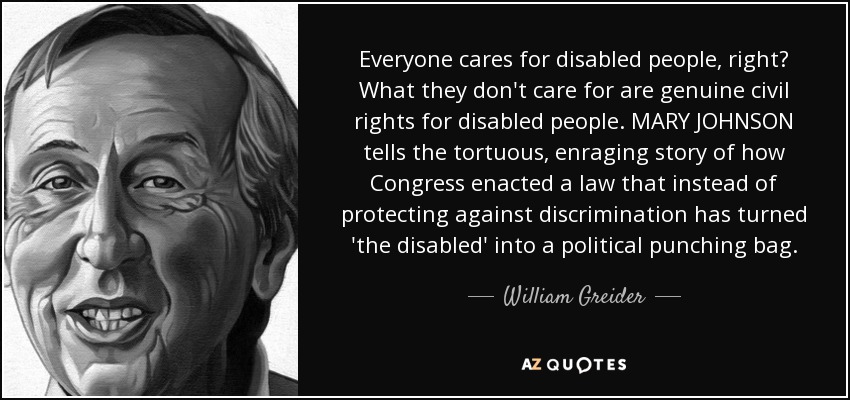
Everyone cares for disabled people, right? What they don't care for are genuine civil rights for disabled people. MARY JOHNSON tells the tortuous, enraging story of how Congress enacted a law that instead of protecting against discrimination has turned 'the disabled' into a political punching bag.
Congress would give the people what they wanted if the people knew what they wanted, and if Congress could give it to them.
Next time a man tells you talk is cheap, ask him if he knows how much a session of Congress costs.
A sturdy lad from New Hampshire or Vermont who in turn tries all the professions, who teams it, farms it, peddles, keeps a school,preaches, edits a newspaper, goes to Congress, buys a township, and so forth, in successive years, and always like a cat falls on his feet, is worth a hundred of these city dolls. He walks abreast with his days and feels no shame in not "studying a profession," for he does not postpone his life, but lives already.
I would a whole lot rather had Carly Fiorina over there doing our negotiation than John Kerry. Maybe we would've gotten a deal where we didn't give everything away. But the issue for us is to have a Congress that stands up and says not only no, but "Hell no" to this money going to a [Iran] regime that is going to use it for terror...
What are the moral implications? What do these people do when they have tremendous amounts of money? They use that money to perpetuate their own wealth and their own power. Every day, Congress works on behalf of big-money interests.
When you don't have as much debt as we do, we don't have to worry about having this debt ceiling fight every single year. And I really think people are getting sick of having this news cycle every single year from Congress, from the Washington bubble.
I think that Goldman Sachs and the Pentagon determine more of America's outcome then any president or any congress, that sounds a bit cynical, but I think I am right.
The function of traditional history is to create a citizenry that looks to the top - the president, Congress, the Supreme Court - to make the important decisions. That's what traditional history is all about: the laws that were passed, the decisions made by the court. So much of history is built around "the great men." All of that is very anti-democratic.
A man or a woman who serves the country with all his or her heart stands on par with the tallest Congress-man.
A bogus Congress register can never lead you to Swaraj any more than a paper boat can help you to sail across the Padma.
For me to dominate the Congress in spite of these fundamental differences is almost a species of violence which I must refrain from.
We had so many different presidents, including Jefferson, Jackson, Lincoln - there were other founders like Hamilton, Adams - who made it very clear that the courts can't make a law. The Constitution is expressly clear that that's a power reserved to Congress.
The Constitution, in addition to delegating certain enumerated powers to Congress, places whole areas outside the reach of Congress' regulatory authority. The First Amendment, for example, is fittingly celebrated for preventing Congress from "prohibiting the free exercise" of religion or "abridging the freedom of speech." The Second Amendment similarly appears to contain an express limitation on the government's authority.
In explaining the Constitution, James Madison, the acknowledged father of the Constitution, wrote in Federalist Paper 45: 'The powers delegated by the proposed Constitution to the Federal government are few and defined. Those which are to remain in the State governments are numerous and indefinite. The former will be exercised principally on external objects, as war, peach, negotiation, and foreign commerce.' Has the Constitution been amended to permit Congress to tax, spend and regulate as it pleases or have Americans said, 'To hell with the Constitution'?
The people can change Congress but only God can change the Supreme Court.
Most Americans, who think Congress has a right to do anything for which they can get a majority vote, ignore the clearly written constitutional restraints on Congress.
Once Congress establishes that one person can live at the expense of another, it pays for everyone to try to do so.
When Congress votes for all sorts of benefits, without voting for enough taxes to pay for them, they get the support of those who have been promised the benefits, without getting grief from the taxpayers. It's strictly win-win as far as the welfare-state politicians are concerned. But it is strictly lose-lose, big-time, for the country, as deficits skyrocket.
Could Congress really do its work if it held its sessions by teleconferencing? Could the Supreme Court? Nothing can replace the spark of intelligence that travels from person to person at meetings.
Too much screaming in Congress. Too much screaming everywhere.
Do you remember the good ol' days when Congress was only unsafe if you were an intern.
Assimilating college sports into the university would prevent them from being run as autonomies or fiefdoms. And you don't need an NCAA bylaw or an act of Congress to do it - just an active, empowered faculty and some administrators with backbone.
Glossed over the disastrous war and its multibillion-dollar price tag and implied again that our presence in Iraq is somehow improving the situation in that chaotic and turbulent country. The Congress must stand up against Bush's plan to escalate the war.
Anybody that brings up amnesty in this Congress, we need to just take the scarlet 'A' for amnesty and pin it on them.
Follow AzQuotes on Facebook, Twitter and Google+. Every day we present the best quotes! Improve yourself, find your inspiration, share with friends
or simply: