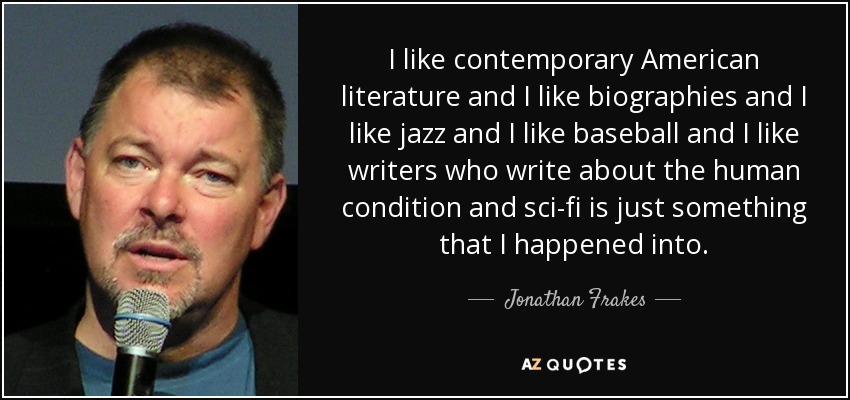
I like contemporary American literature and I like biographies and I like jazz and I like baseball and I like writers who write about the human condition and sci-fi is just something that I happened into.
The contemporary authors I most admire are Nick Hornby and Jonathan Tropper.
When I was doing theater for all those years in New York, I did a lot of classical theater, wearing big corsets and big dresses and doing dialects. It's interesting that once I moved to TV, I'm playing these scrappy, contemporary toughies.
I don't know what issues concerning identity have helped contemporary fiction evolve to what it is now. All I know is that the range of voices that are being heard and published is a lot more diverse than when I was coming up.
Now I'm writing about contemporary Los Angeles from memory. My process was to hang out, observe, research what I was writing about, and almost immediately go back to my office and write those sections. So it was a very close transfer between observation and writing.
Certainly being in California has encouraged a sustained commitment to rethinking the nature, purposes, and relevance of the contemporary arts, specifically music, for a society which by and large seems to manage quite well without them.
Contemporary architects tend to impose modernity on something. There is a certain concern for history but it’s not very deep. I understand that time has changed, we have evolved. But I don’t want to forget the beginning. A lasting architecture has to have roots.
A lot of men do have a fear of my ultra-femininity. Sometimes people say I look like a drag queen, that I look scary, but I think that's a fear of my confidence. Most women in contemporary culture pare down their femininity, so there's a slight androgyny about them, and I think men have got used to seeing that.
It's so funny being a Christian musician. It always scares me when people think so highly of Christian music, Contemporary Christian music especially. Because I kinda go, I know a lot of us, and we don't know jack about anything. Not that I don't want you to buy our records and come to our concerts. I sure do. But you should come for entertainment. If you really want spiritual nourishment, you should go to church... you should read the Scriptures.
I read everything. I've always got a book on the go and I'm really nerdy about it, I get through books and don't remember anything about them afterwards. But I read all sorts, from classic to contemporary.
I write 'by the seat of my pants.' I love to do research. I am inspired by contemporary writers and contemporary events. I live in the real world.
I enjoy meeting not only contemporary children, but yesterday's children as well. It's nice to talk about the experiences we shared, they tell me, 'You were a good friend.' That's the warmest part.
Literacy is part of everyday social practice - it mediates all aspects of everyday life. Literacy is always part of something else - we are always doing something with it. Its what we choose to do with it that is important. There are a range of contemporary literacies available to us - while print literacy was the first mass media, it is now one of the mass media.
I don't think my looks are modern. I always imagined I'd end up doing Chekhov, Ibsen and Shakespeare all my life and never play a contemporary character.
There's a phrase in Shakespeare: he refers to it as the 'hidden imposthume', and this idea of a hidden swelling is seminal to cancer. But even in more contemporary writing it's called 'the big C'.
I went to the University/Resident Theatre Association auditions. Deans come and watch you in this theater. You have three minutes, and you have to do two contrasting monologues - at that time, this is 2003 - one classical and one contemporary.
In Australia I was seen as somebody who did only very modern, contemporary stuff. Then as soon as I went overseas I did two period pieces so it was like, 'When are you going to get out of the corsets?' And I was thinking I just got into them!
Before I started LimoLand, I mainly bought my clothes in Harlem, where I found clothing my size in fun colors. I still like to go there and see the vibrancy and colors of the neighborhood. I am also very influenced by the colors of my contemporary African and Japanese art collections.
I hope I'm not implying role of contemporary poet for myself, although there's a kind of resonant paradigm. It's traditionally a difficult role.
Audrey Auld is a great singer songwriter. She holds a unique place in contemporary Americana/Roots music. I believe that this uniqueness is largely due to the fact that she is Australian. This affords her a totally different attitude as an artist than traditional American contributors to this genre. Audrey is one of the most honest original artists I know.
To Forget Venice is a tour de force of ventriloquism. Elegant, contemporary, and wry, the voice at its center is also capable of disarming flights of imagination as it enters and inhabits other lives across time and gender. The glittering, fetid city emerges as a complex metaphor for the human heart’s simultaneous tenderness and capacity for cruelty, its ‘silver glow / a local specialty: filth / disguised as ornament.’ This Venice is unforgettable.
There is hardly an aspect of contemporary history more irritating and mystifying than the fact that of all the great unsolved political questions of our century, it should have been this seemingly small and unimportant Jewish problem that had the dubious honor of setting the whole infernal machine in motion.
History is contemporary. Your understanding of history confirms what you think of the present. It's not neutral. I would be very surprised if people with a different view of the present, don't take issue with my view of the past. I just hope that people deal with the content of the film.
All our contemporary philosophers perhaps without knowing it are looking through eyeglasses that Baruch Spinoza polished. Spinoza was a philosopher who earned his livelihood by grinding lenses.
The grand delusion of contemporary liberals is that they have both the right and the ability to move their fellow creatures around like blocks of wood - and that the end results will be no different than if people had voluntarily chosen the same action
Follow AzQuotes on Facebook, Twitter and Google+. Every day we present the best quotes! Improve yourself, find your inspiration, share with friends
or simply: