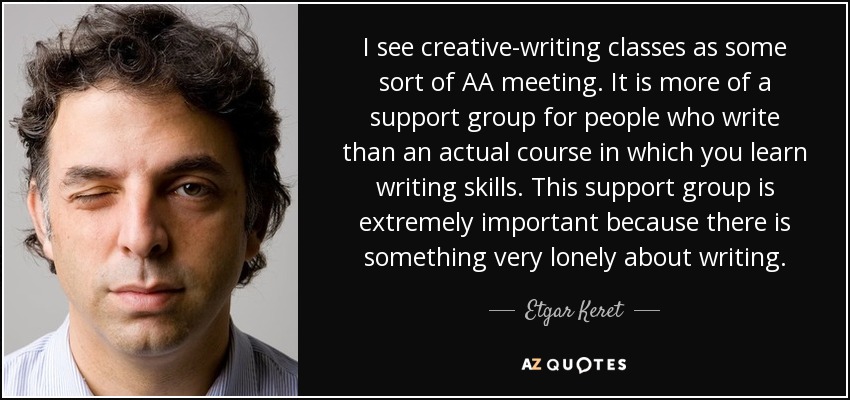
I see creative-writing classes as some sort of AA meeting. It is more of a support group for people who write than an actual course in which you learn writing skills. This support group is extremely important because there is something very lonely about writing.
I didn't do a masters in creative writing until I was 26, which is quite old, and then I found myself in New York and I needed money, so I started working full time as an editor.
Now that I'm staring down the barrel of the last act of my life, I'm less excited about control and solo effort, and I resent the way the business aspects interfere with my space for creative writing.
I'm often asked how I write books, but I don't think my approach is suitable for everyone. If I walked into a creative writing class, all I could say to them was 'I tend to make it up as I go along.' I'm not sure that's brilliant advice.
I was an A student and I liked creative writing.
I was a journalism major, and I would take creative writing classes as part of that, but I would also look for opportunities to write stories for some of my other classes. So for my course in Scandinavian history, I asked if I could write historical fiction instead of term papers. Sometimes they’d say yes.
Back in the days when American billboard advertising was in flower [said Hemingway], there were two slogans that I always rated above all others: the old Cremo Cigar ad that proclaimed, Spit Is a Horrid Word-but Worse on the end of Your Cigar, and Drink Schlitz in Brown Bottles and Avoid that Skunk Taste. You don't get creative writing like that any more.
These kids will make you cry, laugh... They make you feel all kinds of emotions through their writings and they share a lot with me, as an instructor, that they might not normally share with other people because they are young artists and they need a platform for pulling that stuff out.
Writing has laws of perspective, of light and shade just as painting does, or music. If you are born knowing them, fine. If not, learn them. Then rearrange the rules to suit yourself.
A creative writing workshop will contain students whose ambitions and abilities, whose conceptions of literature itself, are so diverse that what they have in common - the desire to write - could almost be considered meaningless.
Literature flourishes best when it is half a trade and half an art.
A man will turn over half a library to make one book.
A great writer reveals the truth even when he or she does not wish to.
Start dating someone who is funny, someone who has what in high school you called a "really great sense of humor" and what now your creative writing class calls "self-contempt giving rise to comic form." Write down all of his jokes, but don't tell him you are doing this. Make up anagrams of his old girlfriend's name and name all of your socially handicapped characters with them. Tell him his old girlfriend is in all of your stories and then watch how funny he can be, see what a really great sense of humor he can have.
The best style is the style you don't notice.
A critic can only review the book he has read, not the one which the writer wrote.
Every great and original writer, in proportion as he is great and original, must himself create the taste by which he is to be relished.
Creative Writing was not a form of psychotherapy, in ways both sublime and ridiculuous, it clearly was, precisely that.
The act of writing itself is much like the construction of a mirror made of words. Looking at certain illuminated corners of or cracks within the mirror, the author can see fragments of an objective reality that comprise the physical universe, social communities, political dynamics, and other facets of human existence. Looking in certain other corners of the same mirror, he or she may experience glimpses of a True Self sheltered deftly behind a mask of public proprieties.
There is then creative reading as well as creative writing. When the mind is braced by labor and invention, the page of whatever book we read becomes luminous with manifold allusion. Every sentence is doubly significant, and the sense of our author is as broad as the world.
A hero knows it takes hard work and a long time to get published; a fool thinks it should happen immediately, because he thinks heÕs a hero already.
Here’s what I learned: First thing in the morning, before I have drowned myself in coffee, while I still have that sleepy brain I used to believe was useless — that is the best brain for creative writing. Words come pouring out easily while my head still feels as if it is full of ground fog, wrapped in flannel and gauze, and surrounded by a hive of humming, velvety sleep bees.
Given the devaluation of literature and of the study of foreign languages per se in the United States, as well as the preponderance of theory over text in graduate literature studies, creative writing programs keep literature courses populated.
When I write what publishers call 'fantasy' I am writing in what I think is the most important tradition of fiction: starting with Homer and up through Shakespeare and Milton, the most important themes to tackle are those of the mythopoeic domain, tales of the body and mind seen through a temperament and a cosmos divorced from current reality so what is said can be more clear.
Most writers - poets in especial - prefer having it understood that they compose by a species of fine frenzy - an ecstatic intuition - and would positively shudder at letting the public take a peep behind the scenes.
Follow AzQuotes on Facebook, Twitter and Google+. Every day we present the best quotes! Improve yourself, find your inspiration, share with friends
or simply: