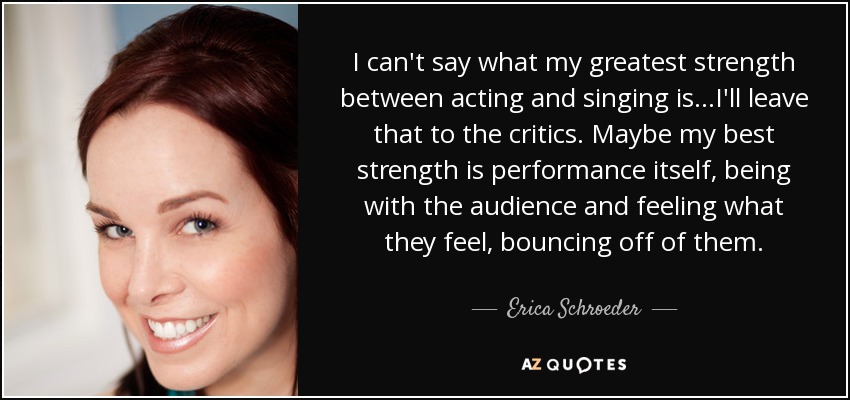
I can't say what my greatest strength between acting and singing is...I'll leave that to the critics. Maybe my best strength is performance itself, being with the audience and feeling what they feel, bouncing off of them.
I first came across her [Bae Suah] when I read some elderly male critic castigating her for 'doing violence to the Korean language', which of course was catnip to me, especially as I'd recently discovered Lispector doing pretty much the same to Portuguese.
I've been among their critics [MBA programs]. Much of what I've seen in business schools is quite non-rigorous. Anecdotal histories are stretched to illustrate favored slogans. Evidence of their effectiveness is similarly anecdotal.
Along with my peers, I gripe about the increasing number of superhero films, and I'm sad that so many critics so uncritically use words like franchise, which should be reserved for your local Burger King.
The critics and hardcore music fans, those are the people you have to get to first, so we're really happy about it.
The job of the critic, as it might have been conceived in the 1950's or 1960's, was some kind of role of moral arbiter for people, not a huge number of people, but people who were, you know, fairly educated, well-placed people.
Frank Rich, Paul Krugman, Maureen Dowd, a whole host of brilliant, courageous critics say all kinds of things, and he [Barack Obama] treats them with respect. They get invited to the White House. I say the same thing, he talks to me like I'm a Cub Scout.
I'm praying for Barack Obama to stay on the tightrope because I want to fight his right-wing critics. I want to down I want to ensure they don't lie about him. I'm sure they don't demonize him, and too much of that is going on. So I don't want my critiques to be in any way confused with the right-wing critiques, even though I'll fight for the right wing to be wrong in that regard.
If you're a critic of the rulers of the United States, you are either demonized, or you are trivialized by the press, and they do a very good job of making you into a non-person or a ridiculous person.
My critics always forget to mention that I was democratically elected, the others were not. Everyone in Uganda can challenge me, everyone can vote, the elections are free. Not many countries have achieved what we did.
I think the answer has to do with the fact that [Louis D.] Brandeis was a consistent critic of bigness in business and in government.
[Louis] Brandeis, like [Tomas] Jefferson, is an equal opportunity critic of bigness. And he, like Jefferson, sees American history as this incredible clash between small producers, farmers, and small business people on the one hand, and wicked oligarchs and financiers and monopolists on the other.
I'm an actor and a writer and a showrunner and I edit my show. ... I have a job that three people usually have, and I have it in one person. And the idea that the critic thought that I had this excess of time for which I could go to, like, panels or write essays was just so laughable to me.
I think as women, you know, if you are considered a pioneer in these things, you can get really distracted by these other things - you know, people's demands of you reflecting on your otherness. And for this white critic to say, "I don't understand why she doesn't do that" - and you're like, "It's because I'm running a show on a major network and I want the show to continue" - and to sort of guilt me.
Unfortunately, cinema critics are very few in America, 400-500 people, but there are more critics of Iran.
I have cultivated a little crew of people whose opinions I understand. It's like the way you'd follow certain film critics because you know what their criteria are, and you may not agree with them, but you can glean from their opinion how you will feel about a film.
I think that once you've produced a conformist, a totally conformist society, a society in which there were no critics, that would in fact be an exact equivalent of the totalitarian societies against which we are supposed to be fighting in a cold war.
I'm not a critic so much of my own writing. People must make up their own minds over that.
I put all of my energy into building the game and giving women opportunities and, to put everything into it and then to be deemed selfish or not a good team player or outspoken, it's been hard. But at the same time, I'm going to get the critics and I know that.
I'm my own worst critic and harshest critic and I just want to put honest music out there.
I don't even want to discuss Flashdance. I'm no critic, but that's an interesting phenomenon, that picture.
I can be negatively criticised, but this is actually a positive thing, especially if the critic is smart, and helpful. I am very attentive to critics, they let me go ahead and push myself harder to continue.
There is no way that my mother hasn't influenced my career. She's my first critic. She's my best critic. She has the best instincts from writing to style to editing, to the visual elements of my career.
Having said that, people here [in Mecklenburg-Western Pomerania] watch the TV. And they hear critics of her policies talk about how more than a million people coming here last year from various war-torn countries and also seeking economic help are going to, like, destroy the fabric of the society.
I don't praise my people. I am their greatest critic.
Follow AzQuotes on Facebook, Twitter and Google+. Every day we present the best quotes! Improve yourself, find your inspiration, share with friends
or simply: