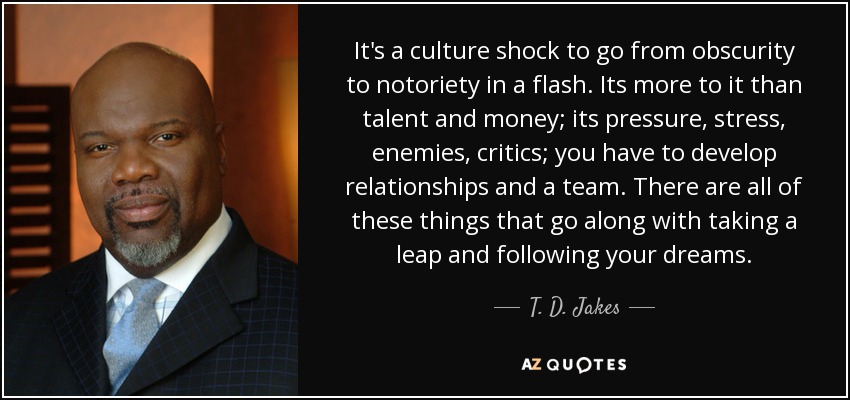
It's a culture shock to go from obscurity to notoriety in a flash. Its more to it than talent and money; its pressure, stress, enemies, critics; you have to develop relationships and a team. There are all of these things that go along with taking a leap and following your dreams.
Stephen King writes mass fiction but gets reviewed by the New York Times and writes for the New Yorker. Critics say to me, "Shut up and enjoy your money," and I think, OK, I'll shut up and enjoy my money, but why does Stephen King get to enjoy his money and get reviewed on the cover of the New York Times Sunday Book Review?
One can never expect critics to behave in any predictable way.
As I look back, I understand what [the record company] was getting at. They were trying to market a record and make it as commercially acceptable as possible. It hurt me and my credibility with critics.
In December of 2002, the late Richard Corliss, a respected movie critic with a long and illustrious career, wrote an embarrassing letter of support for the invasion and occupation of Iraq and Afghanistan in the guise of a Time magazine review of Peter Jackson's The Two Towers.
I think I have to expand my creativity a bit, because it's difficult for critics to be, "Oh, this person writes their own lyrics and sometimes writes their own beats and sometimes makes her own videos." They funnel me through, "Oh, is it as good as blah-blah's record, which has had 50 million writers on it?"
Critics of Consequentialism have often assumed that hedonism (or preference-satisfaction) must be the theory of the good, that the deontic principle must be maximizing, and that the principle should be applied to individual acts. Indeed, this version is often called "classical utilitarianism" and attributed to Bentham and sometimes even to Mill. Rather than a "classical" view it is a recent construction foisted on to the tradition.
What most forms of Consequentialism cannot do is require us to act in such a way as to make the world worse, yet many of the objections to Consequentialism purport to show that Consequentialism requires us to make the world a stinking, bloody mess. The ubiquity of these kinds of arguments shows you just how unseriously many of the critics take Consequentialism.
Most of those who spend their lives as critics secretly wish they'd be considered important enough for someone to bother criticizing them.
I think that 99% of the snipers who take shots at me from electronic foxholes also realize they could never withstand the sort of public disparagement, nor the revelation of so many personal details, that I've endured for years and still remain as impenitent, obnoxious, and ready to argue all critics into the dirt as I am. I think this also jacks up their hatred level, because they realize they'd never be so strong-willed.
I don't care what critics and other people think.
Everything I learned and didn't do in New York I would put into place here in the London West Hollywood. It's fascinating, when you look at the critics' reviews, and we had a great one in the New York Observer and all that, and then the New York Times came and it was a devastation; two stars out of four. They said that I played safe because it wasn't fireworks. Then they judged the persona over the substance that was on the plate.
When I hear my first album today I hear myself reading my rhymes but I'm my worst critic.
Malcolm's X objective was actually to reingratiate himself within the Nation of Islam, that because he had emerged by the early 1960s as a very prominent figure outside of the N.O.I., there were critics within the organization that were saying to the patriarch of the N.O.I., the Honorable Elijah Mohammad, that Malcolm planned to take over the organization, which was not true.
The closeness [of Rex Tillerson] to [Vladimir] Putin will be one of the unifying issues between the Republican critics and Democratic critics.
Trump is what Obama critics think Obama is: Someone who's focused on symbolism rather than substance.
I was at the New York Film Critics Circle Awards one year - they called me up when somebody canceled two days before the thing, and asked me to present some awards. So I went, and one of the funniest film moments I've ever had was when they introduced the New York film critics. They all stood up - motley isn't the word for that group. Everybody had some sort of vision problem, some sort of damage - I had to bury myself in my napkin.
I know from the past, critics often say my films don't have any plot, that kind of thing. I'm used to being told, "Yeah, it's slow and has no plot."
[Sacrifice of Isaac] is a major theme of the so-called Elohist [one authorial strand in the Pentateuch]. It is marked by all of his linguistic characteristics, and so on. We cannot determine what is historical and what isn't. As literary critics, we would understand the importance of this for understanding life, destiny. But the historical question must be left with a question mark.
An important Italian critic once gave Fistful of Dollars a very bad review when it came out. Then he went to the university here [Rome] with Once Upon a Time in America. We showed it to 10,000 students. And while the man was speaking that day to the students, with me present, he said, "I have to state one thing. When I gave that review about Sergio's films, I should have taken into account that on Sergio Leone's passport, there should not be written whether the nationality is Italian or anything else. What should be written is: 'Nationality: Cinema.' "
I have been attacked by media critics and just critics of my own for years. And that, unfortunately, is part of the job in 2016 America. I was used to that. And I've developed a thick skin.
Some [people] may be "servants of the power structure," but that has to be shown. I think it often can be shown, but the burden of proof is on the critic who puts forth that thesis in particular cases.
Those of us and so many other stalwart critics and opponents and questioners and dissidents in conservative media were attacked for doing what those people in the mainstream media should have been doing. Do your job! Subject these political candidates to the same amount of scrutiny that you are now trying to compensate for with the incoming Trump administration!
It's obvious to say you can't please everybody and there are always going to be people who are going to say, I just don't like you. There's nothing I can do about that. I'm aware, probably much more aware than my harshest critic, of what my own problems are with my acting ability. I'm very, very critical of myself, and I don't ever want to not be.
You're happy that people are seeing your work. As for the critics, it really hurts when they knock you.
Follow AzQuotes on Facebook, Twitter and Google+. Every day we present the best quotes! Improve yourself, find your inspiration, share with friends
or simply: