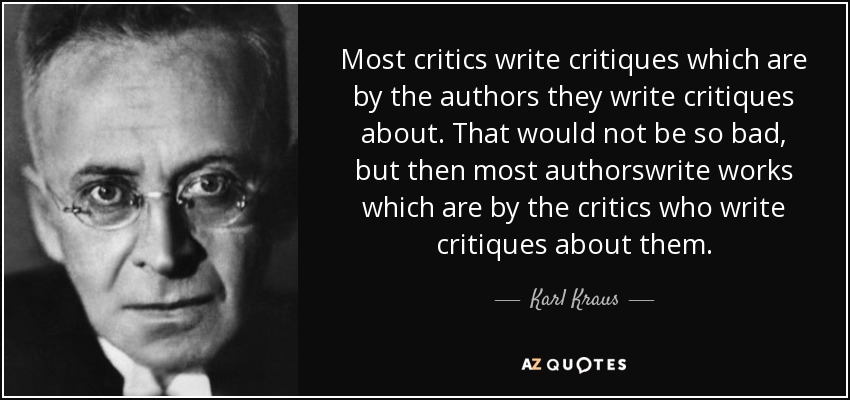
Most critics write critiques which are by the authors they write critiques about. That would not be so bad, but then most authorswrite works which are by the critics who write critiques about them.
I think the Buddha presents an image of someone who believes in self-control. I think he's offering, perhaps, a critique of the romantic idea of the passions being this wonderful source of life or vitality that define you or your writing.
I think there is a legitimate critique of reformism, as a politics that is content with making small changes in society without asking for bigger and deeper changes. And revolutionary reforms, meaning actions that we take in small ways to make the world a better place and disrupt some of the ways that capitalism is reproduced.
I'm honest about expressing my opinions. At the same time, I'm diplomatic in how I do critique things if I have a negative response.
The thing we call critics are not really reviewers, they are not really critics. They don't have the discipline to write what we would term as critique - it's really just reviewers. They have a common man kind of taste. If you watch them overall, they are not different from the box-office. That's my view.
The pleasure of criticizing takes away from us the pleasure of being moved by some very fine things.
Clearly Democrats are not united in what is the critique of what we're doing there and what is the answer to what we do next. The difficulty of coming to a unified position is that for a lot of people who voted for it, they have to decide whether they can admit that they were misled.
Given currency by Jrgen Habermas in the late l980s, 'constitutional patriotism' has emerged as an appealing principle for post-national political allegiance. Jan-Werner Mller traces the long postwar history of the concept, takes honest account of the conservative critiques it has provoked, but proposes that it can serve as a robust norm for European Union citizenship. This is a profound meditation with real importance for contemporary political society.
Every intelligent painter carries the whole culture of modern painting in his head. It is his real subject, of which everything he paints in both an homage and a critique, and everything he says is a gloss.
What distinguishes [Afropolitans] is a willingness to complicate Africa – namely, to engage with, critique, and celebrate the parts of Africa that mean most to them. Perhaps what most typifies the Afropolitan consciousness is the refusal to oversimplify; the effort to understand what is ailing in Africa alongside the desire to honour what is wonderful, unique. Rather than essentialising the geographical entity, we seek to comprehend the cultural complexity; to honour the intellectual and spiritual legacy; and to sustain our parents’ cultures.
A new vision and understanding of something demands a new way of talking about it, for the old terminology gets in the way of this effort. Stubbornly entrenched behind the words coined by a particular conceptual orientation are its secrete prejudices. Any attempt to open out an adequately human vista onto the phenomena of undisturbed existence must include a critique of the most important idea of traditional biology, physiology, and psychology.
A modest critique of an age in which an actor is the President, in which fashion models are asked for their opinions, in which getting into a nightclub is seen as a significant human achievement.
Men=earthbound creatures, living in communities, endowed with common sense, sensus communis, a community sense; not autonomous, needing each other’s company even for thinking (“freedom of the pen”)=first part of the Critique of Judgment: aesthetic judgment.
Whenever convictions are not arrived at by direct contact with the world and the objects themselves, but indirectly through a critique of the opinions of others, the processes of thinking are impregnated with ressentiment. The establishment of "criteria" for testing the correctness of opinions then becomes the most important task. Genuine and fruitful criticism judges all opinions with reference to the object itself. Ressentiment criticism, on the contrary, accepts no "object" that has not stood the test of criticism
As far as the hate, it makes me laugh. Everybody is a critic. Every critic I've ever had, they weren't wrestlers. Every wrestler I've ever had critique me, they were always into my stuff or what I'm doing out there. For a non-wrestler, someone who doesn't even know how to lock up, and if we did lock up, they wouldn't know what to do, for them to critique any of us, it really does pop me.
My work is drawn to the political but avoids an agenda. There is no inherent critique or support.
Some guys that know me from when I was a kid say "My son, oh he's just like your father." It's just a natural part of our lives. But, within the music industry and within the industry of the critiques of music, where it becomes "Ziggy's music is not as good as Bob's music," I don't understand. But I don't really pay much attention to that because I'm just expressing myself.
I think it's important to have an experienced writer or editor critique your work to get it ready to pitch an agent.
We have to constantly critique imperialist white supremacist patriarchal culture because it is normalized by mass media and rendered unproblematic.
So long as human history continues, we will face the perennial challenge of realizing, maintaining and strengthening peace through dialogue, of making dialogue the sure and certain path to peace. We must uphold and proclaim this conviction without cease, whatever coldly knowing smiles or cynical critiques may greet us.
A critique is not a matter of saying that things are not right as they are. It is a matter of pointing out on what kinds of assumptions, what kinds of familiar, unchallenged, unconsidered modes of thought the practices that we accept rest.
Follow AzQuotes on Facebook, Twitter and Google+. Every day we present the best quotes! Improve yourself, find your inspiration, share with friends
or simply: