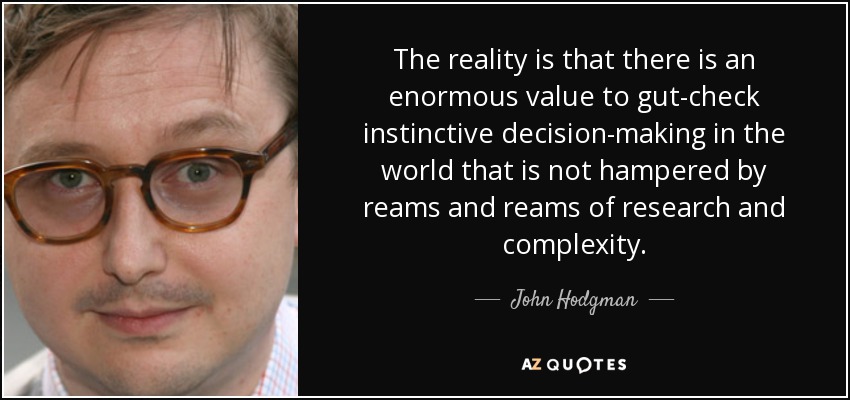
The reality is that there is an enormous value to gut-check instinctive decision-making in the world that is not hampered by reams and reams of research and complexity.
And they discovered something very interesting: when it comes to walking, most of the ant's thinking and decision-making is not in its brain at all. It's distributed. It's in its legs.
It’s better to make a decision, even the wrong one, than to be in limbo.
Every time you make a decision, you mess with someone's life.
When important decisions have to be taken, the natural anxiety to come to a right decision will often keep you awake. Nothing, however, is more conducive to healthful sleep than plenty of open air.
Don't undermine the science just because you don't like the economics. That's a dangerous slope, because the problem of course is you're not undermining just that, you're undermining the basis of rational decision-making in society.
I've passed on a lot of huge-money jobs. Money doesn't enter into the decision-making. If I do a big blockbuster, it's about how big an audience you'll get and where you can take them.
I think electric cars can help save Detroit. They reflect good decision-making, and there has been bad decision making in the auto industry for so long, in my view.
We should probably figure out a new word for this. For us, "open" means transparent, as in "open source" - you're not locked in to what the original creator did. And in our case "open" also means distributed decision making.
If human beings are losing every time, it doesn't matter whether they're losing to a conscious machine or an completely non conscious machine, they still lost. The singularity is about the quality of decision-making, which is not consciousness at all.
The strong point of American research universities is the manner in which trustees, presidents and other senior executives retain a considerable amount of decision-making authority while at the same time maintaining a culture of open exchange and participatory debate.
I think, for the good of the country and the fact that you don't want a question coming up every time there's a decision made, [Donald Trump] should basically take himself out of it and just be a passive participant in the sense that he has no decision-making, no involvement and no decisions get made separate from him. Which is the way the way it's done for more Cabinet offices. Or I think all Cabinet offices.
Balochistan, and to some extent Sindh too, has a general feeling that they are not part of the decision-making process in Pakistan and are ruled by a Punjabi dictatorship. There is a lot of exploitation of the rich resources [in Balochistan] which the locals are not gaining from. As long as this goes on, it is going to keep providing grounds for serious uprisings and insurgencies.
I think the greatest lesson I have just recently learned is how powerful the mind is, informing our decision making unknowingly.
I think all decision making is very instinctive, in the end.
There seems to be a concern about whether the public appreciation of science has eroded to a point where it has removed science from public debate and public decision making. Whether the public has come to regard evidence as optional.
We are nothing but the product of billions of years of molecules coming together and ratcheting up through natural selection, we are composed only of highways of fluids and chemicals sliding along roadways within billions of dancing cells, trillions of synaptic conversations hum in parallel, this vast egglike fabric of micron-thin circuitry runs algorithms undreamt of in modern science, and these neural programs give rise to our decision making, loves, desires, fears, and aspirations. That understanding would be a numinous experience, better than anything ever proposed in anyone's holy text.
In the military, we are also taught to only use one third of the available decision-making time, so that our subordinates have time to go through their own decision processes when they learn what we want them to do.
A fixed habit is supported by old, well-worn pathways in the brain. When you make conscious choices to change a habit, you create new pathways. At the same time, you strengthen the decision-making function of the cerebral cortex while diminishing the grip of the lower, instinctual brain. So without judging your habit, whether it feels like a good one or a bad one, take time to break the routine, automatic response that habit imposes.
The constant drive for campaign dollars has distorted decision-making in Washington, DC, to the point where our systems can no longer effectively address complex, long-term problems like the climate crisis. Which brings me to my other major concern - the short-term focus of capitalism. It distorts the allocation of resources and the decision-making processes of companies.
If you're going to decide to run a data-driven campaign, decision-making has to follow it.
You have to be willing to have the decision-making follow the data.
Decision-making power, whether it's on foreign affairs or domestic affairs, is concentrated in the White House in a reasonably small circle.
At one point, for example, [Donald Trump] argued that he knew much more than military leaders about the pursuit and defeat of ISIS. His assuredness of his own correctness seems also rooted in arrogance reflecting his fundamental insecurity. This insecurity and his belief in his own rightness, when combined with his success at making money, leads him to be self-reliant in his decision-making, which could result in his taking risks with threatening or using nuclear weapons.
I would say democracy once meant an organizational society and a state, in which the individual citizen is - feels - responsible, and acts responsibly, and participates in decision-making.
Follow AzQuotes on Facebook, Twitter and Google+. Every day we present the best quotes! Improve yourself, find your inspiration, share with friends
or simply: