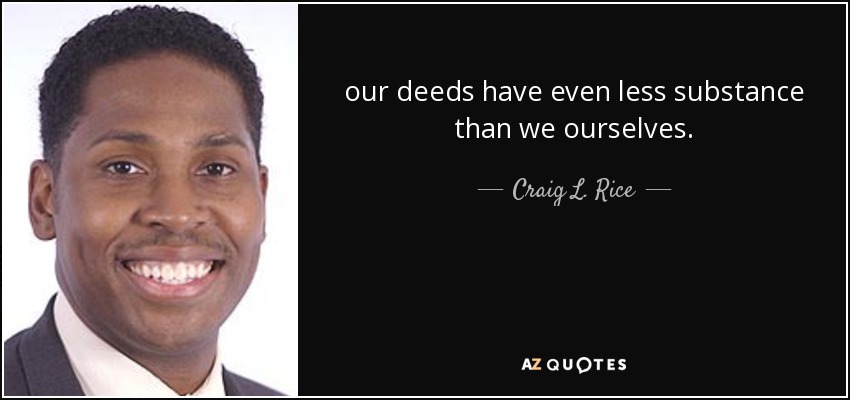
our deeds have even less substance than we ourselves.
Everything sells. Like integrity. Like democracy. Like truth. Like deeds.
Love is indicated by deeds (and not by words)
Now the greatest external good we should assume to be the thing which we offer as a tribute to the gods, and which is most coveted by men of high station, and is the prize awarded for the noblest deeds; and such a thing is honor, for honor is clearly the greatest of external goods.
It must not be supposed that happiness will demand many or great possessions; for self-sufficiency does not depend on excessive abundance, nor does moral conduct, and it is possible to perform noble deeds even without being ruler of land and sea: one can do virtuous acts with quite moderate resources. This may be clearly observed in experience: private citizens do not seem to be less but more given to doing virtuous actions than princes and potentates. It is sufficient then if moderate resources are forthcoming; for a life of virtuous activity will be essentially a happy life.
I have changed my definition of tragedy. I now think tragedy is not foul deeds done to a person (usually noble in some manner) but rather that tragedy is irresolvable conflict.
These are illusions of popular history which successful religion must promote: Evil men never prosper; only the brave deserve the fair; honesty is the best policy; actions speak louder than words; virtue always triumpths; a good deed is its own rewards; any bad human can be reformed; religious talismans protect one from demon possession; only females understand the ancient mysteries; the rich are doomed to unhappiness
When the mind once allows a doubt to gain entrance, the value of deeds performed grow less, their character changes, we forget the past and dread the future.
I would not sacrifice a single living mesquite tree for any book ever written. One square mile of living desert is worth a hundred 'great books' - and one brave deed is worth a thousand.
In marriage for example, you say 'Yes' on the day you get married, 'I do', but each day you implicitly if not explicitly, also say 'Yes', by every act that one performs in a marriage, one is saying 'Yes', making a cup of coffee for one's wife or husband is a form of saying 'Yes' to the marriage vow that one is continuing the marriage by affirming it in one's deeds. And exactly the same in the religious life.
One should not ascribe the evil deeds of individual leaders or political regimes to an innate fault of the Russian people and their country.
The Italians are wise before the deede, the Germanes in the deede, the French after the deede. [The Italians are wise before the deed, the Germens in the deed, the French after the deed.]
If one but tell a thing well, it moves on with undying voice, and over the fruitful earth and across the sea goes the bright gleam of noble deeds ever unquenchable.
I wonder, what's in a book while it's closed. Oh, I know it's full of letters printed on paper, but all the same, something must be happening, because as soon as I open it, there's a whole story with people I don't know yet and all kinds of adventures, deeds and battles. And sometimes there are storms at sea, or it takes you to strange cities and countries. All those things are somehow shut in a book. Of course you have to read it to find out. But it's already there, that's the funny thing. I just wish I knew how it could be.
Every deed has a seed. In other words, the deeds you choose to do in this lifetime create a seed for future generations.
Man is responsible not only for every deed, but also for every idle word and thought.
To triumph fully, evil needs two victories, not one. The first victory happens when an evil deed is perpetrated; the second victory, when evil is returned. After the first victory, evil would die if the second victory did not infuse it with new life.
A wife and a husband should be regarded as friends for the sake of Allaah. And that friendship is above material needs; each encouraging the other one to do good deeds, which are pleasing to Allaah.
Persuade me or prove to me that I am mistaken in thought or deed, and I will gladly change - for it is the truth I seek, and the truth never harmed anyone. Harm comes from persisting in error and clinging to ignorance.
Speak Thou in my words today, think in my thoughts, and work in all my deeds.
In that we say he [Christ] made whole the lame, the paralytic, and those born blind, we seem to say what is very similar to the deeds said to have been done by Esculapius.
If you set out to do a good deed, you may do a hundred small kindnesses on the way.
We are a free people; and now you have planted in our country the title deeds of our future slavery. You are neither god nor demon; who are you, then, to make slaves? Orou! You understand the language of these men, tell us all, as you have told me, what they have written on this sheet of metal: This country is ours. This country yours? And why? Because you have walked thereon? If a Tahitian landed one day on your shores, and scratched on one of your rocks or on the bark of your trees: This country belongs to the people of Tahiti - what would you think?
When you do things for others; don't expect your good deeds to be returned. Do it because you enjoy making someone's day.
Many deeds are done so as to forget another deed: there are also opiate activities. I exist so that another will be forgotten.
Follow AzQuotes on Facebook, Twitter and Google+. Every day we present the best quotes! Improve yourself, find your inspiration, share with friends
or simply: