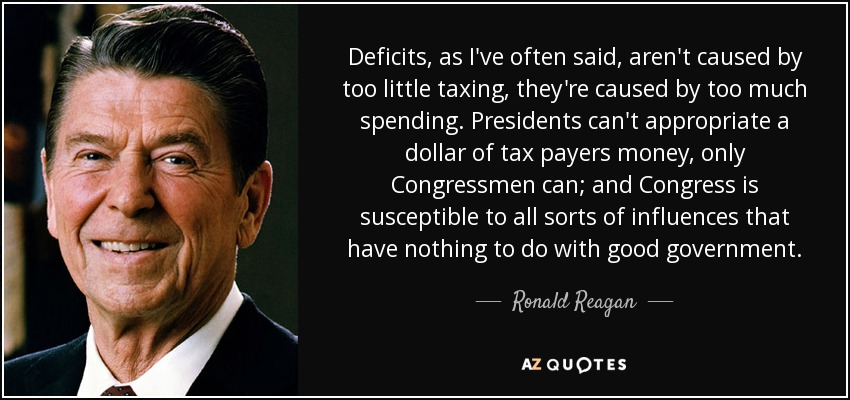
Deficits, as I've often said, aren't caused by too little taxing, they're caused by too much spending. Presidents can't appropriate a dollar of tax payers money, only Congressmen can; and Congress is susceptible to all sorts of influences that have nothing to do with good government.
Our platform calls for a balanced deficit reduction plan where the wealthy pay their fair share. And when your country is in a costly war, with our soldiers sacrificing abroad and our nation facing a debt crisis at home, being asked to pay your fair share isn't class warfare - it's patriotism.
The public has no idea that the deficit has been falling like a stone.
I think if you're going to do a movie about Reagan, you do it about the fact that he created the huge deficit, that he armed the Mujahideen, that he armed Saddam, that he armed Iran, that he armed two-thirds of the Axis of Evil, and that he funded terrorists in Central America. He was, in my mind, a terrible president.
I believe we can and should have it all. Lower deficits but higher spending. More peace with a bigger military that goes off and kills terrorists and whatnot. A cleaner environment without forcing SUVs off the road.
People of color, particularly African Americans, feel the stigma more keenly. In a race-conscious society, some don't want to be perceived as having yet another deficit.
Anything that's done to address unemployment in terms of massive stimulus spending is going to exacerbate deficits. And anything that's done to address deficits in the short-term is going to exacerbate unemployment.
Deficits do not in themselves produce inflation, nor does a balanced budget assure a stable price level.
Larger deficits are necessary and proper means to mitigate unemployment as the far greater evil in terms of human welfare.
Cutting carbs, fats, or calories (dieting) is like trying to hold your breath. The longer you do it, the more your body resists it until you finally gasp for air – taking in more than ever to overcome the short-term deficit you induced.
In different countries the basis of resistance takes different forms, but it comes chiefly from the conservative groups. Hence it becomes increasingly difficult to go on spending in the presence of persisting deficits and rising debt. Some form of spending must be found that will command the support of the conservative groups. Political leaders, embarrassed by their subsidies to the poor, soon learned that one of the easiest ways to spend money is on military establishments and armaments, because it commands the support of the groups most opposed to spending.
If you’re going to enjoy the picnic that life really is, you’d better learn to like yourself not despite your flaws and so-called deficits, but because of them.
Nature-deficit disorder describes the human costs of alienation from nature, among them: diminished use of the senses, attention difficulties, and higher rates of physical and emotional illnesses. The disorder can be detected in individuals, families, and communities.
As the nature deficit grows, another emerging body of scientific evidence indicates that direct exposure to nature is essential for physical and emotional health. For example, new studies suggest that exposure to nature may reduce the symptoms of Attention Deficit Hyperactivity Disorder (ADHD), and that it can improve all children's cognitive abilities and resistance to negative stresses and depression.
Several elements of the ADD mind favor creativity....As mentioned earlier, the term 'attention deficit' is a misnomer. It is a matter of attention inconsistency. While it is true that the ADD mind wanders when not engaged, it is also the case that the ADD mind fastens on to its subject fiercely when it is engaged. A child with ADD may sit for hours meticulously putting together a model airplane.
Economist Frederick Thayer has studied the history of our balanced-budget crusades and has come up with some depressing statistics. We have had six major depressions in our history (1819, 1837, 1857, 1873, 1893 and 1929); all six of them followed sustained periods of reducing the national debt. We have had almost chronic deficits since the 1930s, and there has been no depression since then - the longest crash-free period in our history.
The only way America can reduce the long-term budget deficit, maintain vital services, protect Social Security and Medicare, invest more in education and infrastructure, and not raise taxes on the working middle class is by raising taxes on the super rich.
His presidency ended more than a decade ago, but politicians, Democrat and Republican, still talk about Ronald Reagan. Al Gore has an ad noting that in Congress he opposed the Reagan budget cuts. He says that because Bill Bradley was one of 36 Democratic Senators who voted for the cuts. Gore doesn’t point out that Bradley also voted against the popular Reagan tax cuts and that it was the tax cuts that piled up those enormous deficits, a snowballing national debt.
There's a stability and growth pact which was agreed for the eleven countries which tries to limit the size of budget deficits among the eleven countries.
Brain tumor survivors: don't become hopelessly discouraged if you are experiencing deficits. You in a war and you are bound to have a few battle wounds.
Bush may be a strong leader in the war on terrorism, but on budget deficits he is missing-in-action.
History is replete with examples of moments in time when we talk about deficit reduction and try to advance on it around the world, that is, where it leads to job losses, not job creation.
Generally speaking, investing in yourself is the best thing you can do. Anything that improves your own talents; nobody can tax it or take it away from you. They can run up huge deficits and the dollar can become worth far less. You can have all kinds of things happen. But if you’ve got talent yourself, and you’ve maximized your talent, you’ve got a tremendous asset that can return ten-fold.
Governments don't reduce deficits by raising taxes on the people; governments reduce deficits by controlling spending and stimulating new wealth.
There is no deficit in human resources; the deficit is in human will.
Follow AzQuotes on Facebook, Twitter and Google+. Every day we present the best quotes! Improve yourself, find your inspiration, share with friends
or simply: