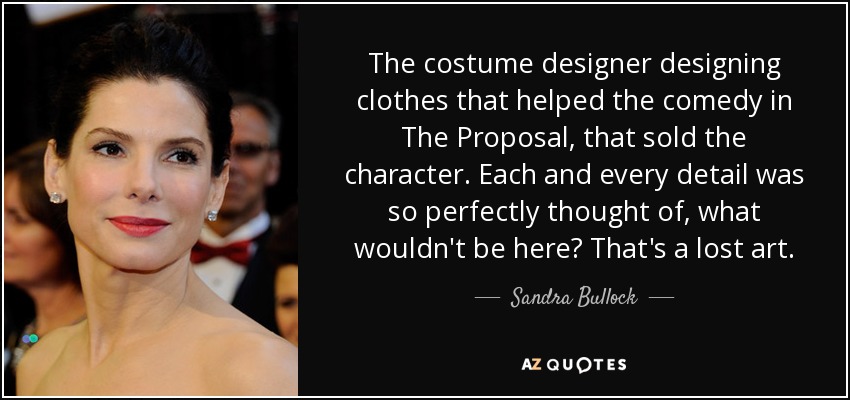
The costume designer designing clothes that helped the comedy in The Proposal, that sold the character. Each and every detail was so perfectly thought of, what wouldn't be here? That's a lost art.
I think that [having not a lot of time sweating the details] can be both a strength and a weakness. I think it depends on how [Donald Trump] approaches it. If it gives him fresh eyes, then that can be valuable. But it also requires you knowing what you don't know and putting in place people who do have the kinds of experience and background and knowledge that can inform good decision making.
One of the big problems we have in this country is that not enough people understand how important it is to save, understand the details of credit card statements, to be able to compare different APRs and the like. I support the idea.
I like to bring a certain sense of humanity and detail to my work, and watercolor allows me to do that. I have fascination and wonder about the line and transparent quality or properties in watercolor. I use watercolor to give voice to what I would like to talk about.
People are interested in relevant stories. In big events. But I'm not interested in big things; I'm interested in the smaller details of life.
I don't see myself as a deep philosopher. The things I write about tend to be what we all have to face, or consider, or experience, that I talk about with my friends and brothers. It's universal stuff, told in my own voice, my own details and truth, which is all I have to offer.
My best friends when I was young were always doctors. I used to dress up in a white gauze helmet and go round and see babies born and cadavers cut open. This fascinated me, but I could never bring myself to disciplining myself to the point where I could learn all the details that one has to learn to be a good doctor. This is the sort of opposition: somebody who deals directly with human experiences, is able to cure, to mend, to help, this sort of thing.
The reality is today most of our political leaders want to be treated as gods and semi-gods, from the security details to the fuss around them and so on.
I don't know of any source for online maps showing the platform, stairs, escalators, elevators, mezzanines and other station details.
You don't go to other books and take little pieces because although say a romantic scene may have been many times before all the details of who it is, where it is, are so intertwined in that text that it's easier to write it from scratch.
I try to really take my art serious, and pay attention to detail.
The walk is like a matrix, like a diffuse, vague happening. It's like - imagine a play, a work of theatre, that is totally vague, almost devoid of details that consists in one person going on a walk. And as a consequence, there is a necessary tension between the determinacy and indeterminacy, the definite and the indefinite, of possibility.
When you are dealing with approximately two-plus hours every few years to do a story, you don't have the luxury of having excessive screen time to explore, in detail and in-depth, lots of other subsidiary or ancillary supporting characters.
I'm tempted to do everything. And sometimes I think, "Oh, come on. You can stick that detail somewhere."
There is space for a different kind of investigative reporting that's about immersion and obsessive attention to detail and deep listening.
I don't like stories where I'm being given pages and pages of detail.
I chose to write about food: food is inherently political, but it's also an essential part of people's real lives. It's where the public and private spheres connect. I wanted to show readers that the larger politics of war and economics and U.S. foreign policy are inextricably bound to the supposedly trivial details of our everyday lives.
I think when you are doing a song you're trying to give people enough details that they connect.
I use a lot of specific places in my songs - traditionally, a lot from Minneapolis and St. Paul, where I grew up. Most people, especially when you get into international touring, have not been there. So you say, "Well, isn't it risky to talk about the corner of Franklin Avenue and Lyndale?" If you do it right, someone should say, "God, I know a corner like that." Offering specific details to describe something universal.
I remember the first day I was looking at my hands and I thought about my nails. People wouldn't really be paying attention to that, but a Civil War doctor - What would they be doing with their nails? Would they cut them really low? And Dr. Burns said, "No, they would let them grow out so they can scoop stuff out. They would use their nails." So for a while I let my nails grow. They were too long. I kept stabbing myself by accident, so I cut them down, but I was trying to be faithful to the details.
A lot more people will want to hear a 5-minute singing cartoon about Communism in China than will want to read that PhD thesis, and that's the power of it even if a lot of details will be missing - that's the reason something like that often has more impact on society.
I prefer to explore the most intimate moments, the smaller, crystallized details we all hinge our lives on.
After five years' work I allowed myself to speculate on the subject, and drew up some short notes; these I enlarged in 1844 into a sketch of the conclusions, which then seemed to me probable: from that period to the present day I have steadily pursued the same object. I hope that I may be excused for entering on these personal details, as I give them to show that I have not been hasty in coming to a decision.
In writing a series of stories about the same characters, plan the whole series in advance in some detail, to avoid contradictions and inconsistencies.
A story contained in the family lore of Brigham Young's descendants illustrates the submissive nature of humility. It recounts that in a public meeting the Prophet Joseph, possibly as a test, sternly rebuked Brigham Young for something he had done or something he was supposed to have done but hadn't - the detail is unclear. When Joseph finished the rebuke, everyone in the room waited for Brigham Young's response. This powerful man, later known as the Lion of the Lord, in a voice everyone could tell was sincere, said simply and humbly, "Joseph, what do you want me to do?"
Follow AzQuotes on Facebook, Twitter and Google+. Every day we present the best quotes! Improve yourself, find your inspiration, share with friends
or simply: