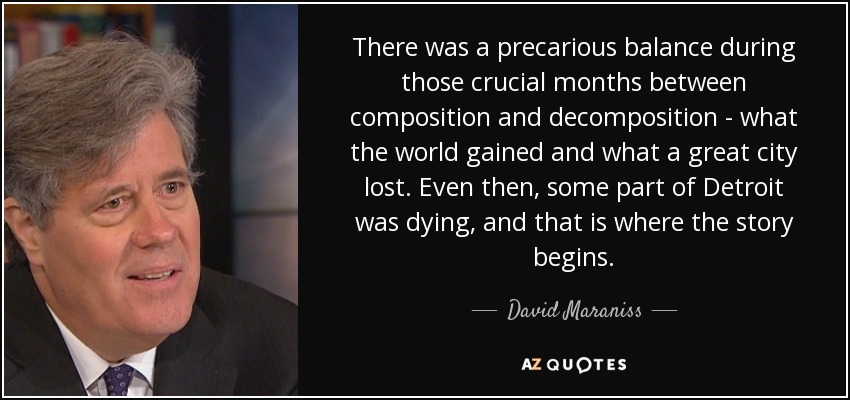
There was a precarious balance during those crucial months between composition and decomposition - what the world gained and what a great city lost. Even then, some part of Detroit was dying, and that is where the story begins.
Well, here you had a city that was selling more cars than ever before, that had this wondrous music being created, that was so vital to the labor and civil rights of this country, and yet it was dying and didn't see it, except for some sociologist at Wayne State University who predicted that Detroit was losing population by a half-million by the end of that '60s decade, and that that trend would continue taking away its tax base.
Well, there were several things. One was that the industry itself built in Detroit was abandoning the city - taking factories elsewhere, the corporate headquarters elsewhere.
And that John F. Kennedy uttered the first variation of "ask not what your country can do for you" in Detroit on Labor Day in 1960. So Detroit was really central to Democratic politics United States. Every Democratic candidate would start their fall campaigns in Cadillac Square.
Detroit was an exaggeration of what was going on across the country. You could see the divisions, even within the Civil Rights Movement of that period. At the same time that Martin Luther King was talking about his dream, Malcolm X gave his most famous address in Detroit during that same period, "The Message To The Grass Roots," dismissing the notion of integration.
You also had in Detroit that summer, an early variation of Ferguson. A black prostitute was shot in the back by police. And all of the efforts that a very progressive police chief and mayor of that period had put into trying to restore race relations started to fall apart again, and you could see that unraveling for several years until the riots or rebellion of 1967.
So, I mean, there's still vast swaths of the city that are suffering from a lack of jobs and poor housing and poor public schools, but they are building momentum - you know, techies, foodies, artists, musicians, all coming to Detroit. So there is this vibrancy. You see it in the newspapers every day - some story about the new Detroit.
My favorites are Stevie Wonder and Marvin Gaye, but those are a little off in terms of getting Detroit right on the head. But of course, you know, "Dancing In The Streets." You can't forget the Motor City. And we can't forget the Motor City.
My step-dad started playing hockey in Detroit so we moved and I had to start home school. I started watching movies since I had a bunch of free time and then I was like, 'You know what? I want to give this a shot, move back to L.A., and audition.' The first show I booked was a show called Threshold with Carla Gugino and it was obviously a terrifying experience and I felt out of my comfort zone, but it made me want to keep going because it was fun.
I became a professional actor in Detroit and I was able to earn some money. It was a good job because it permitted me to study. It fit perfectly with school.
We don't hear our president [Barack Obama] talking about the need for high-quality jobs for everybody, giving it priority, not just giving a speech in Detroit. That's fine, but speaking to Tim Geithner, speaking to Larry Summers. When are you going to make jobs, jobs, jobs a priority rather than Wall Street, Wall Street, Wall Street a priority? That's what I'm concerned about.
I think that the Detroit auto industry is important to the United States. It's important for hundreds of thousands of Americans who have their jobs as a result.
That feeling of hopelessness and racism has been looming over Detroit ever since I was a kid.
You look at the inner cities,I just left Detroit, and I just left Philadelphia.nd I've met some of the greatest people I'll ever meet within these communities. And they are very, very upset with what their politicians have told them and what their politicians have done.
In November 1963, [Malcolm X] gives his famous message to the grassroots address in Detroit, which really kind of marks off the real turning point in his own development.
I had met Michael Stipe, and he was such a kind person, and extremely understanding, so I asked him if he knew a photographer who would come to Detroit, where I lived, who would be child friendly and who would respect my home. Michael suggested Steven [ Sebring]. One day a knock came at my door, and when I opened it, there was Steven. He's been like a brother ever since.
When I went to Detroit, I was very naïve, actually, and I think Patti [Smith] picked up on that quite quickly.
I grew up on the West Side - the "near West Side," [in Detroit], as they say - in what would be considered now the inner city.
I was born in '58, so the riot in Detroit in 1967 was a memorable introduction to the issue of race and how race made a difference in American society. And then the next year, of course, Martin Luther King Jr.'s assassination. And the Detroit Tigers winning the World Series. All of that made a huge impression on my growing mind.
[The World Series] introduced me for the first time to a team with a lot of black players. Detroit had about three of them: I think it was Willie Horton, Gates Brown, and Earl Wilson - might have been one or two more in '68.
The civil rights movement didn't deal with the issue of political disenfranchisement in the Northern cities. It didn't deal with the issues that were happening in places like Detroit, where there was a deep process of deindustrialization going on.
It's just good that Detroit is coming back. I'm so happy it's coming back because it needs to come back. When I do my trips around the world, and I can be anywhere, but I always see somebody from Detroit or Chicago. Those guys are world travelers.
I'm a son of Detroit. I was born in Detroit.
New York has closed itself off to the young and the struggling. But there are other cities. Detroit. Poughkeepsie. New York City has been taken away from you. So my advice is: Find a new city.
I'm a different kind of Republican. I've introduced a five-year balanced budget. I've introduced the largest tax cut in our history. I stood for ten and a half hours on the Senate floor to defend your right to be left alone. But I've also gone to Chicago. I've gone to Detroit. I've been to Ferguson, I've been to Baltimore, because I want our party to be bigger, better and bolder...
Follow AzQuotes on Facebook, Twitter and Google+. Every day we present the best quotes! Improve yourself, find your inspiration, share with friends
or simply: