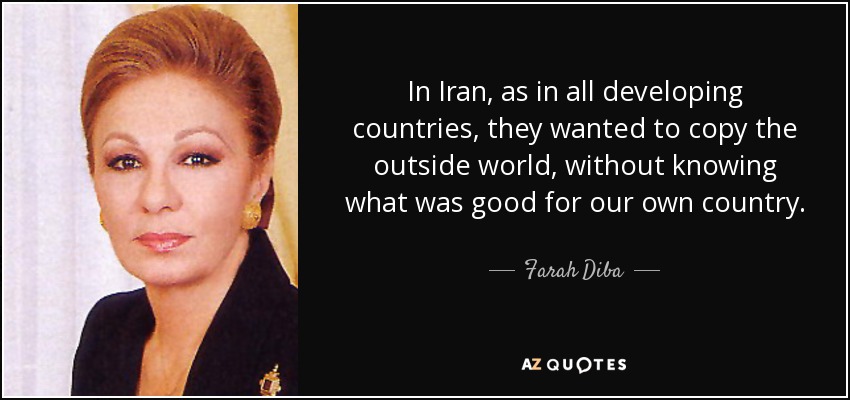
In Iran, as in all developing countries, they wanted to copy the outside world, without knowing what was good for our own country.
I think one big improvement would be if we somehow made it cheaper and easier for developing countries to learn from the sad experience of some of the developed countries, and also from some of the positive experiences we have of building good transportation systems, like high-speed rail.
Developing countries like Malaysia should have a say in changing the world financial system since we have faced the problems that it has caused.
Also, it is interesting that developing countries, with China and India perhaps in the lead, where the future of the global environment will be decided are now on board with the case for sustainable development.
Beyond the borders of wealthy countries like the United States, in developing countries where most people in the world live, the impacts of climate change are much more deadly, from the growing desertification of Africa to the threats of rising sea levels and the submersion of small island nations.
One of the biggest development issues in the world is the education of girls. In the United States and Europe, it has been accepted, but not in Africa and the developing countries.
The biggest problems are the damn national sectors of these developing countries. These countries think that they have the right to develop their resources as they see fit. They want to become powers.
A multi-polar world can not exist without recognising the status and participation of developing countries.
A citizen of an advanced industrialized nation consumes in six months the energy and raw materials that have to last the citizen of a developing country his entire lifetime.
A protected bicycle lane in the city in a developing country is a powerful symbol, showing that a citizen on the $30 bicycle is as important as one in a $30,000 car
It doesn't take a genius to pump up the GNP [of a developing country] by burning down rainforests, using slave labor and social repression to keep things in place.
I live in a developing country.
The E.U. imports more agricultural goods from developing countries around the world than does the U.S., Canada and Japan, combined.
Starbucks goes to a great effort, and pays twice as much for its coffee as its competitors do, and is very careful to help coffee producers in developing countries grow coffee without pesticides and in ways that preserve forest structure.
Feminism is a word that I identify with. The term has become synonymous with vitriolic man-hating but it needs to come back to a place where both men and women can embrace it. It is particularly important for women in developing countries.
Making loans and fighting poverty are normally two of the least glamorous pursuits around, but put the two together and you have an economic innovation that has become not just popular but downright chic. The innovation - microfinance - involves making small loans to poor entrepreneurs, usually in developing countries.
My issue with the state of women became incredibly stimulated when I was visiting developing countries and it became obvious that women bore the brunt of so many things in society.
UN studies conducted in more than forty developing countries show that the birth rate falls as women gain equality... I believe income-earning opportunities that empower poor women ... will have more impact on curbing population growth that the current system of "encouraging" family planning practices through intimidation tactics.. Family planning should be left to the family.
The true nature of bureaucracy may be nowhere more obvious to the observer than in a developing country, for only there will it still be made manifest by the full complement of documents, files, veneered desks and cabinets - which convey the strict and inverse relationship between productivity and paperwork.
...99% of the casualties linked to climate change occur in developing countries. Worst hit are the world's poorest groups. While climate change will increasingly affect wealthy countries, the brunt of the impact is being borne by the poor, whose plight simply receives less attention.
The West has become the world model; developing countries are dreaming of living like us, which is impossible. They should reject our model, because it is not sustainable. Developing countries should even give us the example, but unfortunately that's not what happens.
At the same time, we are keenly aware that China is still the largest developing country in the world and we need to make long and hard efforts if we are to build a moderately prosperous society in all respects and basically achieve modernization.
China is a developing country with a huge population, and also a developing country in a crucial stage of reform. In this context, China still faces many challenges in economic and social development. And a lot still needs to be done in China, in terms of human rights.
Climate experts say we should tell villagers in developing countries to reduce the amount of cooking smoke they generate to help fix global warming. You know, it's as if these people don't hate us enough already. I mean, they live in mud huts, they have thatch roofs, their clothes are made of straw. We pull up in a bunch of Humvees and SUVs going, 'Hey, you want to cut the smoke out of here?'
Developed countries should support developing countries in tackling climate change. This not only is their responsibility, but also serves their long-term interests.
Follow AzQuotes on Facebook, Twitter and Google+. Every day we present the best quotes! Improve yourself, find your inspiration, share with friends
or simply: