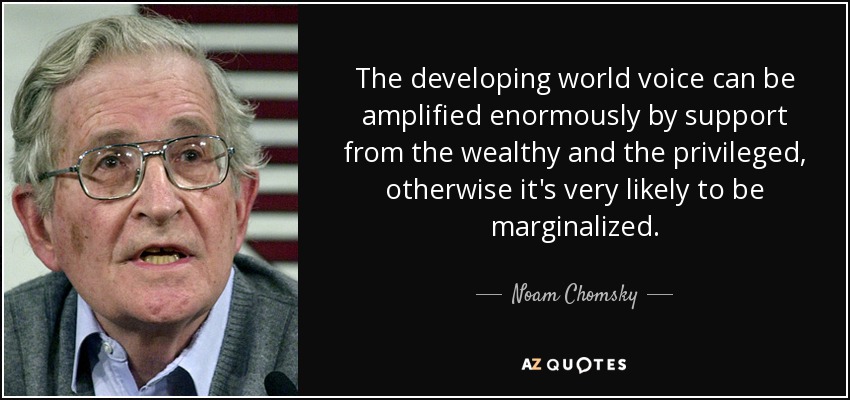
The developing world voice can be amplified enormously by support from the wealthy and the privileged, otherwise it's very likely to be marginalized.
I learned that [Trotskyism] were no different from the Stalinists, and they expelled me, which is the typical Marxist-Leninist way of dealing with dissenters. From that point on, I migrated by the 1950s into anarchism, increasingly emphasizing decentralization. Also, I made the all-important step of bridging my social philosophy with ecology. I did that in 1952 and went on to write a whole series of books developing an anarcho-ecological approach.
I enjoy nothing more than creating new series and watching them grow in front of me month by month. It's a muscle I spent many years developing and it feels good to be using it again.
I am interested in the political economy of institutional power relationships in transition. The question is one of "reconstructive" communities as a cultural, as well as a political, fact: how geographic communities are structured to move in the direction of the next vision, along with the question of how a larger system - given the power and cultural relationships - can move toward managing the connections between the developing communities. There are many, many hard questions here - including, obviously, ones related to ecological sustainability and climate change.
Our international banking system allows banks to accept funds gained from tax evasion and other crimes and thereby facilitates and encourages embezzlement by public officials, especially in developing countries, as well as tax evasion and tax avoidance by multinational corporations.
The international institutions go around the world preaching liberalization, and the developing countries see that means open up your markets to our commodities, but we aren't going to open our markets to your commodities. In the nineteenth century, they used gunboats. Now they use economic weapons and arm-twisting.
I feel like developing the muscle of my imagination became a way to survive reality.
Mao Zedong Thought was not created by Comrade Mao alone - other revolutionaries of the older generation played a part in forming and developing it - but primarily it embodies Comrade Mao's thinking. Nevertheless, victory made him less prudent, so that in his later years some unsound features and unsound ideas, chiefly "Left" ones, began to emerge. In quite a number of instances he went counter to his own ideas, counter to the fine and correct propositions he had previously put forward, and counter to the style of work he himself had advocated.
There's no set time or schedule for developing one's skills as a professional golfer, and it certainly doesn't come overnight. It's a muscle-memory exercise that comes over time.
80 percent of the export of armament in the world comes from the G8 countries. [The] United States alone exports about 50 percent of the world's armament, [for] which, of course, there has to be buyers, and the buyers are very terribly keen, very often military dictator[s] or sometimes not military dictator[s] but for military purposes. But the sellers are also promoting this trade. And two thirds of the arm exports go to developing countries. I'm in favor of putting a control on it, a ban on it.
In fact, one reason I am interested in developing things in virtual reality is that they're so fascinating. I can come up with problems that are harder than warfare to take up people's time.
Autism is a big continuum, going from someone who remains nonverbal, all the way up to geniuses on Silicon Valley. And some kids are visual thinkers like me. Other kids are pattern thinkers - your mathematicians, your programmers. And there are others, they are word thinkers. Uneven skills. You need to take the thing that they're good at and you need to work on developing it.
Doing classic plays is wonderful. It's a wonderful way of developing style.
The term 'human rights' has been too often associated with conditionality, and with concerns of developing countries that in order to benefit from open trade they would be required to implement immediately labour and environmental standards of a comparable level to those applied in industrialised countries. At the same time, debates about the primacy of trade as against human rights legal codes have contributed to maintaining the unfortunate impression that the two bodies of law are pursuing incompatible aims.
I'm not defending the Trump vote. I think they're making a bad choice. But I'm saying the bad choice isn't one out of pure ignorance, and I think it's too easy. And it plays into cliches about, you know, elitist liberals to say, oh, these Trump voters - if they knew more, they would do better. And it's like, well, maybe they would do better if we had a legitimate set of policies in place that doesn't encourage the kind of gross radicalization that has happened under the Trump candidacy. So for me, it's all about developing a richer conversation.
One of the challenges over the last decade is America has done experiments in nation building in places like Iraq and Afghanistan and we've neglected, for example, developing our own economy, our own energy sectors, our own education system. And it's very hard for us to project leadership around the world when we're not doing what we need to do.
I want to control our own energy by developing oil and natural gas but also the energy sources of the future.
I guess a lot of police keep their sanity by developing black humour.
Membership in the European Community, now the European Union, has enabled Ireland to re-find its sense of participation - cultural, political, social - at the European level. I think that also opens up possibilities for Ireland as a European country to look outward - to look particularly, for example, at countries to which a lot of Irish people emigrated, to our links - our human links - with the United States, with Canada, with Australia, with New Zealand. And to look also, because of our history, at our links to the developing countries.
Part of what you need to understand is that we're forced to look back. You had the importation of third world or developing world conditions into the United States because of a bipartisan elite consensus for neo-liberalism. In other words, you had both political parties, the smarty-pants in both political parties said, hey, let's do these crazy trade deals.
What I'd like to see developing is an American radicalism, libertarian in character, which relies, however weak, faint, and even mythic these traditions may be, on the American libertarian tradition. I don't mean right-wing libertarianism obviously.
Physics and those parts of other fields that grow out of physics - chemistry, the structure of big molecules - in those domains, there is a lot of progress. In many other domains, there is very little progress in developing real scientific understanding.
Look at the ozone story. As long as it was the southern hemisphere that was being threatened, there was very little talk about it. When it was discovered in the north, very quickly actions were taken to do something about it. Right now there's discussion of putting serious effort into developing a malaria vaccine, because global warming might extend malaria to the rich countries, so something should be done about it.
I believe education is the key. As an activist and a child of the developing world, I witnessed education's power to transform lives.
Our minds are specifically adapted to developing certain theories, and we have a science if the theories that are available to our minds happen to be close to true. Well, there is no particular reason to suppose that the intersection of true theories and theories that are accessible to the mind is very large. It may not be very large.
Follow AzQuotes on Facebook, Twitter and Google+. Every day we present the best quotes! Improve yourself, find your inspiration, share with friends
or simply: