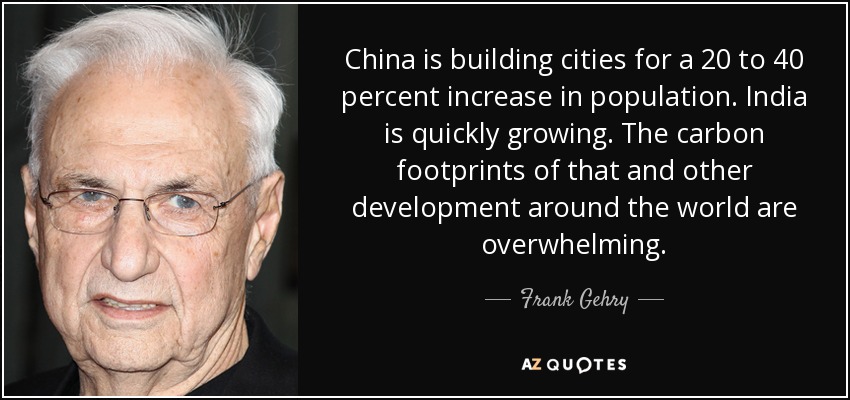
China is building cities for a 20 to 40 percent increase in population. India is quickly growing. The carbon footprints of that and other development around the world are overwhelming.
Socialist economy cannot reject the huge advantages of the world division of labor: on the contrary, it will carry it to the highest development. But in practise, it is not a question of the future socialist society, with an established internal equilibrium, but of the given technically and culturally backward country which in the interests of industrialisation and collectivization is forced to export as much as possible in order to import as much as possible.
The clearer and deeper the public opinion of the world, in the first instance the opinion of the working masses, will understand the contradictions and the difficulties of the socialist development of an isolated country, the higher will it appreciate the results achieved. The less it identifies the fundamental methods of Socialism with the zigzags and errors of the Soviet bureaucracy, the less will be the danger that, by the inevitable revelation of these errors and of their consequences, the authority, not only of the present ruling group, but of the workers' State itself, may decline.
70 percent of India's imports of oil and oil products are imported from abroad. There is uncertainty about supply. There is uncertainty about prices. And that hurts India's development.
If we have access to nuclear energy, that adds to our maneuverability in ensuring energy security as India marches on, on the path to accelerated development.
Working together in helping nascent democracies in the task of reconstruction, in the task of development is another area where our two countries [India and the USA] can work together.
I have always believed that the ultimate purpose of economic policies and development policy is to meet the basic needs of our people. And for that, we need a fast-expanding economy.
I think we need to be a superpower of human rights, of support for true grassroots democracy, not corporatist economic development, which suits our economic elite but has not been helpful to the cause of democracies around the world.
I had been doing private readings for ten years when my guides said, "We want you to reach more people." Then I said "How?" They said, "You're going to write a book." And I said, "Oh, yeah sure, I'm going to write a book. No way." But I did an outline. And I got pushed by my development circle.
The concept of the "information society" is both vague and all-embracing. Different participants meant different things by it. In practice, though, World Summit on the Information Society only dealt with a small number of issues: ICTs and human rights (to some extent), ICTs and development (to some extent), infrastructure finance and Internet governance. Very large aspects of what might have been included in the "information society" were not really discussed.
I wish more of the web had stayed nonprofit. But the advertising model took over and I think has delivered us to where we are, along with the development of content, which is designed to do nothing else but make you click on it or share it. And I think it's kind of a low goal for content, and I think that's taken us to our current abyss.
We Canadians need to go beyond what any previous government has done in terms of our diplomatic network, our support for companies to export, trade and invest beyond North America, and our contribution to the safety of the international system, through defence, development, international organizations, and so forth.
We need to give the private sector many more powerful incentives to do research and development, to bring ideas and new discoveries to market in Canada, and commercialize them here, and stay here through successive stages of growth. But they can only do it with better government policies that give them more powerful incentive.
There is a strong reciprocal relationship whereby our more ambitious design visions encourage the continuing development of the new digital technologies and fabrication techniques, and those new developments in turn inspire us to push the design envelope ever further.
There are some very similar moments in the early work where the focus was on drawing, abstraction and fragmentation. Then it moved to the development of ideas. Lately it has become what architecture should be, which is more fluid organization. There has not been so much 'a change' but 'a development'.
As a cornerstone of my policy, we will substantially expand public-private partnerships to maximize the amount of investment and funding that is available for space exploration and development.
I think anybody who knows anything about South Africa and the South African economy would know that one of the big constraints to growth and development is skills shortages. So all of us, need to come at this thing as vigorously as is possible and, of course, the private sector has the capacity to take it on board.
In a great horror movie, you've gotta have some character development and you've gotta set some of your people up and you've gotta have a little back story going. You've gotta take that time for exposition.
The world may hold startling developments and shocking unknowns.
We have, in the same way, relegated our own responsibility in what happens to our country to the specialists, who are supposed to take care of it, and the individual citizen does not feel that he can judge, and even that he should judge, and take any responsibility. I think there are quite a number of recent developments which show that.
If our supreme value is the development of the Western tradition - of a man for whom the highest thing in life is man, for whom love for man, respect for man, and the dignity of man, are supreme values - then we cannot ask the question that says, "if it is better for our survival, might we drop these values?"
[ Big infrastructure investment mentioned by Donald Trump] that would be a welcome development. We'll see if he wants to deliver on that. The truth is that if he does, we want to see infrastructure development too.
To maintain our economic and national security, we must maximize all of our nation's energy resources, including renewable sources, alternative fuels, and fossil fuels, all in a way that balances economic development and protecting our environment.
The development of space technology, including space warfare today, is similar in its technological-industrial significance to the development of navies a hundred years ago.
We're looking at the dawn of a new arms race. For example, Germany technically opposes the US space militarization program, but is bound to get involved. Otherwise it will be left behind in the development of advanced technology. Germany understands that very well. The US understands it too, and they fully expect that Germany and other countries that they want on board will go along with the program.
Follow AzQuotes on Facebook, Twitter and Google+. Every day we present the best quotes! Improve yourself, find your inspiration, share with friends
or simply: