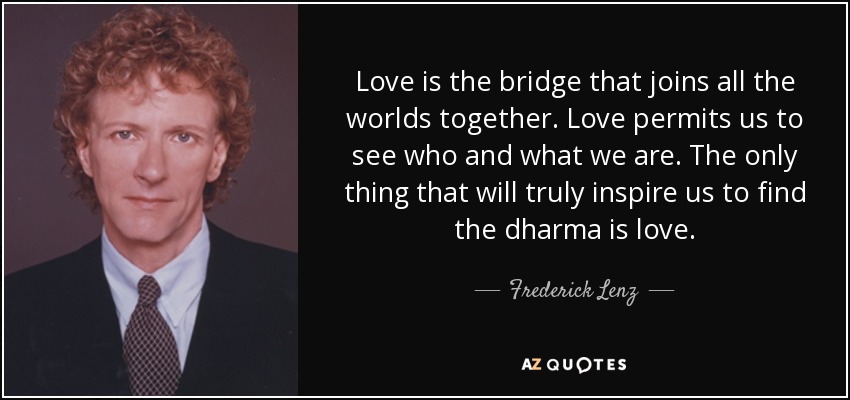
Love is the bridge that joins all the worlds together. Love permits us to see who and what we are. The only thing that will truly inspire us to find the dharma is love.
Thich Nhat Hanh has the ability to express some of the most profound teachings of interdependence and emptiness I've ever heard. With the eloquence of a poet, he holds up a sheet of paper and teaches us that the rain cloud and the tree and the logger who cut the tree down are all there in the paper. He's been one of the most significant carriers of the lamp of the dharma to the West that we have had.
Unlike some of my other dharma brothers who got names that were very long and obscure, and nobody could remember or pronounce, that they didn't like. They wanted to give their names back, but it wasn't like that, it wasn't transactional. He would name some people and say 'you're married', and then they were married, but you know it wasn't really transactional.
There's many lanes on the highway of enlightenment, they don't have to be on the razor's edge like the yellow line dotted in the middle. Balance is appropriate, not too tight, not too loose, the Middle Way as we call it in Buddhist dharma teachings.
When one has a decisive realization of the inherent nature of the mind, which has no ego, it has no sense of duality between oneself and the cup, and a deep sense of interpenetration of the whole dharma. Then whatever we do is spontaneously perfect Buddha activity. And anybody who is even slightly tuned in will get a very deep experience of that.
Determine where you are and where you wish to be. Then use all of your self-effort to make that happen, following the guiding principles of all the Buddhas and bohisattvas and seekers of the dharma, of enlightenment.
A way of spreading the dharma is just telling people, sharing with them your experiences. Never push it, never be a missionary. Be completely selfless; realize you're only an instrument of eternity.
Tolerance is a form of generosity and it is a form of wisdom. There is nothing anywhere in the Dharma [Buddhist scriptures] that should ever lead anyone to become intolerant. Our goal as Buddhists is to learn to accept all kinds of people and to help all kinds of people discover the wisdom of the teachings of Shakyamuni Buddha
When a builder builds he clears the ground for his new foundations. Then he sees that the basic structure will support the whole. Should we not also clear the mind - at least that part of it that we can reach - of the ruins of past thinking, before building our palace of dharma which will one day reach the sky.
The buddha-dharma does not invite us to dabble in abstract notions. Rather, the task it presents us with is to attend to what we actually experience, right in this moment. You don't have to look "over there." You don't have to figure anything out. You don't have to acquire anything. And you don't have to run off to Tibet, or Japan, or anywhere else. You wake up right here. In fact, you can only wake up right here. So you don't have to do the long search, the frantic chase, the painful quest. You're already right where you need to be.
As I study both the exoteric and the esoteric schools of Buddhism, they maintain that human beings are endowed with Dharma-nature by birth. If this is the case, why did the Buddhas of all ages - undoubtedly in possession of enlightenment - find it necessary to seek enlightenment and engage in spiritual practice?
The same Divine Compassion that blessed Dharma; saved Gajendra; restored Kuchela; and stood by Prahlada, has come to the Earth as the Refuge of the refugeless; as the Lord of Peace, Harmony and Righteousness; as the Lord of all the Worlds; as the Sath-Chith-Anandamurthi; and as the Puttaparthi Sathya Sai Sath-Chakravarthi - the King of Kings.
Everyone in advanced meditation practice should be involved with the economic support of the spread of the dharma. We live in a material world, and it's very expensive to teach meditation.
If you have humility, you are willing to undertake anything to spread the dharma.
Right now we have obtained a human rebirth and have the opportunity to attain enlightenment through Dharma practice, so if we waste this precious opportunity in meaningless activities there is no greater loss and no greater foolishness.
Beyond learning and unlearning is awareness, and beyond awareness is consciousness, and beyond consciousness is immortality, and beyond immortality is dharma and beyond dharma is nirvana.
Dharma is in your mind, not in the forest. Don't believe others, just listen to your mind. You don't have to go anywhere else. Wisdom is in yourself, just like a sweet ripe mango is already in a young green one.
By unswerving devotion to Me, a man crosses over three Gunas - I am the Abode of Brahman, Eternal and Immutable, of everlasting Dharma and Absolute Bliss.
We underestimate the value of patience. It is possible that people might sometimes interrupt our meditation sessions or Dharma study, but they can never take away our opportunity to train in inner virtues such as patience. It is this mental training, rather than outer virtuous activities, that is the essence of Dharma practice.
Dharma is one and one only. Ahimsa means moksha, and moksha is the realization of Truth.
If one does not remember death, one does not remember Dharma.
Followers of the Way [of Chán], if you want to get the kind of understanding that accords with the Dharma, never be misled by others. Whether you're facing inward or facing outward, whatever you meet up with, just kill it! If you meet a buddha, kill the buddha. If you meet a patriarch, kill the patriarch. If you meet an arhat, kill the arhat. If you meet your parents, kill your parents. If you meet your kinfolk, kill your kinfolk. Then for the first time you will gain emancipation, will not be entangled with things, will pass freely anywhere you wish to go.
Friends in the Dharma, be satisfied with your own heads. Do not put any false heads above your own. Then, minute after minute, watch your step closely.
Dharma has several connotations in South Asian religions, but in Buddhism it has two basic, interrelated meanings: dharma as 'teaching' as found in the expression Buddha Dharma, and dharma as 'reality-as-is' (abhigama-dharma). The teaching is a verbal expression of reality-as-is that consists of two aspects-the subject that realizes and the object that is realized. Together they constitute 'reality-as-is;' if either aspect is lacking, it is not reality-as-is. This sense of dharma or reality-as-is is also called suchness (tathata) or thatness (tattva) in Buddhism.
The Kama Sutra is neither exclusively a sex manual nor, as also commonly used art, a sacred or religious work. It is certainly not a tantric text. In opening with a discussion of the three aims of ancient Hindu life – dharma, artha and kama – Vatsyayana's purpose is to set kama, or enjoyment of the senses, in context. Thus dharma or virtuous living is the highest aim, artha, the amassing of wealth is next, and kama is the least of three.
Follow AzQuotes on Facebook, Twitter and Google+. Every day we present the best quotes! Improve yourself, find your inspiration, share with friends
or simply: