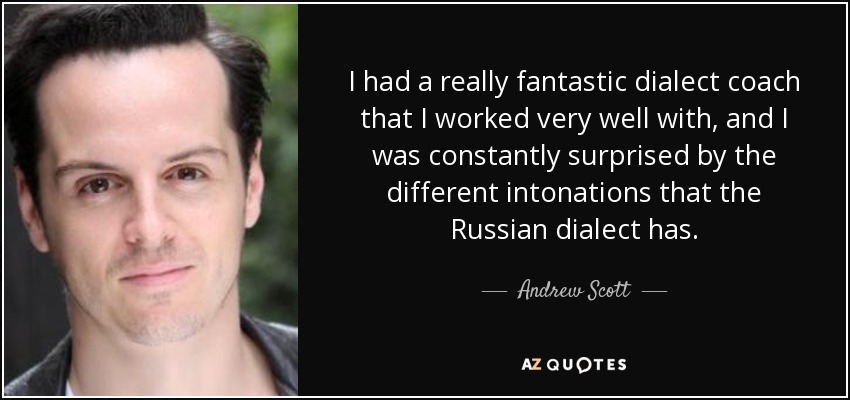
I had a really fantastic dialect coach that I worked very well with, and I was constantly surprised by the different intonations that the Russian dialect has.
I am black, so with my writing and my voice, you get that kind of dialect.
Ebonics - or black English, as I prefer to call it - is one of a great many dialects of English. And so English comes in a great many varieties, and black English is one of them.
Everywhere the sky is blue. There are a multitude of cuisines and dishes. I think of them as the languages and dialects of food.
When a person identifies himself with a group his critical faculties are diminished and his passions enhanced by a kind of emotive resonance. The individual is not a killer, the group is, and by identifying with it, the individual becomes one. This is the infernal dialect reflected in man's history.
Music is a universal language insofar as you don't need to know anything else about a musician that you are playing with other than that they can play music. It doesn't matter what their music is, you can find something that you can play together, with what their culture is. The dialect part of it comes into play, but nothing like the differentiation that language sets up, for example.
We need spies that look like their targets, CIA officers who speak the dialects terrorists use, and FBI agents who can speak to Muslim women who might be intimidated by men.
I keep to a minimum dialect, in-jokes about football (soccer) teams and soap opera characters, so as not to lose North American readers.
When you use a dialect, you worry that the people you're imitating will think you're making fun of them.
'Particularly' is particularly difficult because the 'L' and the 'R' are totally different, like totally different letters. I would spend hours in front of the mirror with my dialect coach to observe my tongue. You don't think, when you speak, about all the things that happen in your jaw and your mouth, how everything reacts, so you have to watch all those things and realise we have a totally different use of our tongue and jaws.
When I speak in Christian terms or Buddhist terms I'm simply selecting for the moment a dialect. Christian words for me represent the comforting vocabulary of the place I came from hometown voices saying more than the language itself can convey about how welcome and safe I am what the expectations are and where to find food. Buddhist words come from another dialect from the people over the mountain. I've become pretty fluent in Buddhist it helps me to see my home country differently but it will never be speech I can feel completely at home in.
Place yourself in the background; write in a way that comes naturally; work from a suitable design; write with nouns and verbs; do not overwrite; do not overstate; avoid the use of qualifiers; do not affect a breezy style; use orthodox spelling; do not explain too much; avoid fancy words; do not take shortcuts as the cost of clarity; prefer the standard to the offbeat; make sure the reader knows who is speaking; do not use dialect; revise and rewrite.
In conducting interviews, my fascination is not only with the content of the conversation, but also the overall delivery of spoken language - so much of one's personality and story is embedded within their speech, their rhythms, the structure of their thoughts, their use of particular diction or dialect.
I don't have a Jersey dialect. So when I approached the singing, I approached it the same way as an actor I approach a dialect, just as a singer.
I approach the singing kind of like with dialect thoughts in my mind. I have to sound like this on certain things to give that Frankie Valli flavor.
I'm most comfortable with the Southern dialects, really. It's easy, for example, for me to do Irish because we've got Irish heritage where I come from.
He [Barack Obama] was light-skinned with no Negro dialect.
Quantum theory was split up into dialects. Different people describe the same experiences in remarkably different languages. This is confusing even to physicists.
Welsh is now almost a national language in Wales. The Scottish dialects are reviving to some extent. I don't think it's a major thing, but it's there, and it's happening elsewhere.
The eyes of men converse as much as their tongues, with the advantage that the ocular dialect needs no dictionary, but is understood all the world over.
Each culture might lend its own dialect, but above all that is the language of music itself, and it doesn't care about politics or boundaries.
Southern writing is regional: it includes dialect, settings, and cultural traditions from that region. However the themes and story conflicts are universal. My challenge is to write regional fiction without falling into the trap of nostalgia. There are important issues facing the south that I believe should be raised in the stories to make them contemporary, believable, and relevant to today's readers.
I guess I'd always mocked the American accent. I didn't consider it a respectable dialect, but I was told that it was.
I grew up being fascinated by accents and dialects. One of the things that interested me were actors that were doing different characters, or sort of more caricatures.
I went to a dialect coach and she told me that I had five problems; two were my Israeli accent and three were my New Jersey accent. I don't even want to know what I sounded like back then!
Follow AzQuotes on Facebook, Twitter and Google+. Every day we present the best quotes! Improve yourself, find your inspiration, share with friends
or simply: