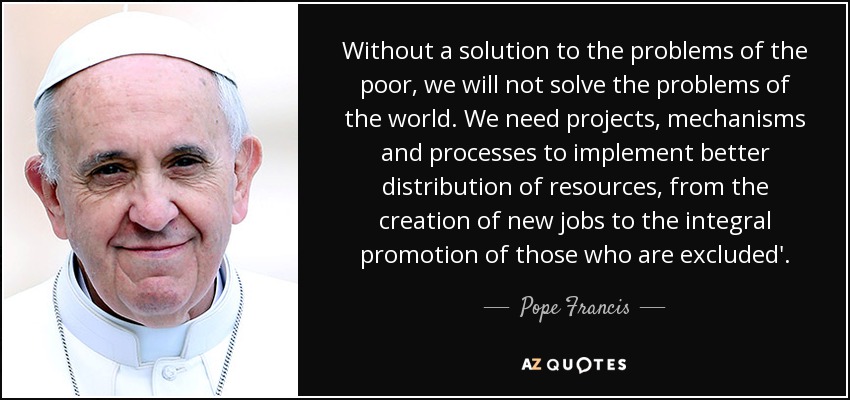
Without a solution to the problems of the poor, we will not solve the problems of the world. We need projects, mechanisms and processes to implement better distribution of resources, from the creation of new jobs to the integral promotion of those who are excluded'.
All "public interest' legislation (and any distribution of money taken by force from some men for the unearned benefit of others) comes down ultimately to the grant of an undefined undefinable, non-objective, arbitrary power to some government officials. The worst aspect of it is not that such a power can be used dishonestly, but that it cannot be used honestly. The wisest man in the world, with the purest integrity, cannot find a criterion for the just, equitable, rational application of an unjust, inequitable, irrational principle.
... an essential feature of a decent society, and an almost defining feature of a democratic society, is relative equality of outcome - not opportunity, but outcome. Without that you can't seriously talk about a democratic state... These concepts of the common good have a long life. They lie right at the core of classical liberalism, of Enlightenment thinking... Like Aristotle, [Adam] Smith understood that the common good will require substantial intervention to assure lasting prosperity of the poor by distribution of public revenues.
But, that’s the whole point of corporatization - to try to remove the public from making decisions over their own fate, to limit the public arena, to control opinion, to make sure that the fundamental decisions that determine how the world is going to be run - which includes production, commerce, distribution, thought, social policy, foreign policy, everything - are not in the hands of the public, but rather in the hands of highly concentrated private power. In effect, tyranny unaccountable to the public.
I'll tell you what I'd do if it were up to me: I would establish a strictly controlled distribution network through which I would make most drugs, excluding the most dangerous ones like crack, legally available. Initially I would keep the prices low enough to destroy the drug trade. Once that objective was attained I would keep raising the prices, very much like the excise duty on cigarettes, but I would make an exception for registered addicts in order to discourage crime. I would use a portion of the income for prevention and treatment. And I would foster social opprobrium of drug use.
This is an age of mass production. In the mass production of materials a broad technique has been developed and applied to their distribution. In this age, too, there must be a technique for the mass distribution of ideas.
If the prior distribution, at which I am frankly guessing, has little or no effect on the result, then why bother; and if it has a large effect, then since I do not know what I am doing how would I dare act on the conclusions drawn?
As mass production has to be accompanied by mass consumption, mass consumption, in turn, implies a distribution of wealth ... to provide men with buying power. ... Instead of achieving that kind of distribution, a giant suction pump had by 1929-30 drawn into a few hands an increasing portion of currently produced wealth. ... The other fellows could stay in the game only by borrowing. When their credit ran out, the game stopped.
If it were (Is it not) outrageous that society should treat with such rigid precision those of its members who were most poorly endowed in the distribution or wealth that chance had made, and who were, therefore, most worthy of indulgence.
Utilities used deregulation to effect a series of mergers limiting competition. In order to accelerate profits, cost cutting ensued, involving the layoff of thousands of utility company employees, including some who were responsible for maintenance of generation, transmission, and distribution systems. A number of investor-owned utilities stopped investing in the maintenance and repair of their own equipment, and, instead, cut costs to enhance the value of their stock rather than spending money to enhance the value of their service.
Love, for too many men in our time, consists of sleeping with a seductive woman, one who is properly endowed with the right distribution of curves and conveniences and one upon whom a permanent lien has been acquired through the institution of marriage.
People try to read a lot into what 'digital' means. It's just another platform. There are very attractive things that happen if you invest in content - movies, TV production, acquired series, specialty genres, digital distribution of our magazines, sports rights.
Now along comes the potential creative destruction brought by a different distribution methodology, the Internet.
Food safety oversight is largely, but not exclusively, divided between two agencies, the FDA and the USDA. The USDA mostly oversees meat and poultry; the FDA mostly handles everything else, including pet food and animal feed. Although this division of responsibility means that the FDA is responsible for 80% of the food supply, it only gets 20% of the federal budget for this purpose. In contrast, the USDA gets 80% of the budget for 20% of the foods. This uneven distribution is the result of a little history and a lot of politics.
Progress in computer science is made with the distribution of revolutionary software systems and the publication of revolutionary books. We don't need a fancy information system to alert us to these grand events; they will hit us in the face. Another good excuse for ignoring the literature is that, since everyone has strong beliefs about fundamentals but can't support those beliefs rationally or consistently convince non-believers, computer science is actually a religion.
Our economic approach to food and its distribution reflects our basic moral values.
I’ve worked in an economy that rewards someone who saves the lives of others on a battlefield with a medal, rewards a great teacher with thank-you notes from parents, but rewards those who can detect the mispricing of securities with sums reaching into the billions.
The Second Wave Society is industrial and based on mass production, mass distribution, mass consumption, mass education, mass media, mass recreation, mass entertainment, and weapons of mass destruction. You combine those things with standardization, centralization, concentration, and synchronization, and you wind up with a style of organization we call bureaucracy.
We're all in the race game, so to speak, either consciously or unconsciously. We can overtly support white-supremacist racial projects. We can reject white supremacy and support racial projects aimed at a democratic distibution of power and a just distribution of resources. Or we can claim to not be interested in race, in which case we almost certainly will end up tacitly supporting white supremacy by virtue of our unwillingness to confront it. In a society in which white supremacy has structured every aspect of our world, there can be no claim to neutrality.
It is not love, or morality, or international law that determines the outcome of world affairs, but the changing distribution of organized force
The main vice of capitalism is the uneven distribution of prosperity. The main vice of socialism is the even distribution of misery.
When it comes to solving problems of poverty, impact investing can act as a catalyst, but it is not a silver bullet. Successful businesses serving the poor need more than investment capital. They also need infrastructure to enable effective distribution, strong regulatory systems, access to markets, technical assistance as they scale up, and more
Crowdsourcing is the ultimate disruptor of distribution because in a most Zen-like fashion, the content is controlled by everyone and no one at the same time.
If we compare the two, Facebook is currently a superior place to market a product like Slide. Twitter is more like a general distribution agent. It's like broadcast radio.
Modern capitalism is just as subversive as Marxism. The materialistic view of life on which both systems are based is identical. As long as we only talk about economic classes, profit, salaries, and production, and as long as we believe that real human progress is determined by a particular system of distribution of wealth and goods, then we are not even close to what is essential.
Follow AzQuotes on Facebook, Twitter and Google+. Every day we present the best quotes! Improve yourself, find your inspiration, share with friends
or simply: