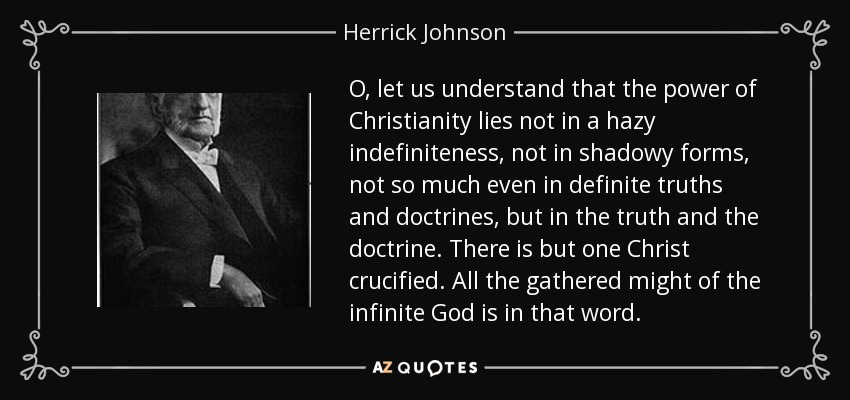
O, let us understand that the power of Christianity lies not in a hazy indefiniteness, not in shadowy forms, not so much even in definite truths and doctrines, but in the truth and the doctrine. There is but one Christ crucified. All the gathered might of the infinite God is in that word.
To Marx the claim of the theory of ideology is that all doctrine is a derivative of social circumstance.
How are we to adjudicate among rival ontologies? Certainly the answer is not provided by the semantical formula "To be is to be the value of a variable"; this formula serves rather, conversely, in testing the conformity of a given remark or doctrine to a prior ontological standard.
Nonbeing must in some sense be, otherwise what is it that there is not? This tangled doctrine might be nicknamed Plato's beard; historically it has proved tough, frequently dulling the edge of Occam's razor.
The orthodox doctrines of economics which were dominant in the last quarter of the nineteenth century had a clear message. They supported laisser faire, free trade, the gold standard, and the universally advantageous effects of the pursuit of profit by competitive private enterprise.
Pulling a crystalline, cogent rule out of the murk of the court's First Amendment, public forum, and Establishment Clause doctrine is an act of creation too complicated for mere mortals.
Only for you, children of doctrine and learning, have we written this work. Examine this book, ponder the meaning we have dispersed in various places and gathered again; what we have concealed in one place we have disclosed in another, that it may be understood by your wisdom.
My observation continues to confirm me more and more in the opinion, that to experience religion is to experience the truth of the great doctrines of Divine grace.
Why seek a doctrine? As soon as you have a doctrine, you fall into dualistic thought.
In their struggle for the ethical good, teachers of religion must have the stature to give up the doctrine of a personal god, that is, give up that source of fear and hope which in the past placed such vast power in the hands of priests. In their labors they will have to avail themselves of those forces which are capable of cultivating the Good, the True, and the Beautiful in humanity itself. This is, to be sure, a more difficult but an incomparably more worthy task.
Our idealists must own that their velleity to abolish all suffering is most fully expressed in the Fifth Wisdom of Lamaism, the doctrine that teaches that "no durable happiness, nor yet security, for any sentient being can exist while others are a prey to suffering." That truth cannot be questioned and you may take it to heart: in practical terms it means we got ourselves born on the wrong planet - in the wrong universe.
The air of caricature never fails to show itself in the products of reason applied relentlessly and without correction. The observation of clinical facts would seem to be a pursuit of the physician as harmless as it is indispensable. [But] it seemed irresistibly rational to certain minds that diseases should be as fully classifiable as are beetles and butterflies. This doctrine ... bore perhaps its richest fruit in the hands of Boissier de Sauvauges. In his Nosologia Methodica published in 1768 ... this Linnaeus of the bedside grouped diseases into ten classes, 295 genera, and 2400 species.
The popularisation of scientific doctrines is producing as great an alteration in the mental state of society as the material applications of science are effecting in its outward life. Such indeed is the respect paid to science, that the most absurd opinions may become current, provided they are expressed in language, the sound of which recals [sic] some well-known scientific phrase.
Whether moral and social phenomena are really exceptions to the general certainty and uniformity of the course of nature; and how far the methods, by which so many of the laws of the physical world have been numbered among truths irrevocably acquired and universally assented to, can be made instrumental to the gradual formation of a similar body of received doctrine in moral and political science.
The church at the time was much more faithful to reason than Galileo himself, and also took into consideration the ethical and social consequences of Galileo's doctrine. Its verdict against Galileo was rational and just.
Nothing could be more idiotic and absurd than the doctrine of the trinity.
Tell me there is a God in the serene heavens that will damn his children for the expression of an honest belief! More men have died in their sins, judged by your orthodox creeds, than there are leaves in all the forests in the wide world ten thousand times over. Tell me these men are in Hell; that these men are in torment; that these children are in eternal pain, and that they are to be punished forever and forever! I denounce this doctrine as the most infamous of lies.
I wish to propose for the reader's favourable consideration a doctrine which may, I fear, appear wildly paradoxical and subversive. The doctrine in question is this: that it is undesirable to believe a proposition when there is no ground whatever for supposing it true.
When it was first said that the sun stood still and world turned round, the common sense of mankind declared the doctrine false; but the old saying of Vox populi, vox Dei [the voice of the people is the voice of God], as every philosopher knows, cannot be trusted in science.
Dhyan means meditation. Meditation means awareness, watchfulness, a silent witnessing of all the processes of the mind. And the magic of watching is that as your watchfulness deepens, the mind starts evaporating. When the watchfulness is absolute mind becomes nil, a zero. And the disappearance of the mind gives you clarity, absolute clarity, transparency; you can see through and through, you become a mirror. And then life is reflected as it is - not according to any doctrine, not according to the Bible or the Koran or the Gita but as it is. And to know life as it is, is to know god.
Science is a human activity, and the best way to understand it is to understand the individual human beings who practise it. Science is an art form and not a philosophical method. The great advances in science usually result from new tools rather than from new doctrines. ... Every time we introduce a new tool, it always leads to new and unexpected discoveries, because Nature's imagination is richer than ours.
We can reject everything else: religion, ideology, all received wisdom. But we cannot escape the necessity of love and compassion. This, then, is my true religion, my simple faith. In this sense, there is no need for temple or church, for mosque or synagogue, no need for complicated philosophy, doctrine, or dogma. Our own heart, our own mind, is the temple. The doctrine is compassion. Love for others and respect for their rights and dignity, no matter who or what they are: ultimately these are all we need.
... what is really inspiriting and ennobling in the doctrine of freewill, is the conviction that we have real power over the formation of our own character; that our will, by influencing some of our circumstances, can modify our future habits or capabilities of willing.
I shall not fear to say that the doctrine of self-interest rightly understood seems to me of all the philosophic theories the most appropriate to the needs of men in our time, and that I see in it the most powerful guarantee against themselves that remains to them. The minds of the moralists of our day ought to turn, therefore, principally toward it. Even should they judge it imperfect, they would still have to adopt it as necessary.
Bolshevism is to be reckoned with Mohammedanism rather than with Christianity and Buddhism. Christianity and Buddhism are primarily personal religions, with mystical doctrines and a love of contemplation. Mohammedanism and Bolshevism are practical, social, unspiritual, concerned to win the empire of the world.
Follow AzQuotes on Facebook, Twitter and Google+. Every day we present the best quotes! Improve yourself, find your inspiration, share with friends
or simply: