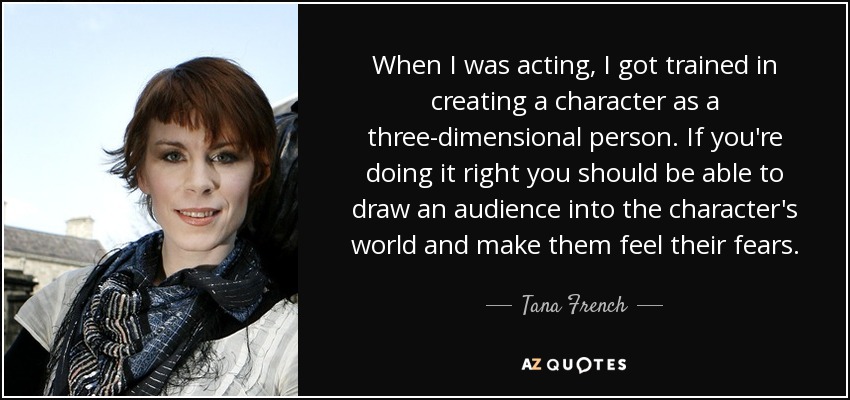
When I was acting, I got trained in creating a character as a three-dimensional person. If you're doing it right you should be able to draw an audience into the character's world and make them feel their fears.
The fact is I'm not making a film in order to draw pictures or make images about Iran.
Always get to the set or the location early, so that you can be all alone and draw your inspiration for the blocking and the setups in private and quiet. In one sense, it's about protecting yourself; in another sense, it's about always being open to surprise, even from the set, because there may be some detail that you hadn't noticed. I think this is crucial. There are many pictures that seem good in so many ways except one: They lack a sense of surprise, they've never left the page.
Woman draws her life from man and gives it back again, and there is love.
Just get out your magic pencil and erase the cloudy skies, and just draw a picture of me saying, I apologize.
Just as a moral distinction is drawn between "those at risk" and "those posing a risk", health education routinely draws a distinction between the harm caused by external causes out of the individual's control and that caused by oneself. Lifestyle risk discourse overturns the notion that health hazards in postindustrial society are out of the individual's control. On the contrary, the dominant theme of lifestyle risk discourse is the responsibility of the individual to avoid health risks for the sake of his or her own health as well as the greater good of society.
Health education emphasizing risks is a form of pedagogy, which, like other forms, serves to legitimize ideologies and social practices. Risk discourse in the public health sphere allows the state, as the owner of knowledge, to exert power of the bodies of its citizens. Risk discourse, therefore, especially when it emphasizes lifestyle risks, serves as an effective Foucauldian agent of surveillance and control that is difficult to challenge because of its manifest benevolent goal of maintaining standards of health. In doing so, it draws attention away from the structural causes of ill-health.
Anyone who agrees to be interviewed must decide where to draw the line between what is public and what is private. But the line can shift, depending on who is asking the questions. What puts someone on guard isn't necessarily the fear of being 'found out.' It sometimes is just the fear of being misunderstood.
I think I draw most inspiration from writers like Richelle Mead and filmmakers like John Hughes. They both really understand the experience of being a teenager and how insistent and intense everything feels, but they're also smart, savvy, and fun.
I happen to think Latinas, Latin women, are the most beautiful women in the world. So that's what I'm going to draw. I love women from all cultures, of course, but if I was going to deal with any of them, that would be No. 1 for me.
There's something fascinating about watching artists draw.
I like to draw my storyboards myself.
I'm not certain that I draw from any one culture more than others. Many myths and legends of many different cultures are really the same story when you get to the heart of it. They are often cultural cautionary tales about how we should behave and how we should live.
My opinions of which of my works are good are vastly different than other people's. There is one that I'm obsessed with but I swear... no one else has ever even commented on it. So I'm a bit shy to draw attention to it.
... being perpetually charmed by his familiar siren, that is, by his geometry, he neglected to eat and drink and took no care of his person; that he was often carried by force to the baths, and when there he would trace geometrical figures in the ashes of the fire, and with his finger draws lines upon his body when it was anointed with oil, being in a state of great ecstasy and divinely possessed by his science.
[M]ost people offend God by passing judgment on the things others do, especially important people, not knowing the reasons why they are doing what they do; for when one does not know the primary cause of some matter, what conclusions can he draw from it?
The love of God again makes us free, for it draws us to set a low value on those things wherein we are subject to others - our wealth, our position, our reputation, and our life - and to set a high value on those things which no man can take from us - our integrity, our righteousness, our love for all men, and our communion with God.
Weight is caused by one element being situated in another; and it moves by the shortest line towards its centre, not by its own choice, not because the centre draws it to itself, but because the other intervening element cannot withstand it.
I describe management as arts, crafts and science. It is a practice that draws on arts, craft and science and there is a lot of craft - meaning experience - there is a certain amount of craft meaning insight, creativity and vision, and there is the use of science, technique or analysis.
The guy who could be me, but he knows when to draw the line, is John Cena. John Cena can rock 'n' roll, let me tell you.
Photography must seize upon this moment and hold immobile the equilibrium of it. The photographers eye is perpetually evaluating. A photographer can bring coincidence of line simply by moving his head a fraction of a millimeter. He can modify perspectives by a slight bending of the knees. By placing the camera closer to or farther from the subject, he draws a detail — and it can be subordinated, or he can be tyrannized by it.
You belong in the most secret part of you. Don’t worry about cool, make your own uncool. Make your own, your own world. If you fear, make it work for you—draw and paint your fear and anxiety.
There are only four or five real events that we have that draw that many people into town each year. We should have at least 12; and once we have 12, we can have 24.
What is Communism? Communism is the doctrine of the conditions of the liberation of the proletariat. What is the proletariat? The proletariat is that class in society which lives entirely from the sale of its labor and does not draw profit from any kind of capital; whose weal and woe, whose life and death, whose sole existence depends on the demand for labor.
Two of the vital pillars that sustain Father in Heaven’s plan of happiness are marriage and the family. Their lofty significance is underscored by Satan’s relentless efforts to splinter the family and to undermine the significance of temple ordinances, which bind the family together for eternity. The temple sealing has greater meaning as life unfolds. It will help you draw ever closer together and find greater joy and fulfillment in mortality.
Follow AzQuotes on Facebook, Twitter and Google+. Every day we present the best quotes! Improve yourself, find your inspiration, share with friends
or simply: