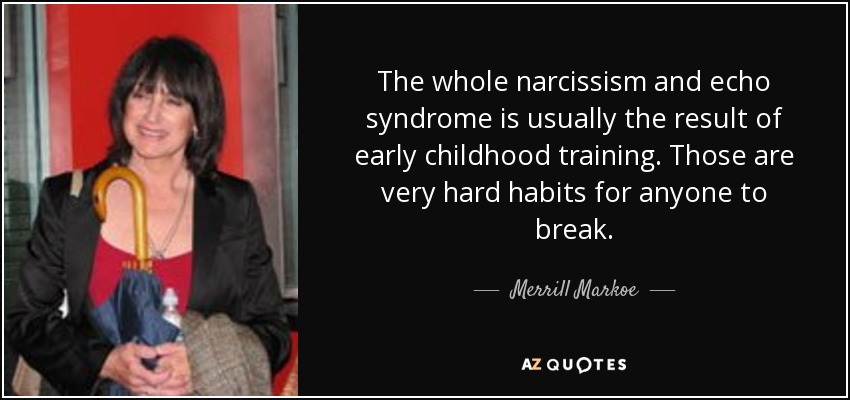
The whole narcissism and echo syndrome is usually the result of early childhood training. Those are very hard habits for anyone to break.
The conviction that the best way to prepare children for a harsh, rapidly changing world is to introduce formal instruction at anearly age is wrong. There is simply no evidence to support it, and considerable evidence against it. Starting children early academically has not worked in the past and is not working now.
With two sons born eighteen months apart, I operated mainly on automatic pilot through the ceaseless activity of their early childhood. I remember opening the refrigerator late one night and finding a roll of aluminum foil next to a pair of small red tennies. Certain that I was responsible for the refrigerated shoes, I quickly closed the door and ran upstairs to make sure I had put the babies in their cribs instead of the linen closet.
To mourn is to be extraordinarily vulnerable. It is to be at the mercy of inside feelings and outside events in a way most of us have not been since early childhood.
Exploration of the natural world begins in early childhood, flourishes in middle childhood, and continues in adolescence as a pleasure and a source of strength for social action.
I certainly don't think it's inevitable that we don't love children who don't carry our own DNA. If that were true we wouldn't have millions of successful adoptions to consider. I do think that it's harder to love a child when you come into that child's life after the unrequited passion of infancy and early childhood has passed.
From early childhood, I was interested in understanding how the world worked, and assumed I would be some kind of physical scientist or chemist. But the truth was, I didn't know there was another kind of world, the inner world, that was just as interesting, if not more relevant, than what was going on in the outside world.
We spend at least $5 for remedial education right now for every dollar we put in early childhood education. All the studies on early childhood education show this is going to pay for itself.
To me the early childhood story is an ecumenical one. You take poverty seriously. You take seriously maternal depression. You take seriously children under stress and you take seriously the effects of extended hours participation in poor quality care. Those are the facts I begin with.
An enthusiastic desire of visiting the Old World haunted me from early childhood. I cherished a presentiment, amounting almost to belief, that I should one day behold the scenes, among which my fancy had so long wandered.
We invest in early childhood education. We invest additional job training dollars. We make sure that we've got a strong research and development strategy so that we continue to innovate. Rebuilding our infrastructure, which we know will attract businesses.
There can be no doubt that the young of today have to be protected against certain poisonous effects inherent in present-day civilization. Five social diseases surround them, even in early childhood. There is the decline in fitness due to modern methods of locomotion; the decline in initiative due to the widespread disease of spectatoritis; the decline in care and skill due to the weakened tradition of craftsmanship; the decline in self-discipline due to the ever-present availability of tranquilizers and stimulants, and the decline in compassion, which William Temple called "spiritual death.
Young children learn in a different manner from that of older children and adults, yet we can teach them many things if we adapt our materials and mode of instruction to their level of ability. But we miseducate young children when we assume that their learning abilities are comparable to those of older children and that they can be taught with materials and with the same instructional procedures appropriate to school-age children.
Oh, be assured, fellow teachers, that there is no time in life so favorable to sound conversion as early childhood.
We have good reason to believe that memories of early childhood do not persist in consciousness because of the absence or fragmentary character of language covering this period. Words serve as fixatives for mental images. . . . Even at the end of the second year of life when word tags exist for a number of objects in the child's life, these words are discrete and do not yet bind together the parts of an experience or organize them in a way that can produce a coherent memory.
In my early childhood, I was a performer by nature. I used to do puppet shows as a kid and entertain kids in classes and the teachers would make it a point that I was the entertainer of the class, but only after high school and in college that I started doing theater and acting classes, because I thought it would be fun.
Quintilian [educational writer in Rome around A.D. 100] thought that the earliest years of the child's life were crucial. Education should start earlier than age seven, within the family. It should not be so hard as to give the child an aversion to learning. Rather, these early lessons would take the form of play--that embryonic notion of kindergarten.
Some children lack tools to see their course in the world in far-sighted ways. Just introducing school vouchers won't change that. You have to have nurse-home partnerships, early childhood education, mentoring programs and so on. People learn from people they love.
The years of early childhood are the time to prepare the soil.
I focus on supporting high quality early childhood health care and education. By betting my resources on very young children, I know I'm making an investment that pays guaranteed dividends with a high rate of return.
Behavior runs in deep channels that were cut during early childhood, and it is very difficult to alter them. In order to change a deeply ingrained pattern, you have to build a sturdy dam, dig another canal and reroute the river in the new direction. That effort is rarely successful over the long haul.
Love is the supreme form of communication. In the hierarchy of needs, love stands as the supreme developing agent of the humanity of the person. As such, the teaching of love should be the central core of all early childhood curriculum with all other subjects growing naturally out of such teaching.
I thought, "Well, I'm writing about early childhood, so maybe it would make sense to write about late childhood as well, early adulthood." Those were my thoughts, and this was how this crazy book [Winter Journal] was composed. I've never seen a book with pictures like at the end, pictures related to things you've read before.
Follow AzQuotes on Facebook, Twitter and Google+. Every day we present the best quotes! Improve yourself, find your inspiration, share with friends
or simply: