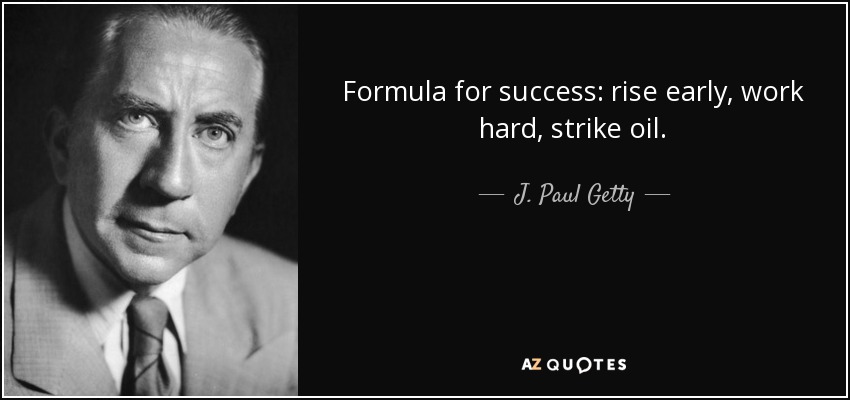
Formula for success: rise early, work hard, strike oil.
An artist's early work is inevitably made up of a mixture of tendencies and interests, some of which are compatible and some of which are in conflict
My first two books are out of print and, okay, they can sleep there comfortably. It's early work, derivative work.
In my early work, I tried to hide my personality, my psychological state, my emotions. This was partly due to my feelings about myself and partly due to my feelings about painting at the time. I sort of stuck to my guns for a while but eventually it seemed like a losing battle. Finally one must simply drop the reserve.
Work on causal theories of knowledge - early work by Armstrong, and Dretske, and Goldman - seemed far more satisfying. As I started to see the ways in which work in the cognitive sciences could inform our understanding of central epistemological issues, my whole idea of what the philosophical enterprise is all about began to change. Quine certainly played a role here, as did Putnam's (pre-1975) work in philosophy of science, and the exciting developments that went on in that time in philosophy of mind.
Much of the early work focused on dopamine and we were really looking for rewarding sorts of effects and sure enough, we only found that. But you can destroy the main dopamine-producing structures of the brain and you can still get an animal to self-administer drugs like cocaine.
There are some very similar moments in the early work where the focus was on drawing, abstraction and fragmentation. Then it moved to the development of ideas. Lately it has become what architecture should be, which is more fluid organization. There has not been so much 'a change' but 'a development'.
[When you are an actor] it's not a burden to go to work whether it's hard work, whether it's super early work, whatever. So, I go there because I want to be there. I want to do this. That helps a lot.
I can look at my early work and see what a pained struggle it was to draw what I was drawing. I was trying so hard to get this specific look that was in my head, and always falling short.
We have to focus on his early work, and just one or two of his movies, and elements of his TV shows, to keep his memory pure. People now know that Elvis could play a mean rhythm guitar himself, and needed no other musicians to perform a great song. But Elvis was not just a rock star, he was an all-round entertainer.
For years, my early work with Roger Penrose seemed to be a disaster for science. It showed that the universe must have begun with a singularity, if Einstein's general theory of relativity is correct. That appeared to indicate that science could not predict how the universe would begin.
In my early work I didn't use much colour. I had no confidence about how I could do this.
Then I realized my early work did have something special that audiences adored apart from what I humbly thought about them. They occupy a distinguished niche in Italian film history and probably always will.
They [the critics] deal with Schoenberg's early works and all their wealth by classifying them, with the music-historical cliché, as late romantic post-Wagnerian. One might just as well dispose of Beethoven as a late-classicist post-Haydnerian.
The world that seemed so various and new, well, it does contract. One's burning desire to investigate human behavior, and to make, or imply, statements about it, does fall off. And so one does find that early works are full of energy and also full of vulgarity, crudity, and incompetence, and later works are more carefully finished, and in that sense better literary products. But . . . there's often a freshness that is missing in later works--for every gain there's a loss. I think it evens out in that way.
I suppose some people find their voice later than others, but it's interesting to look back at really early work to see that there's some kernel or a Rosetta Stone, in a way.
As I look over my work, I mean every time I look over my early work, I see, yes, I could do that then and then I could do that and that... That may be the hardest thing for a writer, at least for a poet, to tell what the identity of his work is.
People wanted to get me published, and my early work was so weird that they weren't getting anywhere. I thought, okay, I'll do something that's just a tad more normal.
My early work and publications centered around expanding on the analysis of life insurance in my dissertation and its relationship to investment banking.
If you get up early, work late, and pay your taxes, you will get ahead -- if you strike oil.
There is in my work a very strong religious foreground and background. In the later work some of that tends to diminish, but it's certainly present in the early work.
The secret of success is to get up early, work late and strike oil.
I don’t go back and look at my early work, because the last time I did, many years ago, it left me cringing. If one publishes, then one is creating a public record of Learning to Write.
Documentation is misleading, because the performance is dead. So the very early works were not documented at all.
I actually never knew Peter Green but I do respect his early work very much.
Follow AzQuotes on Facebook, Twitter and Google+. Every day we present the best quotes! Improve yourself, find your inspiration, share with friends
or simply: