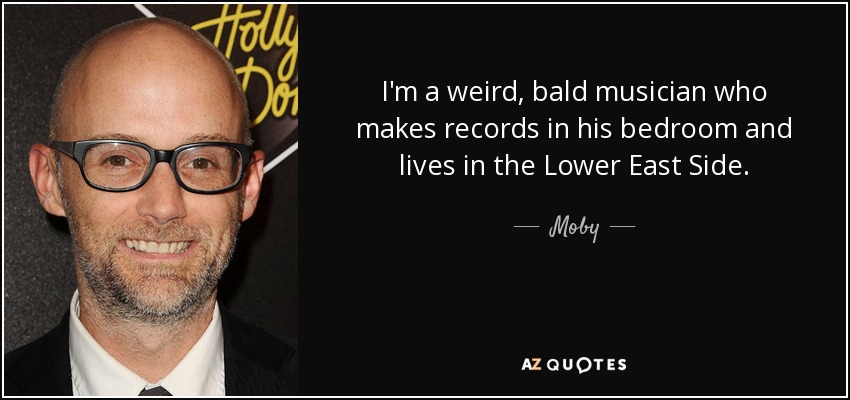
I'm a weird, bald musician who makes records in his bedroom and lives in the Lower East Side.
There's not a lot of precedent for weird, bald musicians in the Lower East Side making records in their bedrooms and going on to sell a lot of copies of the record. Especially if you look at the pop climate.
There are many reasons that universities in East Asia have not reached the positions that they had hoped for. After all, we must remember that modern East Asia did not begin with Confucius. In fact the experience of modern education in East Asia is relatively short and granted that time scale, many universities are doing fine.
There seems also to be a tremendous risk to indigenous cultures if we insist that all scholarship be conducted in English. We are, for example, dealing with ancient and very highly-developed cultures in Korea, Japan, China and the Middle East. What is the impact on cultural and scholarly vitality forcing everyone to do their work in English? I do not have an answer, but this issue has been very much on my mind.
In some Arab art exhibitions that have happened, there's always this idea that the East is more traditional; they show a lot of works on calligraphy and religion.
There are fewer Arabs in Tel Aviv, one of the largest cities in the Middle East, than there are in Chicago, the largest city in the American Midwest. How do you accomplish such a remarkable feat of social engineering without massive violence?
When I think about singing, and music, I think about how the people who live on the East Tennessee side have more of a curve or yodel to their voices, and then you think about the curve of mountains.
So much of what we see and hear about the Middle East focuses on what we call politics, which is essentially ideology. But when it comes to the Middle East, and especially the Arab world, simply depicting people as human beings is the most political thing you can do.
In the Middle East, bread is so essential to everyday life that word for it in Egyptian Arabic is aish, which means life. It's always been the staple grain. But the predicament is that the Fertile Crescent, where wheat cultivation began, has now become the part of the world most dependent on imported wheat.
There's a long history in the Middle East of "bread intifadas," starting with 1977 in Egypt, when Anwar Sadat tried to lift bread subsidies. People rebelled and poured into Tahrir Square, shouting slogans against the government just like they did earlier this year. Sadat learned his lesson and kept bread subsidies in place, and so did a host of other Middle Eastern dictators - many of whom were propped up for years by the West, partly through subsidized American wheat.
The problem is that so many of them are not getting told. This is a massive problem, not just in the Middle East but for places from Africa to Afghanistan. There are millions of stories out there, millions of potential Booksellers of Kabul or Valentino Achak Dengs.
I told Sarah Palin it would be absolutely fine. I thought it would be appropriate. There was tremendous press, and I think it`s something that`s very important to discuss.Not even for her son, but for so many other sons and daughters that are coming back from the Middle East, where they have traumatic problems. They have tremendous problems.
We have chaos reigning in the Middle East. There is a great deal of instability. In the past, people would have turned to their church, and some still do. Counterintuitively, people are now turning into themselves to find their roots. The way you do that is through your family tree. "Where did I come from?" There is an urge to preserve the names of the people who produced you.
We will not commit suicide because of pressure from the international community. A Palestinian state is not possible at the moment. I would rather fight and try to explain the situation in the Middle East to the world than to agree to steps that harm my country to satisfy the international community.
I started in theater when I was 14 in the Henry Street Playhouse on the Lower East Side in New York. You hustle, you beat the sidewalk, the pavement - audition, audition. I just started working around town everywhere. I mean everywhere - the Village, Harlem, you know. Brooklyn Academy Of Music. Just job after job.
I mean, you can agree or disagree with Iraq or Afghanistan, but by the way, now the great campaigning cause out there is the absence of intervention in Syria. And then in Libya, it's partial intervention. And that doesn't really explain why some countries that have literally nothing to do with the interventions in the Middle East end up getting targeted.
You've got problems in Central Asia. And you've got problems within our own communities back home. So if we end up saying, look, this has nothing to do with Islam or it's got no connection with that broader question, then we look, frankly, as if we're in denial about the problem. And the interesting thing in the Middle East is that they have absolutely no problem there in identifying that as Islamist extremism and calling it that.
Well, after Zombie Birdhouse came out, I toured behind it in the fall of 1982, into the spring, and in the summer in the Far East. At that time, I found my work self-referential; it was getting to be rock songs about a rock singer who lived a rock life on the rock road, and I was starting to wonder what I would be like to rent my own apartment, what it would be like to have a checkbook.
They [root causes of terror] come out of a long dialectic of U.S. involvement in the affairs of the Islamic world, the oil-producing world, the Arab world, the Middle East - those areas that are considered to be essential to U.S. interests and security.
A lot of artists are scared to do that, they are scared to step out on their own. What am I the super villain of western Canada is that what I am? Is Classified the clean cut, staying true to his roots, hip hop guy from the East coast that stays in his lane and he made it big staying true to what he did and didn't make corny music? Then that is what he is and I am proud of him for that.
This and the small sample size inevitably leads to stereotypes - sweeping family sagas from India, 'lush' colonial romances from South-East Asia. Mother and daughter reconciling generational differences through preparing a 'traditional' meal together. Geishas. And even if something more exciting does manage to sneak through, it gets the same insultingly clichéd cover slapped on it anyway, so no one will ever know.
We're being attacked, Britain is being attacked, our allies are being attacked because we've installed and backed and implemented a set of policies in the Middle East for the last years or more.
There's practical political considerations obviously, but there's also these broader themes, which is like, I don't want to be the manager of the Middle East.
'm constantly depressed by the Mexican gang members I meet in East L.A. who essentially live their lives inside five or six blocks. They are caught in some tiny ghetto of the mind that limits them to these five blocks because, they say, "I'm Mexican. I live here." And I say, "What do you mean you live here - five blocks? Your granny, your abualita, walked two thousand miles to get here. She violated borders, moved from one language to another, moved from a sixteenth-century village to a twenty-first-century city, and you live within five blocks?"
There are definitely recurring themes in humanity's relationship with our environment. The biggest is probably adaptation, because humans are incredibly good at adapting to new environments in relatively short periods of time. The ancestors of Homo sapiens started leaving Africa over one million years ago, moving from warm, tropical climates into the freezing wilderness of Europe and the desert ecosystems of the Middle East.
Follow AzQuotes on Facebook, Twitter and Google+. Every day we present the best quotes! Improve yourself, find your inspiration, share with friends
or simply: