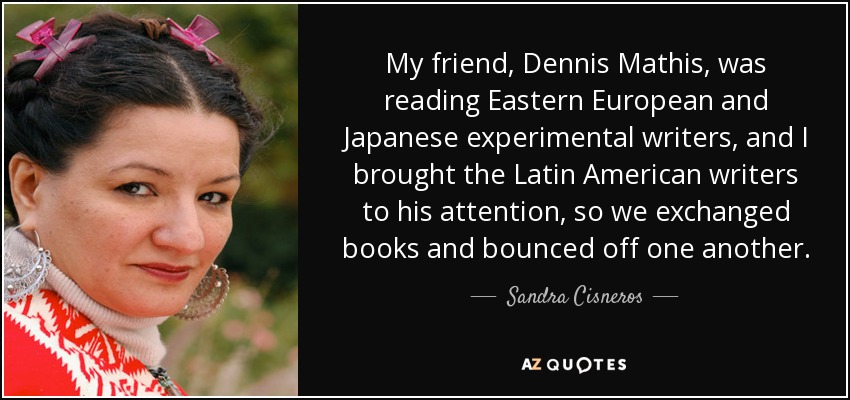
My friend, Dennis Mathis, was reading Eastern European and Japanese experimental writers, and I brought the Latin American writers to his attention, so we exchanged books and bounced off one another.
Get yourself empty in the Eastern sense. Not in the Western sense. In the Western sense when we feel empty we feel lonely, miserable, but in the Eastern sense - "I'm so empty, because I'm filled with everything, and I'm connected to everything." It's very energizing. You want that kind of emptiness, whatever you have to do to get yourself quiet.
Because my main concern is the Tibetan Buddhist culture, not just political independence, I cannot seek self-rule for central Tibet and exclude the 4 million Tibetans in our two eastern provinces of Amdo and Kham.
I've been in a couple with different races like Latino, white, Middle Eastern.
If someone is willing to reconsider the results of World War II, let us discuss this. But then we will have to discuss not only Kaliningrad, but also the eastern lands of Germany, the city of Lvov, a former part of Poland, and so on, and so forth. There are also Hungary and Romania on the list.
There are a few societies that show signs of having been very rational about the physics of construction and the physics of real life. Some of the old middle-Eastern societies had downdraft systems over whole cities, and passive, rapid-evaporation ice-making systems. They were rational people using good physical principles to make themselves comfortable without additional sources of energy.
Many young Danish theologians went to Wittenberg starting in 1517, listened to Luther's theses and, in 1536, brought the Reformation to our country. This is why the Danes, unlike the people of many countries in Eastern and Central Europe, became Lutherans and not Calvinists.
I began researching and writing what I intended as a book-length essay entitled Fascination and Liberation, exploring the question of whether there is a conflict between creativity and the Eastern form of enlightenment. I don't know if I'll ever finish that essay, because I had an experience, after I'd written two or three chapters, in which it seemed to me that my psychic antibodies decisively rejected Buddhism. Interestingly, the rejection felt as if it happened in Zen terms.
[william] Burroughs, incidentally, took up the slogan that we are "Here to go", which contradicts the tendency in Eastern mysticism to advocate staying where you are because there's nowhere to go anyway. I feel conflicted on this one.
The part in Aleppo, what [people] call it the eastern part, is occupied by the terrorists for the last three years, and they have been using the civilians as human shields.
Once the Eastern Bloc collapsed, what I call 'historical spontaneity' prevailed and the countries that were subject to Soviet control naturally gravitated to the West. That's where they sought their security; I don't think there was a way to avoid that. If we tried to exclude them, we would have today not one Europe, we would have three Europes: one in the West, one in the middle and one in the East, and the middle would be insecure and a tempting target. The insecurity felt [today] by Eastern Europe would be replicated on a much larger and more consequential scale.
The Israelis have taken a lot of security measures which reduce significantly the ability of Iran to inflict truly severe pain in Israel. But America is vulnerable with 100,000 troops in Iraq and more than half of that in Afghanistan, and we depend heavily on access to Middle Eastern oil. We're sitting targets for debilitating Iranian retaliation.
I don't want to predict calamity. But I am afraid of a new Russian occupation of parts of Eastern Europe. Also of a new Russian campaign to exert influence in Germany or other parts Europe, aimed at making continental politics less democratic. I am afraid of a US trade war and even a shooting war with China.
An American professor complained that a crypto-Marxist like me was invited in the USA, and I was denounced by the press in Eastern European countries for being an accomplice of the dissidents. None of these descriptions is important by itself; taken together, on the other hand, they mean something. And I must admit that I rather like what they mean.
The bad news is that the movement toward the partnership side of the social scale (and it is always a matter of degree, as no society is a pure partnership or domination system) has been fiercely resisted and countered by periodic regressions. So domination systems have rebuilt themselves in different forms - be they secular or religious, eastern or western, leftist or rightist.
It is not coincidental that for so-called religious fundamentalists - whether they are Western or Eastern, Muslim or Christian - rigid male dominance and "holy wars" are priorities. Or that competing sects of the same religion, such as Sunni and Shia, are at each other's throats. In these cultures, women are rigidly controlled by men.
In fact, what were called the socialist countries in Eastern Europe were the most anti-socialist systems in the world. Workers had more rights in the United States and England than they had in Russia, and it was somehow still called socialism.
The main mineral in your cellphone, coltan [a black metallic ore], comes from the Eastern Congo. Multinational corporations are there exploiting the very rich mineral resources of the region. A lot of them are backing militias which are fighting one other to gain control of the resources or a piece of the resources.
I think that it is true that for me as I observe it, that the Western World tends to be more of , tends to encompass more of, the masculine energy of the planet itself, the planet's population. Whereas the Eastern part of the world tends to encompass more of the planet's population's feminine aspects. And for those reasons the East and the West tend to approach God very much as men and women do. So the differences between East and West are the differences between men and women, largely.
Most of intellectuals are false prophets, flatterers of the court. The real prophets are the exception and treated badly. How badly they're treated depends on the society. Like in Eastern Europe, they were treated very badly. In Latin America, they were slaughtered.
Every once in a while I check and I say, do I still believe in God? And the answer is absolutely yes. And then I think, I suppose I should go to church now. But after going to so many churches in my life and trying to go with the flow with so many denominations, Eastern and Western, I don't really feel I need to go to church at all.
Whether we like it or not, the modernity is something that comes from Western countries, and when the modernity comes to the Eastern countries, although they feel like they really need it, at the same time it shakes the very fundament of the culture - there is always this challenge between the two.
There is much appeal for me in Eastern religion, the little I know of it. And something thorny in me finds American adaptations of Buddhism terribly self-indulgent, silly, gooey in the way the English call "wet."
Luckily I was not born in Eastern Europe, because I might have been born into the communist establishment and I'm glad I was not. But in Israel, communists were dissidents. So you grow up in an environment which is very critical of Israeli policies.
I tell you, my fellow Americans, that if we learned anything from the collapse of the Berlin Wall and the fall of the governments in Eastern Europe, even a totally controlled society cannot resist the winds of change that economics and technology and information flow have imposed in this world of ours. That is not an option. Our only realistic option is to embrace these changes and create the jobs of tomorrow.
Follow AzQuotes on Facebook, Twitter and Google+. Every day we present the best quotes! Improve yourself, find your inspiration, share with friends
or simply: