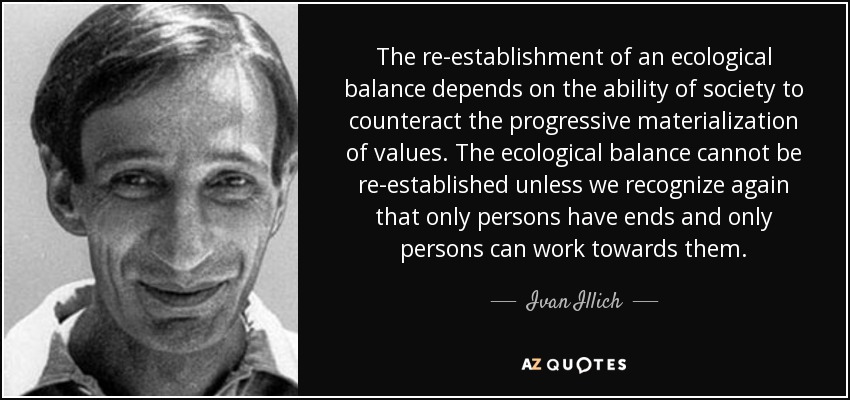
The re-establishment of an ecological balance depends on the ability of society to counteract the progressive materialization of values. The ecological balance cannot be re-established unless we recognize again that only persons have ends and only persons can work towards them.
In Germany it is good if as many people as possible join initiatives and peaceful demonstrations against the rule of the financial markets. Worshipping the unfettered freedom of global markets has brought the world to the brink of ruin. We now need social and ecological rules for the market economy.
In reality, we haven't escaped the gravity of life at all. We are still beholden to ecological laws, the same as any other life-form.
The real survivors are the Earth inhabitants that have lived millions of years without consuming their ecological capital, the base from which all abundance flows.
A species consists of a group of populations which replace each other geographically or ecologically and of which the neighboring ones integrate or hybridise wherever they are in contact or which are potentially capable of doing so (with one or more of the populations) in those cases where contact is prevented by geographical or ecological barriers.
You do not belong to you. You belong to the universe. The significance of you will remain forever obscure to you, but you may assume you are fulfilling your significance if you apply yourself to converting all you experience to highest advantage to others. Make the world work, for 100% of humanity, in the shortest possible time, through spontaneous cooperation, without ecological offense or the disadvantage of anyone.
... the ecological problem of our times demands a radical reevaluation of how we see the entire world; it demands a different interpretation of matter and the world, a new attitude of humankind toward nature, and a new understanding of how we acquire and make use of our material goods.
The ecological crisis shows the urgency of a solidarity which embraces time and space... A greater sense of intergenerational solidarity is urgently needed. Future generations cannot be saddled with the cost of our use of common environmental resources.
The dramatic threat of ecological breakdown is teaching us the extent to which greed and selfishness are contrary to the order of creation. ...A given culture reveals its understanding of life through the choices it makes in production and consumption... a great deal of educational and cultural work is urgently needed, including the education of consumers in the responsible use of their power of choice.
The seriousness of ecological degradation lays bare the depth of man's moral crisis... Simplicity, moderation, and discipline as well as the spirit of sacrifice must become a part of everyday life.
At the heart of the WTO is an assault on everything left standing in the commons, in the public realm. Everything is now for sale. Even those areas of life that we once considered sacred like health and education, food and water and air and seeds and genes and a heritage. It is all now for sale. Economic freedom - not democracy, and not ecological stewardship - is the defining metaphor of the WTO and its central goal is humanity's mastery of the natural world through its total commodification.
What makes the IoT a disruptive technology in the way we organize economic life is that it helps humanity reintegrate itself into the complex choreography of the biosphere, and by doing so, dramatically increases productivity without compromising the ecological relationships that govern the planet.
The most profound and serious indication of the moral implications underlying the ecological problem is the lack of respect for life evident in many of the patterns of environmental pollution.
Human use of fossil fuels is altering the chemistry of the atmosphere; oceans are polluted and depleted of fish; 80 per cent of Earth's forests are heavily impacted or gone yet their destruction continues. An estimated 50,000 species are driven to extinction each year. We dump millions of tonnes of chemicals, most untested for their biological effects, and many highly toxic, into air, water and soil. We have created an ecological holocaust. Our very health and survival are at stake, yet we act as if we have plenty of time to respond.
The roots of our ecological crises are axiomatic: they lie in our belief and value structures which shape our relationship with nature, with each other and the lifestyles we lead.
I have always been a big advocate of tap water-not because I think it harmless but because the idea of purchasing water extracted from some remote watershed and then hauled halfway round the world bothers me. Drinking bottled water relieves people of their concern about ecological threats to the river they live by or to the basins of groundwater they live over. It's the same kind of thinking that leads some to the complacent conclusion that if things on earth get bad enough, well, we'll just blast off to a space station somewhere else.
Modern society will find no solution to the ecological problem unless it takes a serious look at its lifestyle. In many parts of the world society is given to instant gratification and consumerism while remaining indifferent to the damage which these attitudes cause. Simplicity, moderation and discipline, as well as a spirit of sacrifice, must become part of everyday life, lest all suffer the negative consequences of the careless habits of a few.
The modern age has been characterized by a Promethean spirit, a restless energy that preys on speed records and shortcuts, unmindful of the past, uncaring of the future, existing only for the moment and the quick fix. The earthly rhythms that characterize a more pastoral way of life have been shunted aside to make room for the fast track of an urbanized existence. Lost in a sea of perpetual technological transition, modern man and woman find themselves increasingly alienated from the ecological choreography of the planet.
It is really important to solve the problem of rational utilization and distribution of wate supplies. I dare say, the shortage of fresh water is the major ecological problem of this moment.
What the new fertilizer technology has accomplished for the farmer is clear: more crop can be produced on less acreage than before. Since the cost of fertilizer, relative to the resultant gain in crop sales, is lower than that of any other economic input, and since the Land Bank pays the farmer for acreage not in crops, the new technology pays him well. The cost-in environmental degradation-is borne by his neighbors in town who find their water polluted. The new technology is an economic success-but only because it is an ecological failure.
Canada regards herself as responsible to all mankind for the peculiar ecological balance that now exists so precariously in the water, ice and land areas of the Arctic archipelago. We do not doubt for a moment that the rest of the world would find us at fault, and hold us liable, should we fail to ensure adequate protection of that environment from pollution or artificial deterioration.
Consider the willful scorching of the earth, over-fishing, wasteful hunting, excessive and dangerous recycling of resources, and other similar "injustices" against the ways of nature share in the responsibility for this ecological spiraling down.
Perhaps the simplest example is a synthetic plastic, which unlike natural materials, is not degraded by biological decay. It therefore persists as rubbish or is burned-in both cases causing pollution. In the same way, a substance such as DDT or lead, which plays no role in the chemistry of life and interferes with the actions of substances that do, is bound to cause ecological damage if sufficiently concentrated.
Women's struggle for equality worldwide is about more than equality between men and women. Our struggle is about reversing the trends of social, economic, political, and ecological crisis - a global nervous breakdown! Our struggle is about creating sustainable lives and attainable dreams.
I'm first and foremost a biological explorer. I've looked all over the world for answers. Secondly, I'm an ecological designer, and by that I mean I attempt to work with constellations of nature to create technological forms. So I'm part engineer, part ecologist, part inventor, really.
Follow AzQuotes on Facebook, Twitter and Google+. Every day we present the best quotes! Improve yourself, find your inspiration, share with friends
or simply: