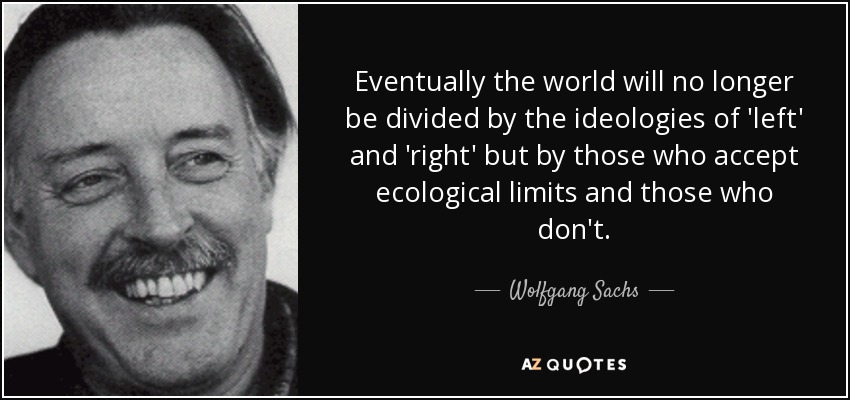
Eventually the world will no longer be divided by the ideologies of 'left' and 'right' but by those who accept ecological limits and those who don't.
A society that could heal the dismembered world would recognize the inherent value of each person and of the plant, animal and elemental life that makes up the earth's living body; it would offer real protection, encourage free expression, and reestablish an ecological balance to be biologically and economically sustainable. Its underlying metaphor would be mystery, the sense of wonder at all that is beyond us and around us, at the forces that sustain our lives and the intricate complexity and beauty of their dance.
The blending of architecture, solar, wind, biological and electronic technologies with housing, food production, and waste utilization within an ecological and cultural context will be the basis of creating a new ...design science for the post-petroleum era.
Reasons to be positive. The economic downturn could be the catalyst for positive change. It should be translated into the wake-up call we need for a major change in aspirations and lifestyles to save humanity from the ecological and economic disaster that would otherwise result from continuing on the high carbon and resource depleting path we have been pursuing
The path to relative economic, social and ecological sustainability is guaranteed to be littered with failures of every nature and scale. If we recognize them and learn from them, the transition will proceed faster and in more resource-efficient ways. If, on the other hand, we prefer the short-term comfort of burying our failures, or of blaming scapegoats, the transition will be significantly slowed, or could even be derailed completely.
We think there is an ecological problem, but the real problem is irresponsible growth of human population.
The superabundance is an ecological myth that we will never run out of resources, that the Earth, that Gaia, is in this perpetual state of renewal. And the "contagious magic" is the blind belief that this is the case, and the reason we're careering towards ecological disaster.
Having a place means that you know what a place means...what it means in a storied sense of myth, character and presence but also in an ecological sense...Integrating native consciousness with mythic consciousness
The ecological challenges we face are the result of billions of ecologically ignorant decisions made by billions of people over centuries. To address the climate crisis, we now need billions of people to make ecologically intelligent decisions.
Like our finances, humankind is living with a growing ecological deficit but the solution is different. The deficit will worsen with dangerous consequences unless we address population growth sooner rather than later. Efficiency improvements, increased use of renewable resources and less waste in themselves are no longer sufficient to put us back into credit
An important measure of our true commitment to environmental quality is our dedication to protecting the wilderness and its inhabitants. We must recognize their ecological significance and preserve them as sources of inspiration and education. And we need them as places of quiet refuge and reflection.
When the Kundalini rises, automatically you develop your own balances and that balanced life manifests outside. Now this ecological problem can be solved as soon as human beings get transformed and develop their balances. Because we are imbalanced, that's why the nature has gone into imbalance.
Look at what realists have done for us. They have led us to war and climate change, poverty on an unimaginable scale, and wholesale ecological destruction. Half of humanity goes to bed hungry because of all the realistic leaders in the world. I tell people who call me 'unrealistic' to show me what their realism has done. Realism is an outdated, overplayed and wholly exaggerated concept.
Prosperity consists in our ability to flourish as human beings - within the ecological limits of a finite planet. The challenge for our society is to create the conditions under which this is possible. It is the most urgent task of our times.
The abuse of the Earth is the ecological crisis.
When you don't take into account the way ecological systems work, then you do damage.
Humankind has suddenly entered into a brand new relationship with our planet. Unless we quickly and profoundly change the course of our civilization, we face an immediate and grave danger of destroying the worldwide ecological system that sustains life as we know it.
Individuals can refuse to use a given technology, but unless they live in total isolation will have to engage with people whose psyches have been shaped by a multitude of technologies. And there is no escaping the pervasive ecological effects.
In my case I would emphasize anarcho-communalism, along with the ecological questions, the feminist questions, the anti-nuclear issues that exist, and along with the articulation of popular institutions in the community. I think it's terribly important for anarchists to do that because at this moment not very much is happening anywhere in North America.
Few understand that procrastination is our natural defense, letting things take care of themselves and exercise their antifragility; it results from some ecological or naturalistic wisdom, and is not always bad - at an existential level, it is my body rebelling against its entrapment. It is my soul fighting the Procrustean bed of modernity.
The shortage of fresh water is the major ecological problem of this moment.
Life and families and babies are all joyous gifts. But if we do not begin to truly account for our numbers, we will surely create an ecological crisis that will only lead to anguish and despair.
We see a world of abundance, not limits. In the midst of a great deal of talk about reducing the human ecological footprint, we offer a different vision. What if humans designed products and systems that celebrate an abundance of human creativity, culture, and productivity? That are so intelligent and safe, our species leaves an ecological footprint to delight in, not lament?
The ecological impact of book manufacture and traditional book marketing - I think that should really be considered. We have this industry in which we cut down trees to make the paper that we then use enormous amounts of electricity to turn into books that weigh a great deal and are then shipped enormous distances to point-of-sale retail.
Birds ... are sensitive indicators of the environment, a sort of "ecological litmus paper," ... The observation and recording of bird populations over time lead inevitably to environmental awareness and can signal impending changes.
Follow AzQuotes on Facebook, Twitter and Google+. Every day we present the best quotes! Improve yourself, find your inspiration, share with friends
or simply: