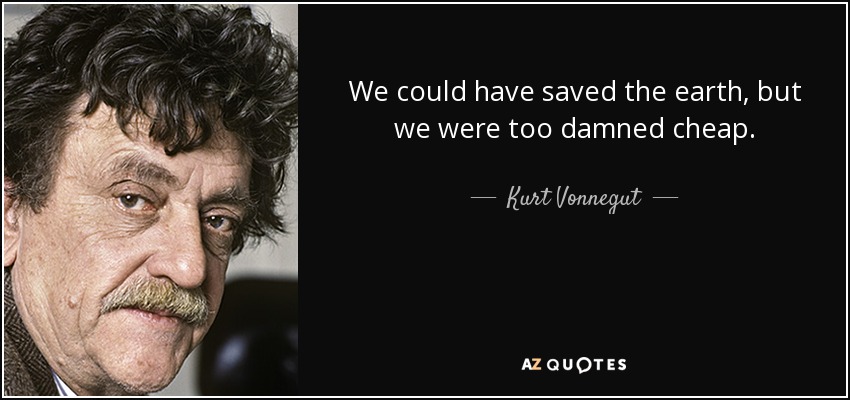
We could have saved the earth, but we were too damned cheap.
Diversity is a survival factor for the community itself. A community of a hundred million species can survive anything short of total global catastrophe. Within that hundred million will be thousands that could survive a global temperature drop of twenty degrees—which would be a lot more devastating than it sounds. Within that hundred million will be thousands that could survive a global temperature rise of twenty degrees. But a community of a hundred species or a thousand species has almost no survival value at all.
Man has been endowed with reason, with the power to create, so that he can add to what he's been given.
I hope a start at getting some oil out of the enormous Alaska field isn't indefinitely mired in a bureaucratic morass as a result of our national concern for the ecology. This concern must not be so misguided, misdirected, misused that it serves to stop economic growth, to bankrupt companies, to stifle new development, new jobs, new horizons. In fighting new pollution and stemming present pollution, exciting, sometimes costly means and methods exist and others will evolve. But blanket legislative naysaying to expanding power and energy sources is stupid, self-defeating.
We're never going to have respectful and reverential relationships with the planet- and sensible policies about what we put in the air, the soil, the water - if very young children don't begin learning about these things literally in their houses, backyards, streets and schools. We need to have human beings who are oriented that way from their earliest memories.
All nations are degrading and consuming their environment to a point beyond capacity. In the past 15 years in the U.S. we have added 1300 cities with populations over 100,000. When the environment is forced to file Chapter 11, the ecology collapses. Nations recover from war but not from a failed eco-system. The status of our environment is more threatening than all wars. It is forever.
Today, people are talking about many things: the danger of war and frequent clashes, water and air pollution, hunger, the increasing erosion of moral values, and so on. As a result, many other concerns have come to the fore: peace, contentment, ecology, justice, tolerance, and dialogue. Unfortunately, despite certain promising precautions, those who should be tackling these problems tend to do so by seeking further ways to conquer and control nature and produce more lethal weapons.
The primary threat to nature and people today comes from centralising and monopolising power and control. Not until diversity is made the logic of production will there be a chance for sustainability, justice and peace. Cultivating and conserving diversity is no luxury in our times: it is a survival imperative.
A garden is an awful responsibility. You never know what you may be aiding to grow in it.
Because we don't think about future generations, they will never forget us.
Man's heart away from nature becomes hard.
Financial institutions have been merging into a smaller number of very large banks. Almost all banks are interrelated. So the financial ecology is swelling into gigantic, incestuous, bureaucratic banks-when one fails, they all fall. We have moved from a diversified ecology of small banks, with varied lending policies, to a more homogeneous framework of firms that all resemble one another. True, we now have fewer failures, but when they occur... I shiver at the thought.
When I was very young, biology, the diversity of life, was one of my main interests. I know there's this image people have that I'm this spoiled, cocky punk of an actor. Honestly, that's not who I am. I really care that so many species have been wiped out, like genocide of entire races. I believe in the divine right of all species to survive on this planet. So I decided I want to be active as an environmentalist. I learned. I asked experts. I got active.
From literature to ecology, from the escape velocity of galaxies to the greenhouse effect, from garbage disposal methods to traffic jams, everything is discussed in our world. But the democratic system, as if it were a given fact, untouchable by nature until the end of time, we don't discuss that.
On Earth Day I made a commitment to reduce our emissions of greenhouse gases to 1990 levels by the year 2000. And I asked for a blueprint on how to achieve this goal. In concert with all other nations, we simply must halt global warming. It is a threat to our health, to our ecology, and to our economy. I know that the precise magnitude and patterns of climate change cannot be fully predicted. But global warming clearly is a growing, long-term threat with profound consequences. And make no mistake about it, it will take decades to reverse.
I am a profound pessimist both about life and about human relations and about politics and ecology. Humans are inadequate and stupid creatures who sooner or later make a mess, and those who are trying to do good do a lot more damage than those who are muddling along.
The frontier in space, embodied in the space colony, is one in which the interactions between humans and their environment is so much more sensitive and interactive and less tolerant of irresponsibility than it is on the whole surface of the Earth. We are going to learn how to relate to the Earth and our own natural environment here by looking seriously at space colony ecologies.
Just by being out you're doing your part. It's like recycling. You're doing your part for the environment if you recycle; you're doing your part for the gay movement if you're out.
All things are bound together. All things connect.
If an economy is to sustain progress, it must satisfy the basic principles of ecology. If it does not, it will decline and eventually collapse. There is no middle ground
Early ecologists soon realised that, since humans are organisms, ecology should include the study of the relationship between humans and the rest of the biosphere. ... We don't often tend to think about the social sciences (history, economics and politics) as subcategories of ecology. But since people are organisms, it is apparent that we must first understand the principles of ecology if we are to make sense of the events in the human world.
We know from the truths of evolution and ecology that we are all related and interdependent. Anthropomorphism (crediting animals with human emotions and traits) is, however, outdated. Rather we know that we are like animals.
The beginning point at both conferences must be that everything is a woman's issue. That means racism in a woman's issue, just as is anti-Semitism, Palestinian homelessness, rural development, ecology, the persecution of lesbians, and the exploitative practices of global corporations.
I realized that Eastern thought had somewhat more compassion for all living things. Man was a form of life that in another reincarnation might possibly be a horsefly or a bird of paradise or a deer. So a man of such a faith, looking at animals, might be looking at old friends or ancestors. In the East the wilderness has no evil connotation; it is thought of as an expression of the unity and harmony of the universe.
We cannot win this battle to save species and environments without forging an emotional bond between ourselves and nature as well - for we will not fight to save what we do not love.
Follow AzQuotes on Facebook, Twitter and Google+. Every day we present the best quotes! Improve yourself, find your inspiration, share with friends
or simply: