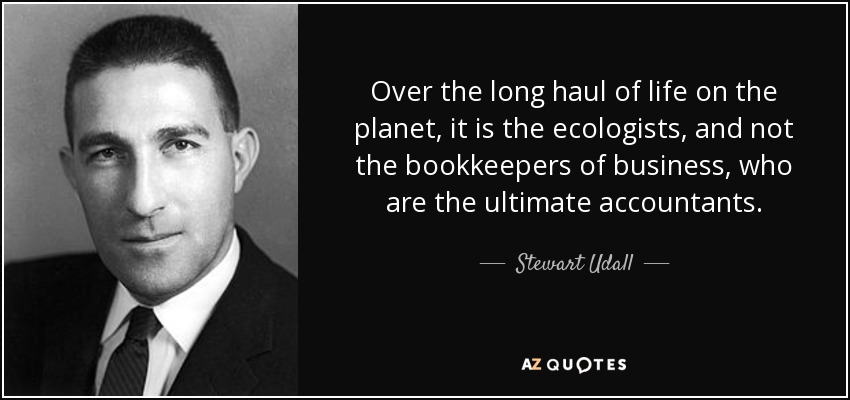
Over the long haul of life on the planet, it is the ecologists, and not the bookkeepers of business, who are the ultimate accountants.
Sometime in the last ten years the best brains of the Occident discovered to their amazement that we live in an Environment. This discovery has been forced on us by the realization that we are approaching the limits of something.
The average American family head will be forced to do twenty years' labor to pay taxes in his or her lifetime.
I feel obliged to withhold my approval of the plan to indulge in benevolent and charitable sentiment through the appropriation of public funds ... I find no warrant for such an appropriation in the Constitution.
It economics is a method rather than a doctrine, an apparatus of the mind, a technique of thinking which helps its possessor to draw correct conclusions.
The discipline of economics has yet to get over its childish passion for mathematics and for purely theoretical and often highly ideological speculation, at the expense of historical research and collaboration with the other social sciences.
I admit that these terms and the diagrams connected with them repel some readers, and fill others with the vain imagination that they have mastered difficult economics problems, when really they have done little more than learn the language in which parts of those problems can be expressed, and the machinery by which they can be handled. When the actual conditions of particular problems have not been studied, such knowledge is little better than a derrick for sinking oil-wells erected where there are no oil-bearing strata.
Political Economy, in truth, has never pretended to give advice to mankind with no lights but its own; though people who knew nothing but political economy (and therefore knew it ill) have taken upon themselves to advise, and could only do so by such lights as they had.
You can always get sympathy by using the word small. With little industries you feel as you do about a little puppy.
Even as a young man, Vito Corleone became known as a "man of reasonableness." He never uttered a threat. He always used logic that proved to be irresistible. He always made certain that the other fellow got his share of profit. Nobody lost. He did this, of course, by obvious means. Like many businessmen of genius he learned that free competition was wasteful, monopoly efficient. And so he simply set about achieving that efficient monopoly.
A colleague saw the same model-calibrating the elasticity of demand facing a Cournot oligopolist as a function of the number of firms in the industry--described at the University of Chicago and at M.I.T. A Chicago economist derived the formula and said, "Look at how few firms you need to get close to infinite elasticities and perfect competition." An M.I.T. economist derived the same formula and said, "Look at how large n has to be before you get anywhere close to an infinite elasticity and perfect competition."
Hume develops his arguments by a series of models. He doesn't call them models in the pretentious way in which we envelope, very often, pure banalities in this jargon
If economists did not concern themselves with economic efficiency, nobody would.
Obviousness is always the enemy of correctness.
Marshall's crime is to pretend to handle imperfect competition with tools only applicable to perfect competition.
I'il n'est pas en notre pouvoir de changer la nature des choses. Il faut les йtudier telles qu'elles sont.
Course titles and even course descriptions often fail to reveal what is actually taught (much less learned).
It is however always important to remember that the ability to see things in their correct perspective may be, and often is, divorced from the ability to reason correctly and vice versa. That is why a man may be a very good theorist and yet talk absolute nonsense.
Besides, do any of us understand what we are doing? If we did, would we ever do it?
There is a history of mathematical models of oligopolistic competition dating from Cournot to the theory of games. There is also a literature generated by institutional economists, lawyers, and administrators interested in formulating and implementing public policy. It has been the tendency of these groups to work almost as though the other did not exist.
The discipline of colleges and universities is in general contrived, not for the benefit of the students, but for the interest, or more properly speaking, for the ease of the masters. Its object is, in all cases, to maintain the authority of the master, and whether he neglects or performs his duty, to oblige the students in all cases to behave toward him as if he performed it with the greatest diligence and ability.
But part of the job of economics is weeding out errors. That is much harder than making them, but also more fun.
Where combination is possible, competition is impossible.
...it is distressing how often one can guess the answer given to an economic question merely by knowing who asks it.
"Law professors were never like economics professors," a Harvard Law professor told me. "If you disagreed with someone, you didn't call him a fool."
Follow AzQuotes on Facebook, Twitter and Google+. Every day we present the best quotes! Improve yourself, find your inspiration, share with friends
or simply: