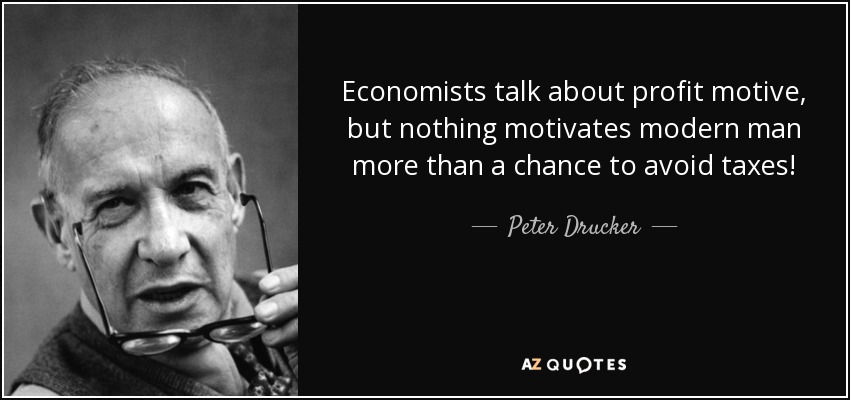
Economists talk about profit motive, but nothing motivates modern man more than a chance to avoid taxes!
Philosophy can add to our happiness in no other manner but by diminishing our misery; it should not pretend to increase our present stock, but make us economists of what we are possessed of. Happy were we all born philosophers; all born with a talent of thus dissipating our own cares by spreading them upon all mankind.
An economist's definition of hatred is the willingness to pay a price to inflict harm on others.
As a preacher, I should be prompted to tell men, not so much how to get their wheat bread cheaper, as of the bread of life compared with which that is bran. Let a man only taste these loaves, and he becomes a skillful economist at once.
They [free market policies] were never based on solid empirical and theoretical foundations, and even as many of these policies were being pushed, academic economists were explaining the limitations of markets for instance, whenever information is imperfect, which is to say always.
most economists, like doctors, are reluctant to make predictions, and those who make them are seldom accurate. The economy, like the human body, is a highly complex system whose workings are not thoroughly understood.
Repeal the entire Banking Act of 1933, and Austrian School economists will cheer, especially if the current system were replaced by a 100%-reserve competitive banking with no central bank. That banking reform would give us a sound money system, meaning no more business cycle, bailouts, or inflation.
There are, of course, a number of epistemological questions, some of which lie more in the province of the philosopher than they do the economist or the social scientist. The one with which I am particularly concerned here is that of the role of knowledge in social systems, both as a product of the past and as a determinant of the future.
There is something, however humble, which can properly be called skill among those who recognise themselves as economists.
[The notion of equilibrium] is a notion which can be employed usefully in varying degrees of looseness. It is an absolutely indispensable part of the toolbag of the economist and one which he can often contribute usefully to other sciences which are occasionally apt to get lost in the trackless exfoliations of purely dynamic systems.
The concept of need is often looked upon rather unfavorably by economists, in contrast with the concept of demand. Both, however, have their own strengths and weaknesses. The need concept is criticized as being too mechanical, as denying the autonomy and individuality of the human person, and as implying that the human being is a machine which "needs" fuel in the shape of food, engine dope in the shape of medicine, and spare parts provided by the surgeon.
It [knowledge] is clearly related to information, which we can now measure; and an economist especially is tempted to regard knowledge as a kind of capital structure, corresponding to information as an income flow. Knowledge, that is to say, is some kind of improbable structure or stock made up essentially of patterns - that is, improbable arrangements, and the more improbable the arrangements, we might suppose, the more knowledge there is.
It is almost as hard to define mathematics as it is to define economics, and one is tempted to fall back on the famous old definition attributed to Jacob Viner, "Economics is what economists do," and say that mathematics is what mathematicians do. A large part of mathematics deals with the formal relations of quantities or numbers.
The ability to work with systems of general equilibrium is perhaps one of the most important skills of the economist - a skill which he shares with many other scientists, but in which he has perhaps a certain comparative advantage.
One of the most important skills of the economist, therefore, is that of simplification of the model. Two important methods of simplification have been developed by economists. One is the method of partial equilibrium analysis (or microeconomics), generally associated with the name of Alfred Marshall and the other is the method of aggregation (or macro-economics), associated with the name of John Maynard Keynes.
Physicists can only talk to other physicists and economists to economists... sociologists often cannot even understand each other.
Colleges don't teach economics properly. Unfortunately we learn little from the experience of the past. An economist must know, besides his subject, ethics, logic, philosophy, the humanities and sociology, in fact everything that is part of how we live and react to one another.
Take care to be an economist in prosperity. There is no fear of your being one in adversity.
Many of us economists who believe in efficiency do so because we view markets as amazingly successful devices for reflecting new information rapidly and, for the most part, accurately.
Financial security is a constant in my life. I allow my income to constantly expand, no matter what the newspapers and economists say. I move beyond my present income, and I go beyond the economic forecasts. I do not listen to people out there telling me how far I can go or what I can do.
I have never considered myself an economist.
The problem is that people really just don't care and they have been "educated" not to care about the monetary system: that it's boring, it's difficult to understand, we need to have high minded people like "Greenscum" and Bernanke to do things like this (and don't forget Volcker, there's the whole cast of them). The thing is that people have been educated or miseducated or brainwashed into believing that this is wayyyy too complicated for regular people to understand and that we need to let PhD economists guide us along in terms of what's right... and that's all bull.
Economists get impatient with philosophy. They are often trained as skilled mathematicians. They don't like going back to ordinary language and first principles.
It gives evolutionary biologists great status if they champion competition and the economists have to consult them. The economists have to consult the evolutionary biologists, because they are the ones who invented the idea of competition. It comes from the field of evolution.
The oil corporations spend a lot of money to get, say, the tar sands pipeline through, but nobody's - you know, there are definitely environmentalists being paid - but a lot of people are acting for something other than financial compensation. So if the tar sands pipeline doesn't get made, it's because a huge amount of people are doing something that doesn't involve remuneration, money, etc., because we're not actually the self-interested financial instruments that economists like to imagine we are.
Follow AzQuotes on Facebook, Twitter and Google+. Every day we present the best quotes! Improve yourself, find your inspiration, share with friends
or simply: