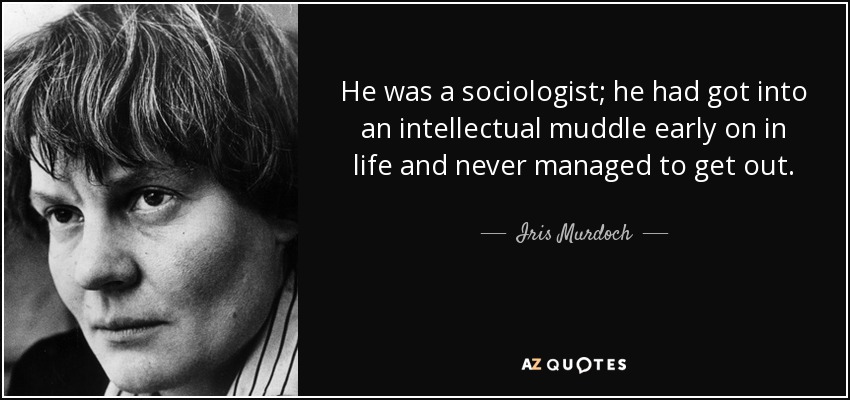
He was a sociologist; he had got into an intellectual muddle early on in life and never managed to get out.
No sociologist should think himself too good, even in his old age, to make tens of thousands of quite trivial computations in his head and perhaps for months at a time.
Whether sociology can ever become a full-fledged "science" (a description of a class of events predictable on the basis of deductions from a constant rationale) depends on whether the terms which sociologists employ to describe events can be analyzed into quantifiable observables.
Mills insisted that a sociologist's proper subject was the intersection of biography and history.
It is those who are successful, in other words, who are most likely to be given the kinds of special opportunities that lead to further success.
Academic sociologists have been trained to conceive of their discipline - sociology - as the scientific study of society, and to remit to the sister discipline of psychology the study of individuals.
Sociologists have a theory of the looking-glass self: You become what the most important person in your life (wife, father, boss, etc.) thinks you are. How would my life change if I truly believed the Bible's astounding words about God's love for me, if I looked in the mirror and saw what God sees?
Max Weber was right in subscribing to the view that one need not be Caesar in order to understand Caesar. But there is a temptation for us theoretical sociologists to act sometimes as though it is not necessary even to study Caesar in order to understand him. Yet we know that the interplay of theory and research makes both for understanding of the specific case and expansion of the general rule.
If the sociologist has a role, it is probably more to furnish weapons than to give lessons.
I think people do look to writers to tell the truth in a way that nobody else quite will, not politicians or ministers or sociologists. A writer's job, is to, by way of fiction, somehow describe the way we live. And to me, this seems an important task, very worth doing, and I think also, to the reading public, it seems, even though they might not articulate it, it seems to them something worth doing also.
As the popular trust in science fades - and many sociologists say that's happening today - people will develop a distrust of purely "scientific" psychology. Researchers in the universities haven't picked up on this; they're more interested in genetics and computer models of thinking than ever. But, in general, there is a huge distrust of the scientific establishment now.
Most people don't put things together. Geologists study the surface of the earth and geological phenomena. Meteorogists study the weather. That isn't science. Science is the study of all things that affect human beings. They have to be together! A meteorologist has difficulty talking with a sociologist, because they don't understand each other. You can't teach sciences in 'bits'; you have to bring it all together. Science is a way of thinking - a way at arriving at conclusions without your own opinion in it.
I think what I and most other sociologists of religion wrote in the 1960s about secularization was a mistake. Our underlying argument was that secularization and modernity go hand in hand. With more modernization comes more secularization
I have friends, political scientists, sociologists, who all share an interest at least in certain kinds of science fiction.
For some reason that only a sociologist might be able to accurately explain, the Brazilian Press was extremely unkind to me, reporting only selective derogatory untruthful rumors (some of which are still around), harsh criticism, and unwarranted sarcasm. I was very hurt by this. It was such great disappointment... When I came back from Brazil at that time, I made a promise to myself that I would never, ever again sing in Brazil. So far [as of 2002], I have kept this promise, having declined each and every invitation or proposals to perform in Brazil. Once was enough!
Indeed, the distribution of wealth is too important an issue to be left to economists, sociologists, historians, and philosophers.
A bigot is simply a sociologist without credentials.
The president is the high priest of what sociologist Robert Bellah calls the 'American civil religion.' The president must invoke the name of God (though not Jesus), glorify America's heroes and history,quote its sacred texts (the Declaration of Independence and the Constitution), and perform the transubstantiation of pluribus unum.
No serious sociologist any longer believes that the voice of the people expresses any divine or specially wise and lofty idea. The voice of the people expresses the mind of the people, and that mind is made up for it by the group leaders in whom it believes and by those persons who understand the manipulation of public opinion. It is composed of inherited prejudices and symbols and clichés and verbal formulas supplied to them by the leaders.
Sociologists are those academic accountants who think that truth can be shaken from an abacus.
One of the peculiarities of economics is that it still rests on a behavioral assumption-rational utility maximization-that has long since been rejected by sociologists and psychologists.
If you are a good economist, a virtuous economist, you are reborn as a physicist. But if you are an evil, wicked economist, you are reborn as a sociologist.
I'd like to know why sociologists can't decide whether movie sex and violence has any effect on children, but there's a universal consensus that even a glimpse of a Camel will force children to become lifelong smokers.
I never think in terms of alienation; it's the others who do. Alienation means one thing to Hegel, another to Marx and yet another to Freud; so it is not possible to give a single definition, one that will exhaust the subject. It is a question bordering on philosophy, and I'm not a philosopher nor a sociologist. My business is to tell stories, to narrate with images - nothing else. If I do make films about alienation - to use that word that is so ambiguous - they are about characters, not about me.
Men live in a community in virtue of the things which they have in common; and communication is the way in which they come to possess things in common. What they must have in common in order to form a community or society are aims, beliefs, aspirations, knowledge - a common understanding - likemindedness as the sociologists say.
Follow AzQuotes on Facebook, Twitter and Google+. Every day we present the best quotes! Improve yourself, find your inspiration, share with friends
or simply: