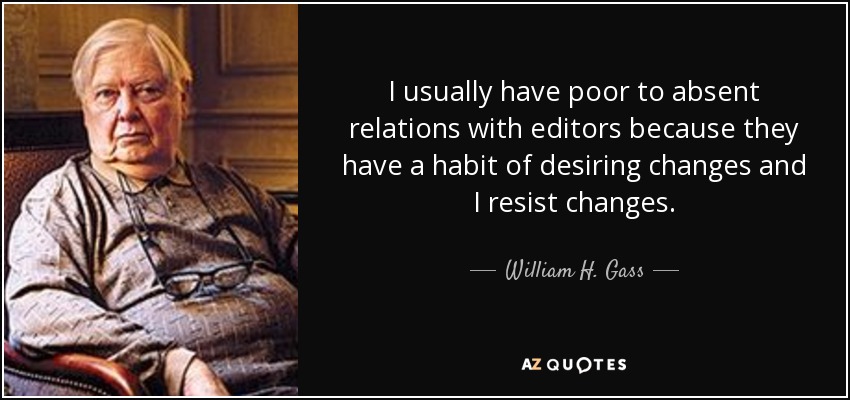
I usually have poor to absent relations with editors because they have a habit of desiring changes and I resist changes.
In a highly competitive newspaper market, every editor needs to appeal to female readers to boost their circulation.
Will you tell me my fault, frankly as to yourself, for I had rather wince, than die. Men do not call the surgeon to commend the bone, but to set it, Sir.
I began using pseudonyms early in my career, when I was being paid a quarter a cent a word for my work, and when I had to write a lot to earn a living. Sometimes I had three or four stories in a single magazine without the editor knowing they were all by me.
A writer is unfair to himself when he is unable to be hard on himself.
Politicians, bureaucrats, editors, new commentators, 'economists' teachers,' and other word artists who denounce private enterprise and praise socialism are their own worst enemies...these attackers are unwittingly destroying the sources of their own livelihood. They kill the geese that lay the golden eggs - and don't know it!
I decided honestly that comic art is an art form in itself. It reflects the life and times more accurately and actually is more artistic than magazine illustration - since it is entirely creative. An illustrator works with camera and models; a comic artist begins with a white sheet of paper and dreams up his own business - he is playwright, director, editor and artist at once.
The pressure for conformity is enormous. I have experienced it in editors’ rejection of submitted papers, based on venomous criticism of anonymous referees. The replacement of impartial reviewing by censorship will be the death of science.
There hadn't been one done since the late 70s. I was living in Brooklyn, had no connection to Roger Corman, to no one in this movie. I didn't go to film school. I'm like the person who should have never made this film. But I just decided to put one foot in front of the other. I was writing film articles for magazines at the time. I convinced an editor from one of the magazines that I was working for to give me a shot to do a piece on Roger. This was an excuse to go meet him.
The best advice on writing was given to me by my first editor, Michael Korda, of Simon and Schuster, while writing my first book. 'Finish your first draft and then we'll talk,' he said. It took me a long time to realize how good the advice was. Even if you write it wrong, write and finish your first draft. Only then, when you have a flawed whole, do you know what you have to fix.
Reporters have a different point of view and a different job. Consequently, to the extent that you can help them turn in an interesting story that their editor is going to like and that's going to further their careers, they're going to give you more ink and cover you.
I have students that I tell, "If your book doesn't sell or you can't publish it, write another book. Quit sitting around." The publishing world is a business, but it's not any big deal. An editor is not your guru. Your agent is not your guru.
Try pitching a story of happiness to your editors and their toes are going to curl up.
Never use the word, 'very.' It is the weakest word in the English language; doesn't mean anything. If you feel the urge of 'very' coming on, just write the word, 'damn,' in the place of 'very.' The editor will strike out the word, 'damn,' and you will have a good sentence.
I was the first records editor at Rolling Stone, and there were no rules. There was nothing to fall back on as to how do you write about this kind of music, so people were trying absolutely everything with a great sense of freedom and experimentation and success and failure, and a feeling of, “My God, people are actually paying attention to this. Let’s pretend they aren’t because we don’t want to be intimidated by what somebody might think of what we’re saying.
Without the book business it would be difficult or impossible for true books to find their true readers and without that solitary (and potentially subversive) alone with a book the whole razzmatazz of prizes, banquets, television spectaculars, bestseller lists, even literature courses, editors and authors, are all worthless. Unless a book finds lovers among those solitary readers, it will not live . . . or live for long.
Embarrassed journalists ask me embarrassing questions, and they get embarrassing answers, and then hand out embarrassing stories to the embarrassing editors, who put them to the front pages of newspapers. When is this going to end?
To entrust to an editor a story over which you have labored and to which your name and reputation are attached can be like sending your daughter off for an evening with Ted Bundy.
First, the three of us holed up in winter in a cabin and took the 500 hours down to twelve hours. Then we found an editor, Lambis Haralambidis. He took that twelve hours and brought it to five. Then we get together and started taking the ax and chopping off different parts of our film.
When I decided to launch my first knitwear line, it was because I saw a void in the basics category. The editors were always looking for cool, fashion-forward tees and sweaters. So that's where I started.
I was interested in creating things that I could be proud of and so, you know, I was interested in being an editor of a magazine, things that I could be proud of, and so, you know, I was interested in being an editor of a magazine, but in order to be an editor of a magazine I had to become a publisher as well. I had to pay the bills. I had to worry about the printing and the paper manufacturing and the distribution of that magazine.
To find something comparable, you have to go back 500 years to the printing press, the birth of mass media – which, incidentally, is what really destroyed the old world of kings and aristocracies. Technology is shifting power away from the editors, the publishers, the establishment, the media elite. Now it’s the people who are taking control.
I don't think fashion week will go back to what it used to be because people are realising that the industry is completely changing. It's not just in Bryant Park any more, people are figuring out who their audience is, where they want to show, they aren't really playing by the rules. It's not so much about these editors, these buyers.
When I went in, my editor said, ‘I hope you don’t think you’re a writer.’ And I said, ‘I hope you don’t think I’m a journalist.’ And, uh, turned out we were both right.
When both my editors say 'This is really bad, you need to change this,' I ignore that at my peril.
Follow AzQuotes on Facebook, Twitter and Google+. Every day we present the best quotes! Improve yourself, find your inspiration, share with friends
or simply: