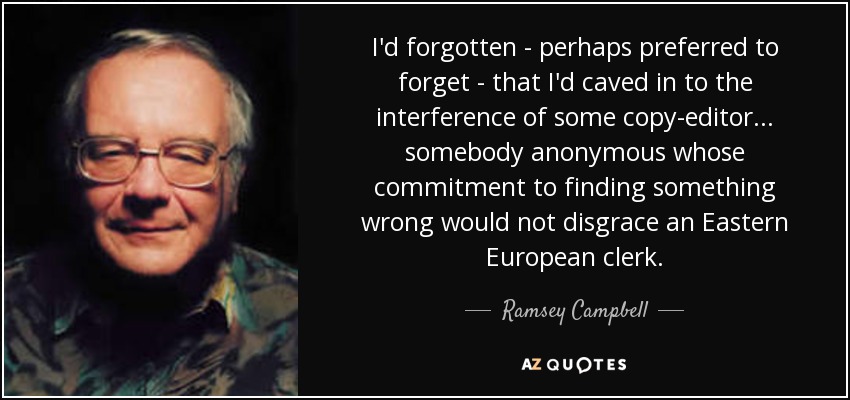
I'd forgotten - perhaps preferred to forget - that I'd caved in to the interference of some copy-editor... somebody anonymous whose commitment to finding something wrong would not disgrace an Eastern European clerk.
My first job out of college was as an editorial assistant in a New York publishing house. Being an editorial assistant is the purgatory would-be editors must endure before they can ascend the ladder and begin acquiring books on their own. I spent a year filing paperwork, writing copy, and typing rejection letters.
It's important to understand it's OK to control the subject. If most editorial stories were photographed just as they are, editors would end up throwing most in the waste basket. You have to work hard at making an editorial picture. You need to re-stage things, rearrange things so that they work for the story, with truth and without lying.
Would you convey my compliments to the purist who reads your proofs and tell him or her that I write in a sort of broken-down patois which is something like the way a Swiss waiter talks, and that when I split an infinitive, God damn it, I split it so it will stay split, and when I interrupt the velvety smoothness of my more or less literate syntax with a few sudden words of bar-room vernacular, that is done with the eyes wide open and the mind relaxed but attentive.
Media reporters have pointed out that the paragraphs in my Time column this week bear close similarities to paragraphs in Jill Lepore's essay in the April 22nd issue of The New Yorker. They are right. I made a terrible mistake. It is a serious lapse and one that is entirely my fault. I apologize unreservedly to her, to my editors at Time, and to my readers.
An editor is someone dedicated to destroying the work of a creator.
There are just two people entitled to refer to themselves as "we"; one is the editor and the other is the fellow with a tapeworm.
[A comic book writers' union] will never happen. Someone will always be willing to write Batman for free. ... You sit at a bar with an editor at a show and you see 19 people come up and pitch ideas at them. If everybody writing the top 20 books all quit and demanded, 'Union now, union forever,' those 19 guys would be getting phone calls. There will never be a union. I think things are getting better - I bet things have never been so good - but there will never be a union.
After university, I got a job sub-editing and for years I was a literary editor.
Your writing is still yours, no matter what the contract or your editor might say. Trust your gut. It knows when you're screwing up. Your brain will lie to you. It loves the paycheck, it loves positive feedback. Your gut is under no obligation to make you feel good.
Every first-rate editor I have ever heard of reads, edits and rewrites every word that goes into his publication.... Good editors are not 'permissive'; they do not let their colleagues do 'their thing'; they make sure that everybody does the 'paper's thing.' A good, let alone a great editor is an obsessive autocrat with a whim of iron, who rewrites and rewrites, cuts and slashes, until every piece is exactly the way he thinks it should have been done.
What editors are obliged to appear to say that
All writers are crazy. So never mind what the editors and your family and your critique group tells you. Submit your manuscripts and keep submitting until you get an offer. Then you can be crazy, with a paycheck.
I've got a folder full of rejection slips that I keep. Know why? Because those same editors are now calling my agent hoping I'll write a book or novella for them. Things change. A rejection slip today might mean a frantic call to your agent in six months.
The dubious privilege of a freelance writer is he’s given the freedom to starve anywhere.
LUMINARY, One who throws light upon a subject; as an editor by not writing about it.
I don't think anyone has ever been in a better place at a better time than I was when I was editor of Vogue. Vogue always did stand for people's lives. I mean, a new dress doesn't get you anywhere; it's the life you're living in the dress, and the sort of life you had lived before, and what you will do in it later. Like all great times, the sixties were about personalities.
June 17, 1972. Nine o'clock Saturday morning. Early for the telephone. Woodward fumbled for the receiver and snapped awake. The city editor of the Washington Post was on the line. Five men had been arrested earlier that morning in a burglary attempt at Democratic headquarters, carrying photographic equipment and electronic gear. Could he come in?
In a broadcast society, there were these gatekeepers, the editors, and they controlled the flows of information. Along came the Internet and it swept them out of the way, and it allowed all of us to connect together, and it was awesome. But that's not actually what's happening right now.
I had always loved to write and my mom was my editor for my school papers.
As CEO, my main job is editor-in-chief.
Leaders are problem solvers by talent and temperament, and by choice. For them, the new information environment-undermining old means of control, opening up old closets of secrecy, reducing the relevance of ownership, early arrival, and location-should seem less a litany of problems than an agenda for action. Reaching for a way to describe the entrepreneurial energy of his fabled editor Harold Ross, James Thurber said" 'He was always leaning forward, pushing something invisible ahead of him.' That's the appropriate posture for a knowledge executive.
The BBC is very much in thrall to all this techno cross-fertilisation, in much the same way that print journalists are now encouraged to blog. To the point where there is an emerging breed of sub-editors who take perfectly well-written and punctuated original copy and rewrite it so that it resembles a text message written by a 14-year-old under the influence of Bacardi Breezers.
Why do Britons keep stabbing each other in August? Why do seaside hotels burn down in August? Why do children disappear in August, examinations get easier and Heathrow become the world's worst airport? The answer lies not in reality but in appearance. News editors abhor a vacuum. Half an hour of airtime and 10 pages of news must be filled each day, whatever the weather.
What makes a good editor is staying the hell out of the way as much as possible. ... If you're a DC or Marvel or Dark Horse or BOOM! editor who's assigning work, then if you did your job properly to begin with, then the people you've hired can be trusted to do what they do without excessive meddling. The ideal situation you're shooting for as an editor is to groom a collaborative creative team to the point where their work sails effortlessly through production and the most you have to do is fix the spelling and the commas.
Follow AzQuotes on Facebook, Twitter and Google+. Every day we present the best quotes! Improve yourself, find your inspiration, share with friends
or simply: