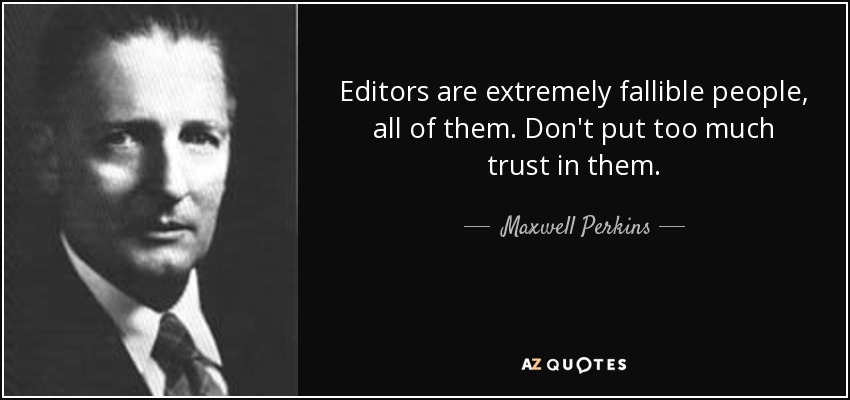
Editors are extremely fallible people, all of them. Don't put too much trust in them.
The reviewer always has hold of the wrong horror.
I am opposed to writing about the private lives of living authors and psychoanalyzing them while they are alive. Criticism is getting all mixed up with a combination of the Junior FBI-men, discards from Freud and Jung and a sort of Columnist peep-hole and missing laundry list school. ... Every young English professor sees gold in them dirty sheets now. Imagine what they can do with the soiled sheets of four legal beds by the same writer and you can see why their tongues are slavering.
No man has an appreciation so various that his judgment is good upon all varieties of literary work.
You need a good editor because every writer thinks he can write a War and Peace, but by the time he gets it on paper, it's not War and Peace anymore; it's comic-book stuff. Your manuscript is both good and original. But the part that is good is not original, and the part that is original is not good.
Fear your admirers! Learn in time to hear, understand, and love the cruel truth about yourselves!
Critics are like brushers of noblemen's clothes.
Book reviewers are little old ladies of both sexes.
The job of the critic is to report to us his moods.
The difference between critics and audiences is that one is a group of humans and one is not.
I've been reading reviews of my stories for twenty-five years, and can't remember a single useful point in any of them, or the slightest good advice. The only reviewer who ever made an impression on me was Skabichevsky, who prophesied that I would die drunk in the bottom of a ditch.
Critics sometimes appear to be addressing themselves to works other than those I remember writing.
In a highly competitive newspaper market, every editor needs to appeal to female readers to boost their circulation.
I began using pseudonyms early in my career, when I was being paid a quarter a cent a word for my work, and when I had to write a lot to earn a living. Sometimes I had three or four stories in a single magazine without the editor knowing they were all by me.
When you send off a short story, it sits on the editor's desk in the same pile with stories by the most famous and honored names in present-day writing-and it's not going to be accepted unless it's as good as theirs. (And it'll probably have to be better.)
The best advice on writing was given to me by my first editor, Michael Korda, of Simon and Schuster, while writing my first book. 'Finish your first draft and then we'll talk,' he said. It took me a long time to realize how good the advice was. Even if you write it wrong, write and finish your first draft. Only then, when you have a flawed whole, do you know what you have to fix.
The job of an editor in a publishing house is the dullest, hardest, most exciting, exasperating and rewarding of perhaps any job in the world.
I usually have poor to absent relations with editors because they have a habit of desiring changes and I resist changes.
Embarrassed journalists ask me embarrassing questions, and they get embarrassing answers, and then hand out embarrassing stories to the embarrassing editors, who put them to the front pages of newspapers. When is this going to end?
I'd like to drill in a little more detail into one aspect of cutting which is particularly close to me and that's dialogue editing. It is a vital part of editing especially in animated film, but in the end it is usually completely transparent to the audience. The vocal performances are reported for over several years and the actors are very rarely in recording studios together. That's why the editor has got to all these different performances and edit them together to create the illusion of spontaneity and real action.
A writer is unfair to himself when he is unable to be hard on himself.
Try pitching a story of happiness to your editors and their toes are going to curl up.
Never use the word, 'very.' It is the weakest word in the English language; doesn't mean anything. If you feel the urge of 'very' coming on, just write the word, 'damn,' in the place of 'very.' The editor will strike out the word, 'damn,' and you will have a good sentence.
I was the first records editor at Rolling Stone, and there were no rules. There was nothing to fall back on as to how do you write about this kind of music, so people were trying absolutely everything with a great sense of freedom and experimentation and success and failure, and a feeling of, “My God, people are actually paying attention to this. Let’s pretend they aren’t because we don’t want to be intimidated by what somebody might think of what we’re saying.
Without the book business it would be difficult or impossible for true books to find their true readers and without that solitary (and potentially subversive) alone with a book the whole razzmatazz of prizes, banquets, television spectaculars, bestseller lists, even literature courses, editors and authors, are all worthless. Unless a book finds lovers among those solitary readers, it will not live . . . or live for long.
Follow AzQuotes on Facebook, Twitter and Google+. Every day we present the best quotes! Improve yourself, find your inspiration, share with friends
or simply: