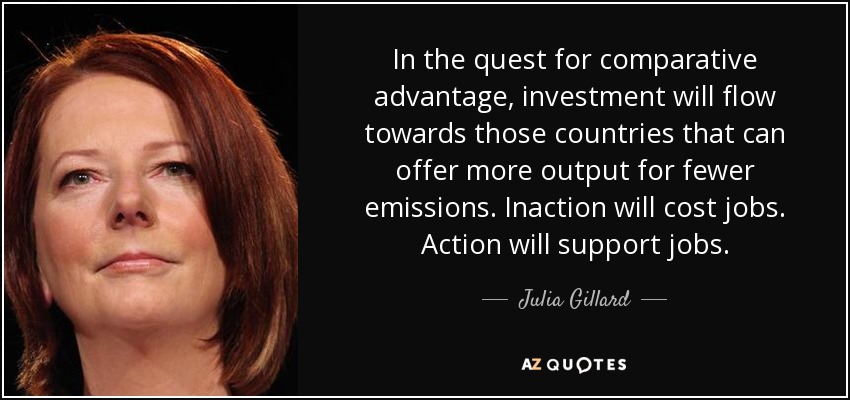
In the quest for comparative advantage, investment will flow towards those countries that can offer more output for fewer emissions. Inaction will cost jobs. Action will support jobs.
Global warmers predict that global warming is coming, and our emissions are to blame. They do that to keep us worried about our role in the whole thing. If we aren't worried and guilty, we might not pay their salaries. It's that simple.
I am troubled by the lack of common sense regarding carbon dioxide emissions. Our greatest greenhouse gas is water. Atmospheric spectroscopy reveals why water has a 95 percent and CO2 a 3.6 percent contribution to the 'greenhouse effect.' Carbon dioxide emissions worldwide each year total 3.2 billion tons. That equals about 0.0168 percent of the atmosphere's CO2 concentration of about 19 trillion tons. This results in a 0.00064 percent increase in the absorption of the sun's radiation. This is an insignificantly small number.
When a woman is making love with a man, a sense of heat in her brain, which brings forth with it sensual delight, communicates the taste of that delight during the act and summons forth the emission of the man's seed. And when the seed has fallen into its place, that vehement heat descending from her brain draws the seed to itself and holds it, and soon the woman's sexual organs contract and all parts that are ready to open up during the time of menstruation now close, in the same way as a strong man can hold something enclosed in his fist.
Look, very clearly there are things that need to be done urgently in relation to climate change, and of those the most obvious is to have an enforceable and equitable arrangement delivering deep cuts in emissions into the middle of the century.
I am sympathetic to developing countries’ concerns: because of our emissions it’s their crops that will disappear; because of our inaction, it’s their fields that turn to desert...
Many governments are giving subsidies to fossil fuel production and consumption that encourage greenhouse gas emissions, at the same time as they are spending on projects to promote clean energy. This is a wasteful use of scarce budget resources.
I did a lot of work on energy efficiency at the White House. By the time I left we had taken the equivalent of six hundred cars a year off the road in reduced greenhouse gas emissions just in the White House complex.
We run enormous risks and we know what kind of reductions of greenhouse gases are necessary to drastically reduce risks. Reducing emissions by half by 2050 is roughly in the right ballpark. It would bring us below 550 ppm.
If the EPA continues unabated, jobs will be shipped to China and India as energy costs skyrocket. Most of the media attention has focused on the EPA's efforts to regulate climate-change emissions, but that is just the beginning.
Nuclear is not only emissions-free, but renewing our commitment to nuclear power will create countless jobs at a time when our nation endures nearly double-digit unemployment.
Proponents of efficiency standards argue that they save consumers and businesses money, reduce energy use, and reduce emissions. But families and businesses already understand how energy costs impact their lives and make decisions accordingly.
Indeed the three policy pillars of the neoliberal age-privatization of the public sphere, deregulation of the corporate sector, and the lowering of income and corporate taxes, paid for with cuts to public spending-are each incompatible with many of the actions we must take to bring our emissions to safe levels.
We have at most ten years—not ten years to decide upon action, but ten years to alter fundamentally the trajectory of global greenhouse emissions.
The money economy thus leaves a large ecological footprint, defined as the amount of land and resources required to meet a typical consumer's needs. For example, with only about 4% of the world's population, the United States, the largest money economy, consumes in excess of one-quarter of the world's energy and materials and generates in excess of 25 percent of the world's greenhouse gas emissions.
Both rich and poor nations have a common stake in policies that put the globe on a sustainable development path. The conflict is less between poor and rich countries than between the broad interests of people and the narrow interests of extractive industries. We need to find our way towards some kind of global regime that reduces emissions of the greenhouse gases, but well-off nations need to transfer the technology to make this possible, rather than viewing this shift as one more opportunity for private industry to profit.
In developing countries the situation could be even worse because developing countries do not have to count their emissions under the Kyoto Protocol. Private companies from industrialized nations will seek cheap carbon credits for their country in the developing world.
With regard to Banks, they have taken too deep and too wide a root in social transactions, to be got rid of altogether, if that were desirable. They have a hold on public opinion, which alone would make it expedient to aim rather at the improvement, than the suppression of them. As now generally constituted, their advantages whatever they be, are outweighed by the excesses of their paper emissions, and the partialities and corruption with which they are administered.
When it comes to the environment and global warming from emissions, it has to be dealt with in one of two ways - preemptive regulations, which I don't agree with, or with private property principles. Nobody has the right to pollute their neighbors' air or water or land.
It seems that, notwithstanding the dramatic increases in manmade CO2 emissions over the last decade, the world's warming has stopped.
The horn of dilemma of energy politics is what really drives concern about this energy in this country, at the gut level for most people, is high gas prices. And if you really want to fight global warming and try to reduce our carbon emissions, the cleanest, easiest, most rational way to do it would to make the price of gas even higher through very stiff gas prices.
The transition from coal, oil, and gas to wind, solar, and geothermal energy is well under way. In the old economy, energy was produced by burning something - oil, coal, or natural gas - leading to the carbon emissions that have come to define our economy. The new energy economy harnesses the energy in wind, the energy coming from the sun, and heat from within the earth itself.
Three scenarios for post-Kyoto emissions reductions indicate that ... the long-term consequences are small... The influence of the Protocol would, furthermore, be undetectable for many decades.
Sensible policies on global warming should weight the costs of slowing climate change against the benefits of slower climate change. Ironically, recent policy initiatives, such as the Kyoto Protocol of 1997, have been introduced without any attempt to link the emissions controls with the benefits of the lower emissions.
The total efforts of the last 20 years of climate policy has likely reduced global emissions by less than 1 percent, or about 250 million metric tons of carbon dioxide per year.
Follow AzQuotes on Facebook, Twitter and Google+. Every day we present the best quotes! Improve yourself, find your inspiration, share with friends
or simply: