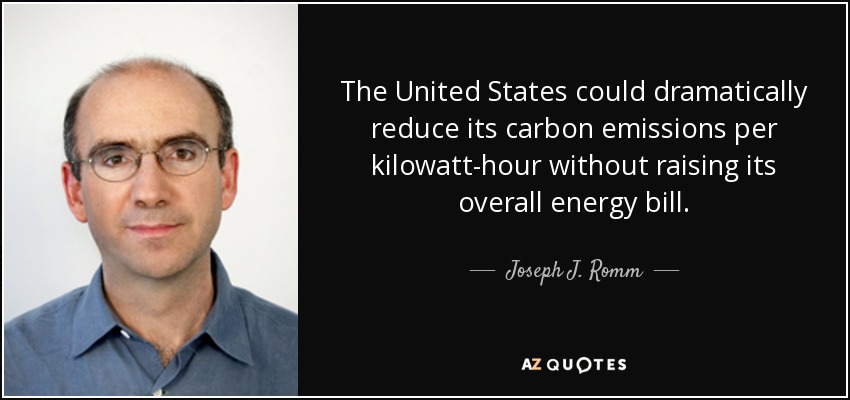
The United States could dramatically reduce its carbon emissions per kilowatt-hour without raising its overall energy bill.
Unless we decide to reduce greenhouse gas emissions within just a few years from now, our destinies will already be chosen and our path towards hell unalterable as the carbon cycle feedbacks... kick in one after another.
We have at most ten years - not ten years to decide upon action, but ten years to alter fundamentally the trajectory of global greenhouse emissions... We are near a tipping point, a point of no return, beyond which the built in momentum and feedbacks will carry us to levels of climate change with staggering consequences for humanity and all of the residents of this planet.
But reducing harmful emissions, abating our dependence on foreign oil and developing alternative renewable energy sources have benefits that go beyond environmental health, they improve personal health, enhance national security and encourage our nations economic viability.
Society's emissions of carbon dioxide may or may not turn out to have something significant to do with global warming-the jury is still out.
Nuclear power will help provide the electricity that our growing economy needs without increasing emissions. This is truly an environmentally responsible source of energy.
Another big problem with any Australian emissions reduction scheme is that it would not make a material difference to atmospheric carbon concentrations unless the big international polluters had similar schemes.
We can't conclusively say whether man-made carbon dioxide emissions are contributing to climate change.
There is much to be said for an emissions trading scheme. It was, after all, the mechanism for emission reduction ultimately chosen by the Howard government.
There was almost a universal acceptance of unhealthy conditions. Sulfur dioxide in smokestack emissions were the price, or smell, of prosperity.
Recent warming coincides with rapid growth of human-made greenhouse gases. The observed rapid warming gives urgency to discussions about how to slow greenhouse gas emissions.
The urgency for reducing climate emissions is too great. We must take our collective experience and use it toward making green design a part of all design.
The best way to reduce emissions and pollution is not through partisan political theater but through developing consensus on areas that will bring about effectual change.
It is critical that the world captures every last bit of energy efficiency, if we are to reduce greenhouse gas emissions enough to keep below dangerous rises in temperature. I am pleased that this important new study shows how information and communication technology can play an essential role in saving energy. Now we need more and effective government policies that reward such action and penalize delayed responses.
At the moment, every country arrives at climate negotiations seeking to keep their own emissions as high as possible. This is the logic of the madhouse, a recipe for collective suicide. We dont want a global suicide pact. We want a global survival pact
Looking back, I underestimated the risks. The planet and the atmosphere seem to be absorbing less carbon than we expected, and emissions are rising pretty strongly. Some of the effects are coming through more quickly than we thought then.
Mercury emissions will continue to harm the environment and to endanger the health of children and pregnant women, until this Administration puts public health before politics.
If food was no longer obliged to make intercontinental journeys, but stayed part of a system in which it can be consumed over short distances, we would save a lot of energy and carbon dioxide emissions. And just think of what we would save in ecological terms without long-distance transportation, refrigeration, and packaging--which ends up on the garbage dump anyway--and storage, which steals time, space, and vast portions of nature and beauty.
Binding emissions targets for the developing nations are out of the question.
President Obama flew to China a few days ago and announced a joint environmental pact with the communist regime. The United States will reduce its carbon emissions substantially over the next 11 years. China will do absolutely nothing but hope that its emissions decline after 2030.
The press heralded this as a major accomplishment. The rush from the press as soon as it was announced suggested a high level of coordination. Like lemmings in a staged dive off a cliff, 'historic' became the media's rallying cry. There is nothing historic about the deal. In fact, news reports from November 2012 noted that China expected, in 2012, that its carbon emissions would begin to decline after 2030 because of factory upgrades, efficiencies, etc.
With a decrease in the number of pirates, there has been an increase in global warming over the same period. Therefore, global warming is caused by a lack of pirates. Even more compelling: Somalia has the highest number of Pirates AND the lowest Carbon emissions of any country. Coincidence?
Although they [light and medium trucks] have only 5% of the transportation market..., they account for fully 35% of greenhouse gas emissions from freight transportation.
Shipping by sea produces 1/60 the emissions of shipping by air and about 1/5 that of trucking.
We have 20 years [until 2026] to reduce carbon emissions or climate change will become irreversible.
Follow AzQuotes on Facebook, Twitter and Google+. Every day we present the best quotes! Improve yourself, find your inspiration, share with friends
or simply: